
Condition guide · Neurological
Multiple Sclerosis
For decades people with multiple sclerosis were advised to avoid exertion. That advice has been overturned: exercise is safe, and it is one of the few things that reliably reduces the symptom people rank as most disabling — fatigue.
In plain words. Multiple sclerosis is a disease in which the immune system damages the insulating sheath around nerve fibres in the brain and spinal cord. Messages between brain and body then travel slowly, unreliably, or not at all, which is why the symptoms are so varied: weakness, imbalance, numbness, visual disturbance, bladder problems and, most commonly of all, fatigue.
Physiotherapy does not alter the disease. Drug treatment does that. What rehabilitation changes is what you can do — balance, walking, strength, and how much the fatigue interferes with daily life. On those outcomes the evidence is genuinely good.
The safety question, answered first. Many people are still told, or assume, that exercise might trigger a relapse. An updated meta-analysis of 46 interventions from 40 randomised trials, covering 1,780 people, found no higher risk of relapse with exercise training than with the comparison (relative risk 0.95, 95% CI 0.61 to 1.48), and no higher risk of adverse events (1.40, 0.90 to 2.19) or serious adverse events (1.05, 0.62 to 1.80). The authors conclude that exercise training may be promoted as safe and beneficial. [1]
Key points
- Exercise is safe. No increased relapse risk across 40 randomised trials and 1,780 participants. [1]
- Meeting physical activity guidelines reduces fatigue by a clinically meaningful amount. Across 22 trials and 920 participants, fatigue severity fell with a standardised mean difference of -1.46 (95% CI -2.11 to -0.81), an effect exceeding the minimal clinically important difference. [2]
- Combined exercise is the best-ranked modality for fatigue in a network meta-analysis of 58 studies; resistance training ranked highest for total fatigue. [3]
- Balance and mobility rehabilitation works, and dose matters. A dose-response meta-analysis of 71 studies found longer sessions and task-oriented training associated with better outcomes. [4]
- Balance training improves balance, not gait speed. That distinction is real and is worth knowing before you start. [5]
- Virtual reality is not magic. It probably beats conventional therapy for balance, and probably does not differ for walking. [6]
- Exercise improves participation — engagement in everyday life, not just test scores. [7]
What is actually happening
Nerve fibres in the central nervous system are wrapped in myelin, which lets electrical signals travel quickly and cleanly. In multiple sclerosis the immune system attacks that sheath, and later the fibre itself. Where a patch of damage sits determines the symptom: in the optic nerve it affects vision, in the spinal cord it affects strength, sensation and bladder control, in the cerebellum it affects coordination and balance.
Most people begin with a relapsing course, in which symptoms appear over days, then partly or fully recover. Some later move to a progressive course, in which disability accumulates without distinct relapses. Disease-modifying drug treatment is aimed at the relapses and the underlying immune process, and is a matter for the neurologist.
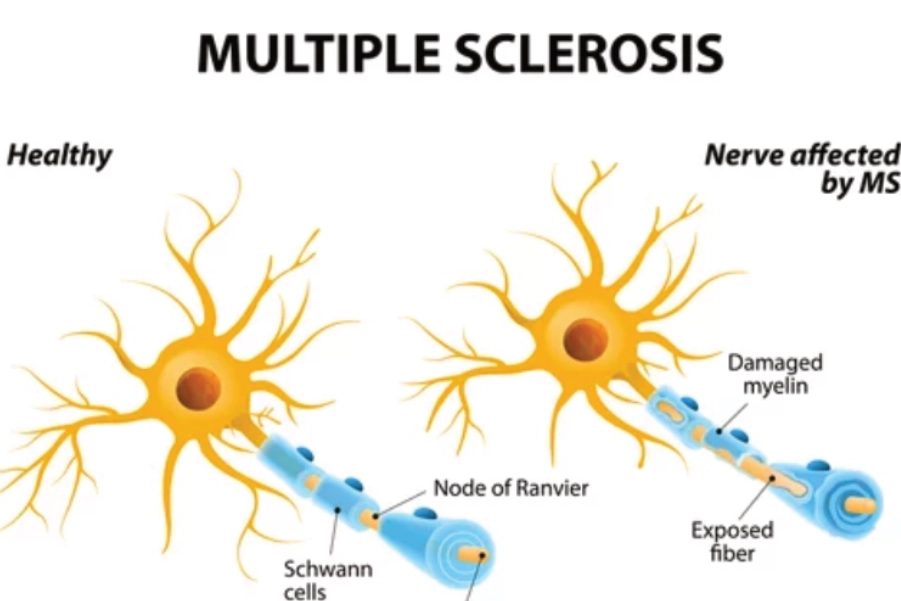
Myelin insulates the nerve fibre so signals travel quickly and cleanly. Where it is damaged, the fibre is exposed and conduction slows or fails — which is why symptoms depend on where the damage sits rather than following one pattern.
Rehabilitation works on a different problem. When a signal arrives late or weakly, the body compensates — and the compensations themselves cost effort, reduce efficiency, and become part of the disability. Strength, balance control and cardiorespiratory fitness are all trainable, and all of them are affected by disuse as well as by disease.
What it feels like
- Fatigue that is out of proportion to activity and is not fixed by sleep — the symptom most people rank as the hardest to live with.
- Weakness or heaviness, often worse in one leg.
- Unsteadiness, especially in the dark or on uneven ground.
- Numbness, tingling or a band-like tightness.
- Blurred or double vision, sometimes with pain on moving the eye.
- Bladder urgency and frequency.
- Symptoms that worsen temporarily in heat — a hot day, a hot bath, a fever.
That last point matters for exercise. Heat-related worsening is temporary and reverses on cooling; it is not a relapse and it is not damage.
How it is diagnosed
By a neurologist, from the clinical history and examination, supported by MRI of the brain and spinal cord and often by examination of the cerebrospinal fluid. The diagnosis requires evidence of damage in more than one place and at more than one time. A physiotherapist does not make this diagnosis.
What a physiotherapy assessment establishes is different and complementary: what you can currently do, what limits it, and what is trainable. The Expanded Disability Status Scale, which appears throughout the research on this page, is the standard measure of overall disability — the balance training review, for instance, included people across the full range from 0 to 7.5. [5]
How physiotherapy and rehabilitation help
Three things are being targeted: fatigue, balance and mobility, and participation in ordinary life. Each has its own evidence, and they are not equally strong.
Fatigue — the strongest and most surprising finding
Fatigue in multiple sclerosis is not ordinary tiredness, and for a long time it was assumed that exercise would make it worse. The opposite is the case.
A 2025 systematic review and meta-analysis looked specifically at trials in which the intervention actually met the physical activity guidelines written for people with multiple sclerosis. Twenty-two randomised trials with 920 participants were reviewed and 17 pooled. Interventions meeting the guidelines for at least four weeks significantly reduced fatigue severity (standardised mean difference -1.46, 95% CI -2.11 to -0.81) and fatigue impact, on both the modified Fatigue Impact Scale (mean difference -11.88, 95% CI -20.57 to -3.19) and the Fatigue Impact Scale (-21.08, -31.01 to -11.15). Every one of those effects exceeded the established minimal clinically important difference for the measure. [2]
The dose those trials met is specific and achievable: at least 150 minutes of physical activity per week, or two sessions of 10 to 30 minutes of moderate-intensity aerobic training plus two sessions of resistance training per week. [2]
Which type of exercise? A network meta-analysis of 58 studies ranked them. Combined exercise produced the largest effect on physical fatigue (-1.51, 95% CI -2.01 to -1.01), and resistance training the largest on total fatigue (-1.15, -1.81 to -0.49), both compared with control. [3] The practical reading is that a programme mixing aerobic and resistance work is the reasonable default, and that resistance training is not the optional extra it is often treated as.
Balance and mobility
A dose-response meta-analysis screened 5,020 records, took 196 to full text and included 71 studies covering 3,306 people. Individual-level data from 20 studies (1,016 people) gave a medium pooled effect for balance interventions (standardised mean difference 0.41, 95% CI 0.22 to 0.59). Fourteen studies with the Berg Balance Scale as the primary endpoint gave a mean difference of 3.58 points (95% CI 1.79 to 5.38). The authors describe this as level 1 evidence that balance intervention improves mobility. [4]
The dose-response part is the useful bit. Meta-regression across those 20 studies found better outcomes associated with longer sessions and with task-oriented intervention. [4] In plain terms: practise the thing you want to be able to do, and do enough of it.
A second review is more sobering about what balance training actually changes. Across 18 studies and 902 people, interventions improved balance when measured with a balance composite score (effect size 0.46, 95% CI 0.18 to 0.74) and, more weakly, with a mobility test (0.19, 0.01 to 0.36) — but showed no effect on stepping or gait speed outcomes. [5] Balance training improves balance. It does not automatically make you walk faster, and a programme aimed at walking speed has to be aimed at walking speed.
One subgroup stood out: cognitive dual-task training had a significant effect when measured with a mobility outcome (0.81, 95% CI 0.24 to 1.37). [5] That is training balance while doing something mentally demanding at the same time — which is what real walking, in a real street, actually is.
Participation
Test scores are not the point. A systematic review examined how participation — engagement in everyday life — has been measured in exercise trials, then pooled 23 randomised trials and found a moderate positive effect of exercise training on it (0.60, 95% CI 0.36 to 0.84). [7] This is the outcome that most closely matches what people actually want from rehabilitation, and it is the one least often reported.
What a programme involves
| Component | What it is for | Evidence |
|---|---|---|
| Combined aerobic and resistance training meeting the published activity guidelines |
Reducing fatigue severity and its impact on daily life; maintaining cardiorespiratory fitness and strength. | Supported Fatigue severity SMD -1.46 (-2.11 to -0.81), exceeding the MCID, across 22 trials [2]; combined exercise ranked highest for physical fatigue in a 58-study network meta-analysis [3] |
| Task-oriented balance training enough volume, and enough minutes per session |
Improving balance and mobility, and reducing the risk of falls that follows from them. | Supported Pooled SMD 0.41 (0.22 to 0.59); Berg Balance Scale mean difference 3.58 points (1.79 to 5.38); intensity and task-oriented content associated with better outcomes [4] |
| Dual-task training balance and walking while doing something cognitively demanding |
Bridging the gap between balance in a clinic and walking in the world. | Supported, subgroup only Significant subgroup effect 0.81 (0.24 to 1.37) on a mobility outcome, within a review whose overall gait-speed finding was null [5] |
| Virtual reality training | An engaging way to deliver balance practice, not a separate treatment. | Better than conventional therapy for balance only Berg Balance Scale mean difference 2.39 points (1.22 to 3.57) versus conventional therapy, moderate certainty, almost reaching the clinically important 3 points; no clear difference for walking [6] |
| Rest and activity avoidance the historical advice |
Was intended to protect against relapse and worsening fatigue. | Not supported No increased risk of relapse, adverse events or serious adverse events with exercise across 40 randomised trials [1]; exercise reduces fatigue rather than increasing it [2][3] |
| Electrotherapy for fatigue or weakness ultrasound, TENS, laser |
Sometimes offered alongside rehabilitation. | Not tested here Not evaluated in the sources cited on this page, so this page makes no claim either way — see electrotherapy and passive modalities |
An amber badge is a statement about the evidence cited on this page, not a verdict on the treatment.
What a course of treatment looks like
Assessment first, and it is longer than for a musculoskeletal problem: walking, balance, strength, fatigue, and what a typical day actually contains. The Expanded Disability Status Scale gives a common reference point, and the goals are set from what you want to be able to do rather than from the score.
Then a programme built around the dose that has been shown to work. In practice that means two or more aerobic sessions and two resistance sessions a week, with balance work woven through, progressed over time. [2] Most of this is done independently between appointments; the appointments exist to set it up, progress it, and correct it.
Heat is planned for, not avoided. Exercising in a cooler part of the day, using cooling before and after, and knowing that heat-related worsening reverses are all part of making the programme sustainable. Fatigue is managed by pacing and by scheduling, not by doing less overall.
Expect the programme to change as the condition does. Multiple sclerosis is variable over months and years, and the rehabilitation plan should be reviewed rather than renewed unchanged.
Where balance and dizziness are the dominant problem and the cause is in the inner ear rather than the central nervous system, see vestibular neuritis and BPPV. Where bladder urgency is the main difficulty, pelvic floor rehabilitation is relevant — though the evidence there comes from different populations. Falls risk is covered in more detail under falls prevention.
What the evidence supports — and what it does not
Supported
- Exercise as safe. No increased relapse or adverse event risk across 40 randomised trials and 1,780 people. [1]
- Meeting the activity guidelines to reduce fatigue — effects exceeding the minimal clinically important difference on three separate fatigue measures. [2]
- Combined aerobic and resistance training as the best-ranked approach for fatigue. [3]
- Task-oriented balance training at adequate dose. [4]
- Exercise improving participation in everyday life, not only laboratory measures. [7]
Not supported
- Advising rest to avoid relapse. [1]
- Expecting balance training to improve gait speed. No effect on stepping or gait speed outcomes. [5]
- Virtual reality as better than conventional therapy for walking. Probably no difference. [6]
- Any claim that exercise slows the disease itself. These trials measured function, fatigue and participation — not disease progression. [1][2][3]
How certain is this?
Evidence grade: Moderate.
The safety conclusion is the most secure thing on this page: 40 randomised trials, no significant heterogeneity for any outcome, and confidence intervals that comfortably include no effect in the direction of harm. [1] It is also the finding most likely to change what someone actually does.
The fatigue evidence is strong in effect size and honest about its limits. The review authors note methodological concerns and rate the evidence from very low to moderate, so the direction of the finding is more secure than the exact magnitude. [2] The network meta-analysis that ranks exercise types is an indirect comparison across 58 studies, which is the right method for the question but is weaker than head-to-head trials. [3]
The balance evidence is the clearest example of why reading past the headline matters. One review reports level 1 evidence for balance intervention improving mobility, [4] while another finds effects on balance composite scores but none on stepping or gait speed. [5] Both are correct; they measured different things. The second review also reports a median study-quality score of 11 out of a maximum 15, which is respectable rather than excellent.
The Cochrane review of virtual reality judged most included studies at overall high risk of bias, across 33 trials and 1,294 participants, and its certainty ratings run from very low to moderate. [6] That is why this page treats virtual reality as a way of delivering therapy rather than as a therapy.
What none of this establishes is any effect on the disease itself. Nothing on this page should be read as a reason to change or delay disease-modifying treatment.
What to expect
Fatigue is usually the first thing to change, and the trials that produced clinically meaningful reductions ran for at least four weeks. [2] That is a reasonable window in which to judge whether a programme is doing anything.
Balance and strength change more slowly and need to be maintained. The dose-response finding cuts both ways: if longer sessions and greater volume are associated with better outcomes, [4] then stopping is likely to give the gains back.
Expect variability. Symptoms fluctuate with heat, infection, sleep and stress independently of anything the programme is doing, and a bad fortnight is not evidence that rehabilitation has failed.
Expect the target to be participation. The outcome worth tracking is not the balance score but whether the week contains more of what you want it to contain — which is the outcome exercise training has been shown to move. [7]
Common questions
Will exercise trigger a relapse?
The evidence says no. Pooling 46 interventions from 40 randomised trials with 1,780 participants, the relative risk of relapse with exercise training was 0.95 (95% CI 0.61 to 1.48) — no different from the comparison group. Adverse events and serious adverse events showed the same pattern. [1] This is one of the clearest reversals of old advice in neurological rehabilitation.
I already have no energy. How can exercise help fatigue?
It seems contradictory, and it is one of the best-supported findings here. Interventions meeting the physical activity guidelines for at least four weeks reduced fatigue severity with a standardised mean difference of -1.46 and reduced fatigue impact by amounts exceeding the minimal clinically important difference on two separate scales. [2] The programme has to be paced and progressed properly — which is what the supervision is for — but the direction of effect is not in doubt.
How much, and what kind?
The dose in the trials that worked was at least 150 minutes per week, or two sessions of 10 to 30 minutes of moderate-intensity aerobic training plus two resistance sessions per week. [2] On type, a network meta-analysis of 58 studies ranked combined exercise highest for physical fatigue and resistance training highest for total fatigue. [3] A mixed programme is the sensible default.
Everything gets worse when it is hot. Should I stop?
No — plan around it. Heat-related worsening in multiple sclerosis is temporary and reverses on cooling. Exercising in a cooler part of the day, cooling before and after, and swimming in a cool pool are all standard adaptations. The safety data cited above came from trials in which people exercised, not from trials in which they were protected from exertion. [1]
Will balance training help me walk faster?
Probably not on its own. A review of 18 studies and 902 people found improvements in balance composite scores and mobility tests, but no effect on stepping or gait speed outcomes. [5] If walking speed is your goal, the programme needs to include walking practice at speed, not only balance work. Dual-task training — balance and walking combined with a cognitive task — showed a significant subgroup effect on a mobility measure. [5]
Are the virtual reality and gaming systems worth it?
They are a reasonable way to deliver practice, not a separate treatment. Against conventional therapy, virtual reality probably improves balance (Berg Balance Scale mean difference 2.39 points, 95% CI 1.22 to 3.57, moderate certainty) — almost reaching the 3-point clinically important difference — and probably makes no difference to walking. [6] If it keeps you doing the practice, that is a real advantage; the equipment is not doing anything the practice could not.
Does any of this slow the disease down?
No, and nothing on this page claims it does. The trials here measured fatigue, balance, mobility and participation. Disease-modifying treatment is a matter for your neurologist, and rehabilitation is not a substitute for it.
References
- Learmonth YC, P Herring M, Russell DI, et al. Safety of exercise training in multiple sclerosis: An updated systematic review and meta-analysis. Multiple Sclerosis Journal. 2023 Nov;29(13):1604–1631. doi:10.1177/13524585231204459 PMID 37880997 Systematic review and meta-analysis
- Abou L, Murphy T, Truong E, et al. Meeting Physical Activity Guidelines for Persons With Multiple Sclerosis Reduces Fatigue Severity and Impact: A Systematic Review and Meta-Analysis of Randomized Clinical Trials. Physical Therapy. 2025 Jun 2;105(6):. doi:10.1093/ptj/pzaf046 PMID 40167216 Systematic review and meta-analysis
- Torres-Costoso A, Martínez-Vizcaíno V, Reina-Gutiérrez S, et al. Effect of Exercise on Fatigue in Multiple Sclerosis: A Network Meta-analysis Comparing Different Types of Exercise. Archives of Physical Medicine and Rehabilitation. 2022 May;103(5):970–987.e18. doi:10.1016/j.apmr.2021.08.008 PMID 34509464 Network meta-analysis
- Corrini C, Gervasoni E, Perini G, et al. Mobility and balance rehabilitation in multiple sclerosis: A systematic review and dose-response meta-analysis. Multiple Sclerosis and Related Disorders. 2023 Jan;69:104424. doi:10.1016/j.msard.2022.104424 PMID 36473240 Systematic review and dose-response meta-analysis
- Wallin A, Johansson S, Brincks J, et al. Effects of Balance Exercise Interventions on Balance-Related Performance in People With Multiple Sclerosis: A Systematic Review and a Meta-Analysis of Randomized Controlled Trials. Neurorehabilitation and Neural Repair. 2024 Oct;38(10):775–790. doi:10.1177/15459683241273402 PMID 39162296 Systematic review and meta-analysis
- De Keersmaecker E, Guida S, Denissen S, et al. Virtual reality for multiple sclerosis rehabilitation. Cochrane Database of Systematic Reviews. 2025 Jan 7;1(1):CD013834. doi:10.1002/14651858.CD013834.pub2 PMID 39775922 Cochrane systematic review
- Edwards T, Michelsen AS, Fakolade AO, et al. Exercise training improves participation in persons with multiple sclerosis: A systematic review and meta-analysis. Journal of Sport and Health Science. 2022 May;11(3):393–402. doi:10.1016/j.jshs.2021.07.007 PMID 34325022 Systematic review and meta-analysis
About this guide
If you need assessment
This page explains. It does not diagnose.
Multiple sclerosis is diagnosed and medically managed by a neurologist, and a rehabilitation programme has to be built around your own pattern of symptoms, disability level and goals. New or worsening symptoms lasting more than a day need medical assessment, not a change of exercise. Physiotherapist India publishes information and takes no bookings. Ask a qualified physiotherapist to examine your own case before acting on anything written here.