Condition guide · Vestibular & balance
Vestibular Neuritis
Sudden, severe, constant vertigo from one inner ear — and the rehabilitation that has some of the strongest evidence in this entire library behind it.
In plain words. Each inner ear contains a balance organ that constantly reports which way your head is moving. Vestibular neuritis is inflammation of the nerve carrying those signals from one side. The brain suddenly receives a strong signal from one ear and nothing from the other, and interprets the mismatch as violent spinning.
The result is dramatic: severe constant vertigo, often with vomiting, usually coming on over hours and lasting days. It is frightening, and it is different from BPPV, where the spinning comes in brief bursts triggered by head position.
Key points
- Vestibular rehabilitation works. Compared with control or no intervention, it more than doubled the odds of improvement in dizziness (odds ratio 2.67, 95% CI 1.85 to 3.86). [1]
- The effect on daily function was substantial — a standardised mean difference of −0.83 (95% CI −1.02 to −0.64) on measures such as the Dizziness Handicap Inventory. [1]
- The reviewers describe moderate to strong evidence that vestibular rehabilitation is a safe, effective management for unilateral peripheral vestibular dysfunction. [1]
- There were no reported adverse effects. [1]
- Crucially, this is not the treatment for BPPV. For BPPV, repositioning manoeuvres were superior to exercise-based rehabilitation in the short term (OR 0.19, 95% CI 0.07 to 0.49). [1]
- Getting the diagnosis right therefore changes the treatment completely.
What is actually happening
The vestibular system in each inner ear detects head movement and sends that information along the vestibular nerve to the brain. Normally the two sides send balanced signals, and the brain compares them. When one nerve becomes inflamed — usually presumed viral — its signal is disrupted, and the resulting asymmetry is interpreted as intense rotation.
What happens next is the key to the treatment. The inflammation settles, but the affected side may not fully recover its function. The brain then has to recalibrate — learning to interpret the new, permanently asymmetric input as normal. That process is called vestibular compensation, and it happens through exposure to movement. Rehabilitation is essentially structured, graded provocation designed to drive it.
This is why the intuitive response — keeping still, avoiding movements that make you dizzy, taking sedating anti-sickness medication for weeks — works against recovery. The brain cannot recalibrate to movement it never experiences.
What it feels like
- Sudden severe vertigo, a sensation that the room is spinning, developing over minutes to hours.
- Constant rather than intermittent — unlike BPPV, it does not come in brief bursts and settle between them.
- Nausea and vomiting, often severe in the first day or two.
- Unsteadiness on standing and walking, often veering to one side.
- Worse with head movement, but not caused by it.
- Hearing is normal. Vertigo with new hearing loss or tinnitus points elsewhere and needs medical assessment.
- Gradual improvement over days to weeks, often leaving a residual unsteadiness or sensitivity to busy visual environments.
How it is diagnosed
Clinically, by the pattern and by examination of eye movements — characteristic nystagmus, the head impulse test, and tests of balance and gait. The essential job is to distinguish it from other causes of acute vertigo, particularly a stroke affecting the brainstem or cerebellum, which can present similarly and is why sudden severe vertigo warrants prompt medical assessment rather than a self-diagnosis.
It also has to be separated from BPPV, because as the evidence below shows, the two need different treatments.
How physiotherapy and rehabilitation help
Vestibular rehabilitation drives the brain's recalibration by exposing it to controlled, graded head and eye movement. The exercises deliberately provoke a manageable amount of symptom, because that mismatch signal is what prompts adaptation. Done properly, this feels counterintuitive at first — you are being asked to do the thing that makes you dizzy — which is why explanation is a genuine part of the treatment.
This is one of the few areas in this library where the evidence is genuinely strong and clearly positive. The Cochrane review pooled 39 studies and 2,441 participants and found moderate to strong evidence of benefit, with no reported adverse effects. [1]
What a programme involves
| Component | What it is for | Evidence |
|---|---|---|
| Gaze stabilisation exercises focusing on a target while moving the head |
Retraining the reflex that keeps vision steady during head movement — the function most directly lost. | Supported Core component of the rehabilitation shown effective [1] |
| Habituation exercises | Repeated, graded exposure to the movements that provoke symptoms, so the brain adapts to them. | Supported Part of the movement-based rehabilitation in the review [1] |
| Balance and gait retraining | Rebuilding steadiness when standing and walking, including on uneven ground and in busy visual environments. | Supported Reflected in the strong effect on activity and participation measures [1] |
| Education and reassurance | Explaining why provoking symptoms is part of the treatment, so the programme is actually followed rather than avoided. | Not separately tested Standard practice; adherence underpins the tested programmes |
| Repositioning manoeuvres Epley and similar |
Moving displaced crystals out of a semicircular canal — the treatment for BPPV, a different condition. | Not for this condition Superior to exercise for BPPV (OR 0.19); not the treatment for neuritis [1] |
| Prolonged vestibular sedative medication | Suppressing the sensation of vertigo. | Not tested here Not evaluated in this review; prolonged use is generally thought to impede compensation. A medical decision. |
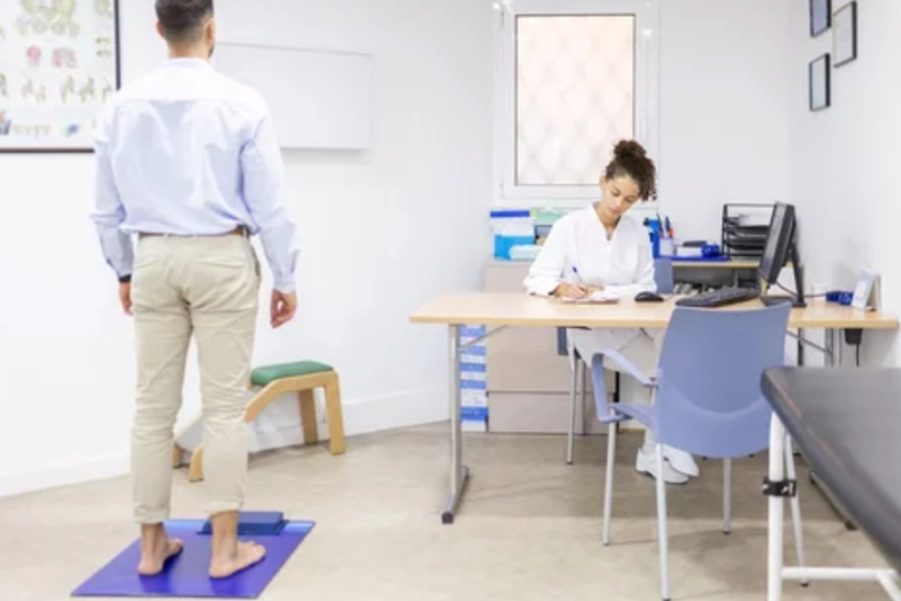
Balance and gaze stability are measured at the start and re-tested as the programme progresses. The 2022 clinical practice guideline sets out both which exercises to use and how much of them to do. [2]
What a course of treatment looks like
Assessment first — confirming which vestibular problem this is, since the treatment differs sharply between neuritis and BPPV, and testing balance, gaze stability and gait to set a baseline. Then a programme of exercises performed several times daily at home, progressed as symptoms settle, with periodic review to increase the challenge.
The exercises are deliberately provocative within tolerable limits. Progress is judged by how quickly symptoms settle after a movement, and by improvement in function — measures such as the Dizziness Handicap Inventory, used as an outcome in the trials themselves. [1] Expect weeks rather than days, with the steepest improvement early.
What the evidence supports — and what it does not
Vestibular rehabilitation, and the one place it is not the answer
Supported
- Vestibular rehabilitation for unilateral peripheral vestibular dysfunction — moderate to strong evidence that it is a safe, effective management, based on a number of high-quality randomised trials. [1]
- Improvement in dizziness — odds ratio 2.67 (95% CI 1.85 to 3.86) against control or no intervention. [1]
- Improvement in daily function — a strong effect on activity and participation measures (SMD −0.83, 95% CI −1.02 to −0.64). [1]
- Safety — no adverse effects were reported. [1]
Not supported
- Exercise-based rehabilitation as the treatment for BPPV — repositioning manoeuvres were clearly superior in the short term (OR 0.19, 95% CI 0.07 to 0.49). [1]
- Claiming one specific form of vestibular rehabilitation is best — there was insufficient evidence to discriminate between different forms. [1]
- Rest and avoidance as a strategy — the treatment shown to work is movement-based, and the mechanism it relies on requires exposure to movement.
Where dizziness has settled but unsteadiness persists into later life, the falls evidence becomes the more useful guide — see falls prevention in older adults.
How certain is this?
Evidence grade: Moderate to high. This is among the best-supported interventions on this site. The review included 39 studies and 2,441 participants, and the authors state there is moderate to strong evidence based on a number of high-quality randomised controlled trials. Risk of selection and attrition bias was low in most studies. [1]
The honest limitations: non-blinding of outcome assessors and selective reporting may have biased results in about a quarter of the studies, and the review could not determine which specific form of vestibular rehabilitation is best. [1] The evidence is for medium-term symptom resolution and improved functioning — it does not establish how long benefits persist over years.
What to expect
The acute phase — severe constant vertigo and vomiting — typically settles over days. What follows is often a longer period of unsteadiness, sensitivity to head movement and difficulty in visually busy environments such as supermarkets or traffic. That is the phase rehabilitation targets, and it is usually measured in weeks.
Recovery depends partly on how much function the affected nerve regains and partly on how well the brain compensates. Compensation is the part you can influence, and it responds to the exercises. Some residual sensitivity in demanding environments can persist and often improves further with continued exposure.
Sudden vertigo can be a stroke — seek emergency assessment
Call emergency services or go to hospital immediately if vertigo comes with:
- Double vision, difficulty speaking or slurred speech, or facial droop.
- Weakness, numbness or clumsiness in an arm or leg.
- Difficulty swallowing, or a severe sudden headache or neck pain.
- Inability to stand or walk at all, even with help.
- New hearing loss or tinnitus with the vertigo — this points away from vestibular neuritis.
- Vertigo after a head or neck injury.
A stroke affecting the brainstem or cerebellum can closely mimic vestibular neuritis. A first episode of severe vertigo should be medically assessed. This list is not exhaustive.
Common questions
Should I rest until the dizziness passes?
Beyond the first day or two of severe symptoms, no. Recovery depends on the brain recalibrating to the altered signal, and that process is driven by exposure to movement. The treatment with moderate to strong evidence behind it is movement-based rehabilitation. [1] Prolonged rest and prolonged sedative medication work against the mechanism of recovery.
Is this the same as BPPV?
No, and the difference matters for treatment. BPPV causes brief bursts of spinning triggered by head position; vestibular neuritis causes severe constant vertigo lasting days. For BPPV, repositioning manoeuvres were superior to exercise-based rehabilitation in the short term (OR 0.19). [1] See our BPPV guide.
The exercises make me dizzy. Am I doing them wrong?
Provoking a manageable amount of symptom is how the exercises work — the mismatch is the signal that drives adaptation. What matters is that symptoms settle within a reasonable time afterwards and that the programme is graded appropriately, which is why the dose should be set and progressed by a clinician rather than guessed.
How long until I am back to normal?
The acute vertigo usually settles over days; the unsteadiness and movement sensitivity typically improve over weeks with rehabilitation. Some people retain a degree of sensitivity in visually busy environments, which often continues to improve with ongoing exposure.
Will it come back?
Vestibular neuritis is usually a single episode. Recurrent attacks of vertigo, or vertigo with hearing symptoms, suggest a different diagnosis and should be reassessed medically.
What the most recent evidence adds
The Cochrane review above is from 2015. The most consequential thing published since is a guideline that tells you not just whether these exercises work, but how much of them to do.
There is strong evidence, and there is a dose. In 2022 the Academy of Neurologic Physical Therapy updated its clinical practice guideline for peripheral vestibular hypofunction. Based on strong evidence, clinicians should offer vestibular rehabilitation to adults with unilateral or bilateral hypofunction, and should offer it supervised. The guideline also puts numbers on the home programme: gaze stabilisation exercises 3 times a day totalling at least 12 minutes daily in acute or subacute unilateral hypofunction; 3 to 5 times a day totalling at least 20 minutes daily for 4 to 6 weeks in chronic unilateral hypofunction; and 3 to 5 times a day totalling 20 to 40 minutes daily for around 5 to 7 weeks in bilateral hypofunction. [2] If you have been handed a sheet of exercises with no frequency or duration on it, that is the gap to point at.
One thing the guideline rules out. Based on strong evidence and a judgement that harm outweighs benefit, clinicians should not use voluntary saccadic or smooth-pursuit eye movements in isolation — that is, without head movement — to promote gaze stability. [2] Head movement is the part that drives the adaptation; eye exercises alone are not a gentler version of the same thing.
The principle appears to generalise beyond the inner ear. A 2023 systematic review of 15 randomised trials and 769 participants found that vestibular rehabilitation added to usual rehabilitation improved balance after stroke (SMD 0.59, 95% CI 0.40 to 0.78) with moderate certainty of evidence [3], and a 2025 meta-analysis in late subacute and chronic stroke survivors found a similar effect on balance (SMD 0.64, 95% CI 0.44 to 0.85), with dual-task training moderately improving gait (SMD 0.46, 95% CI 0.18 to 0.74). [4] The balance system recalibrates when it is challenged, whatever caused the deficit.
The technology is not the treatment. A systematic review of virtual-reality-based vestibular rehabilitation found only preliminary evidence of benefit, limited by inclusion criteria, heterogeneity and comparator design. [5] The 2022 guideline does allow virtual reality or augmented sensory feedback as a way of targeting specific limitations [2] — but as a way of delivering the exercises, not as a reason to pay more.
References
- McDonnell MN, Hillier SL. Vestibular rehabilitation for unilateral peripheral vestibular dysfunction. Cochrane Database of Systematic Reviews. 2015 Jan 13;1(1):CD005397. doi:10.1002/14651858.CD005397.pub4 PMID 25581507 Systematic review
- Hall CD, Herdman SJ, Whitney SL, et al. Vestibular Rehabilitation for Peripheral Vestibular Hypofunction: An Updated Clinical Practice Guideline From the Academy of Neurologic Physical Therapy of the American Physical Therapy Association. Journal of Neurologic Physical Therapy. 2022 Apr 1;46(2):118–177. doi:10.1097/NPT.0000000000000382 PMID 34864777 Clinical practice guideline
- Meng L, Liang Q, Yuan J, et al. Vestibular rehabilitation therapy on balance and gait in patients after stroke: a systematic review and meta-analysis. BMC Medicine. 2023 Aug 25;21(1):322. doi:10.1186/s12916-023-03029-9 PMID 37626339 Systematic review and meta-analysis
- Nairn B, Koohi N, Kaski D, et al. Impact of Vestibular Rehabilitation and Dual-Task Training on Balance and Gait in Survivors of Stroke: A Systematic Review and Meta-Analysis. Journal of the American Heart Association. 2025 Jun 3;14(11):e040663. doi:10.1161/JAHA.124.040663 PMID 40407062 Systematic review and meta-analysis
- Xie M, Zhou K, Patro N, et al. Virtual Reality for Vestibular Rehabilitation: A Systematic Review. Otology & Neurotology. 2021 Aug 1;42(7):967–977. doi:10.1097/MAO.0000000000003155 PMID 33782257 Systematic review
About this guide
If you need assessment
This page explains. It does not diagnose.
Sudden severe vertigo needs medical assessment to exclude a stroke, and the treatment differs entirely between vestibular neuritis and BPPV. Both require examination. Physiotherapist India publishes information and takes no bookings. Ask a qualified physiotherapist to examine your own case before acting on anything written here.