
Condition guide · Vestibular
Benign Paroxysmal Positional Vertigo (BPPV)
Brief, intense spinning triggered by a change of head position. It is the most treatable cause of vertigo — usually with a repositioning manoeuvre rather than medication — and it commonly comes back.
In plain words. Tiny crystals that normally sit in one part of the inner ear come loose and drift into one of the balance canals. When you move your head — rolling over in bed, lying down, looking up — they move too, and your brain briefly receives a false signal that you are spinning.
The spinning is intense but short, usually well under a minute. It is not dangerous in itself, and a trained clinician can often settle it by guiding your head through a specific sequence of positions that moves the crystals back where they belong. It is not usually treated with medication.
Key points
- Episodes are brief and position-triggered — seconds to under a minute, brought on by moving the head, not present constantly.
- Diagnosis is clinical. The Dix-Hallpike test provokes the characteristic eye movement; scans are not needed to diagnose it.
- Treatment is a canalith repositioning manoeuvre (commonly the Epley), not medication.
- It recurs in roughly one in three people after treatment. That is expected, not treatment failure, and repeat treatment usually works again.
- Guidelines recommend against routine vestibular suppressant drugs, routine imaging, and post-treatment postural restrictions.
What is actually happening
The inner ear contains calcium carbonate crystals (otoconia) that sit in the utricle, where they help you sense gravity and linear movement. In BPPV, some of these crystals become dislodged and migrate into one of the semicircular canals, which are meant to detect rotation only.
Once inside a canal, the crystals move with gravity whenever the head changes position, dragging fluid past the sensory receptor and generating a signal that says "you are rotating" when you are not. The mismatch between that signal and what your eyes and body report is experienced as vertigo.
The posterior canal is affected most often, which is why the classic triggers are lying down, sitting up, rolling over in bed and tipping the head back. The lateral (horizontal) canal can also be involved and behaves differently on testing.
The vestibular apparatus — where BPPV happens
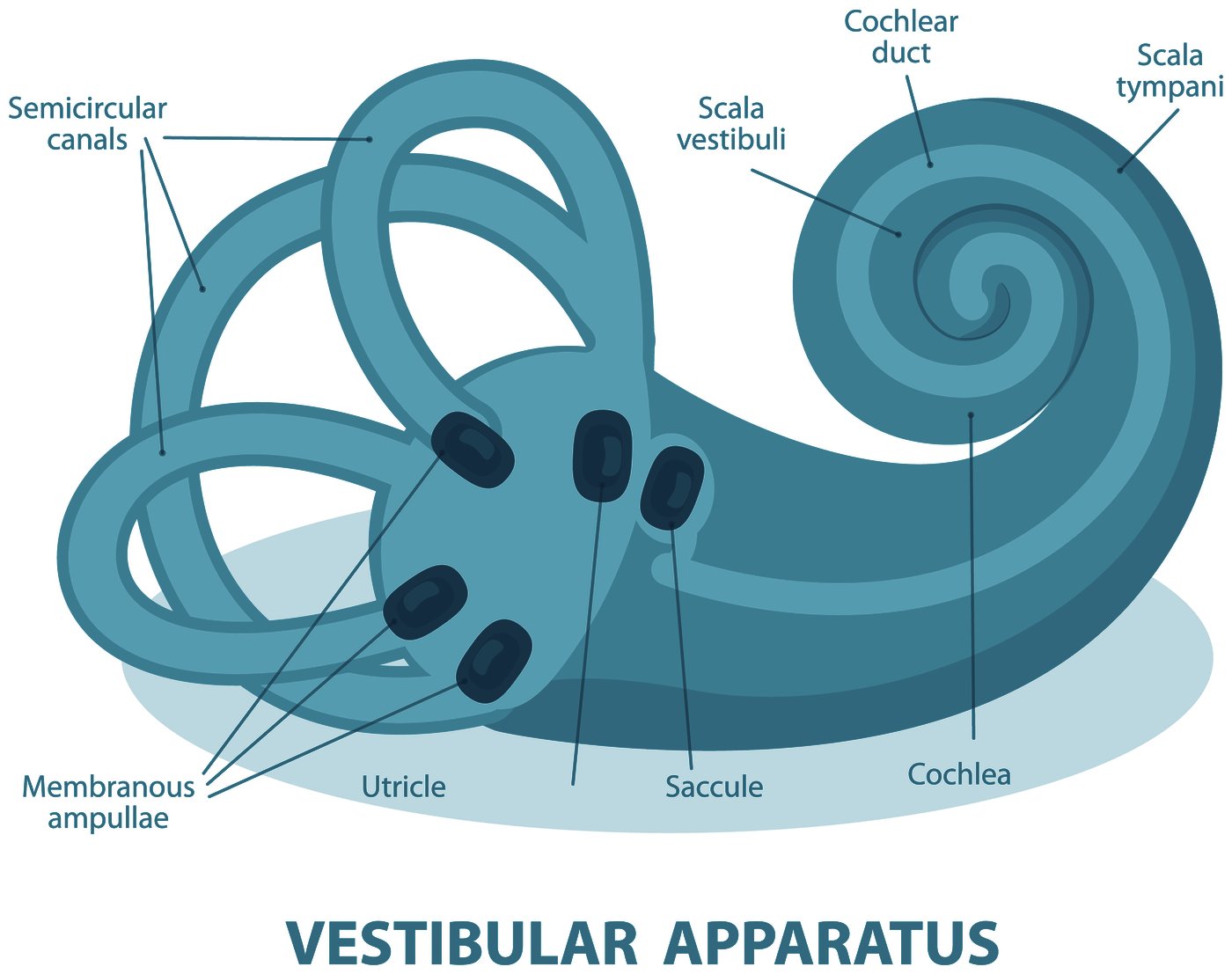
How BPPV happens
What it feels like
- A sudden sense that the room is spinning, triggered by a change in head position
- Episodes that are brief — typically seconds, usually under a minute
- Nausea, sometimes vomiting, with severe episodes
- Unsteadiness or a "wobbly" feeling that can linger between attacks
- No hearing loss, no ringing in the ears, no headache as part of the condition itself
Constant dizziness that does not change with head position is not typical of BPPV and points toward a different diagnosis.
How it is diagnosed
BPPV is diagnosed by provoking it deliberately and watching the eyes, not by scanning. The American Academy of Otolaryngology–Head and Neck Surgery guideline makes this a strong recommendation. [3]
The Dix-Hallpike test
The clinician brings you from sitting to lying with your head turned 45° to one side and the neck extended about 20°, affected ear down. In posterior canal BPPV this provokes vertigo together with a characteristic torsional, upbeating nystagmus — a specific flickering eye movement. That combination is the diagnosis. [3]
The supine roll test
If the history fits BPPV but the Dix-Hallpike produces horizontal nystagmus or none at all, the guideline recommends a supine roll test to check the lateral semicircular canal instead. [3]
What is not needed
Where the picture is typical, the guideline recommends against radiographic imaging and against vestibular function testing. They are reserved for cases with features that do not fit BPPV. [3]
How physiotherapy and rehabilitation help
BPPV is the one condition on this site where physiotherapy is not a course of treatment but a procedure. Loose crystals have moved into a semicircular canal where they do not belong; a repositioning manoeuvre uses head position and gravity to move them back out. That is the entire mechanism, and it is why the results are unusually fast compared with anything else a physiotherapist does.
What the clinician actually contributes is diagnosis rather than treatment. Deciding which canal is affected, and on which side, is what determines which manoeuvre to perform — and performing the wrong one does not work. That assessment is the part that is difficult to do for yourself.
What is actually offered, and what it is worth
- Positional testing to identify the canal and the side — the step that makes everything after it work.
- A repositioning manoeuvre — Epley, Semont or a canal-specific alternative, chosen from the test findings.
- Teaching you the manoeuvre to use at home — the part most worth asking for, because BPPV recurs and there is now trial evidence that self-treatment works. [4][5]
- Screening for what else could cause it — not all positional dizziness is BPPV, and the pattern of nystagmus is what separates them.
Exercise-based vestibular rehabilitation is not the treatment for BPPV, and it is worth knowing that before paying for a programme of it. It is the right treatment for a different problem — see vestibular neuritis, where the deficit is a weakened balance signal rather than a displaced crystal.
What treatment involves
The guideline makes a strong recommendation that clinicians treat posterior canal BPPV with a canalith repositioning procedure, or refer to someone who can. [3] The best known is the Epley manoeuvre: a sequence of head and body positions that walks the displaced crystals around the canal and back into the utricle, where they stop causing symptoms.
It takes a few minutes, is done in the clinic, and often works within one to a few sessions. Vertigo and nausea during the manoeuvre are common and expected — it works by provoking the problem in a controlled direction.
Your clinician should also assess factors that change how BPPV is managed: impaired mobility or balance, central nervous system disorders, falls risk, and whether you have support at home. Reassessment within a month is recommended to confirm the symptoms have actually resolved. [3]
What the evidence supports — and what it does not
Supported
- Canalith repositioning (Epley) for posterior canal BPPV. Complete resolution of vertigo rose from 21% to 56% versus sham or control (OR 4.42, 95% CI 2.62–7.44; 5 studies, 273 participants). [1]
- Effective in general practice, not only specialist clinics. A 27-trial meta-analysis found symptom reduction in primary care (RR 3.14, 95% CI 1.96–5.02) and in subspecialty settings (RR 2.42, 95% CI 1.64–3.56). [2]
- Objective change on retesting — conversion of the Dix-Hallpike from positive to negative significantly favours treatment. [1][2]
- Semont and Gans manoeuvres perform comparably to the Epley. [1]
Not supported
- Postural restrictions after the manoeuvre — sleeping upright, avoiding bending. Strong recommendation against. [3]
- Routine vestibular suppressant medication (antihistamines, benzodiazepines) as treatment for BPPV. Recommendation against. [3]
- Routine imaging or vestibular testing where the presentation is typical. Recommendation against. [3]
- Brandt-Daroff exercises as first-line — the Epley is superior to them. [1]
- Any claim of a "cure rate" above 90%. No pooled estimate in these sources supports that figure.
Complete resolution of vertigo — Cochrane, 5 studies, 273 participants
What the most recent evidence adds
Self-treatment of recurrence works, and has been properly tested. A randomised clinical trial enrolled 585 patients with a history of BPPV and gave one group access to a web-based system for diagnosing and treating a recurrence at home. Of those who did recur, 72.4% in the treatment group reported their vertigo resolved, against 42.9% of controls, and 85.2% of participants successfully used the system. [5] For a condition that recurs often and is treatable in minutes, being taught to handle the next episode yourself is worth more than another appointment.
Which manoeuvre, done at home, may matter. A randomised study of 195 people compared the Semont-plus self-manoeuvre against the Epley self-manoeuvre for posterior canal BPPV. Time to recovery was shorter with Semont-plus — a mean of 2.0 days versus 3.3 days. For the effect of a single manoeuvre there was no significant difference (68.4% versus 62.9%). No serious adverse events occurred with either, though relevant nausea affected roughly a fifth to a quarter of participants in both groups. [4]
Read that carefully: the advantage is in how quickly it settles over repeated self-treatment, not in whether a single manoeuvre performed in clinic works. Both manoeuvres work. Nausea during treatment is common and is not a sign something has gone wrong.
Unsteadiness without the spinning sensation is a different problem, and in older adults it is the one that drives injury. See falls prevention in older adults.
How certain is this?
Evidence grade: Moderate. The direction of effect is consistent and supported by a Cochrane systematic review, a 27-trial meta-analysis and a clinical practice guideline. The grade is not higher because the Cochrane authors describe the underlying trials as "11, mostly small, randomised controlled trials with relatively short follow-up", and the 2023 review reported uncertainty about adverse-event data. [1][2]
What that means practically: you can be confident repositioning works and is the right first treatment. You should be cautious about any precise promise of how quickly, or how permanently, it will work for one individual.
What to expect afterwards
Many people improve quickly, sometimes after a single session. Some need the manoeuvre repeated. Mild unsteadiness for a day or two afterwards is common and settles.
BPPV recurs. The Cochrane review reports a recurrence rate of 36% after treatment. [1] If your symptoms return weeks or months later, that is a known feature of the condition rather than a sign that treatment failed or that something worse has been missed. Repeat treatment is usually straightforward and effective.
Because recurrence and falls risk both matter, the guideline specifically recommends that patients are educated about safety, the likelihood of recurrence, and the importance of follow-up. [3]
When dizziness is not BPPV — seek urgent assessment
BPPV is brief and position-triggered. Seek immediate medical attention if dizziness comes with any of the following, which suggest a different and potentially serious cause:
- Sudden weakness or numbness, especially on one side of the body
- Difficulty speaking, slurred speech, difficulty swallowing, or facial droop
- Double vision or sudden loss of vision
- Severe unsteadiness or inability to walk unaided
- Sudden severe headache unlike any you have had before
- New hearing loss or ringing in one ear alongside the dizziness
- Dizziness that is constant and does not change with head position
This list is not exhaustive. If you are worried about a symptom, seek professional advice.
Common questions
Will medication fix it?
Not usually. Vestibular suppressants such as antihistamines and benzodiazepines are specifically not recommended as routine treatment for BPPV. [3] They may briefly dull the nausea, but they do nothing about the displaced crystals and can slow the brain's own adaptation.
Do I need a scan?
Where the history and Dix-Hallpike findings are typical, no. The guideline recommends against routine imaging, which is reserved for presentations with features that do not fit BPPV. [3]
Do I have to sleep sitting up afterwards?
No. This used to be widely advised. The guideline now makes a strong recommendation against post-procedural postural restrictions after canalith repositioning for posterior canal BPPV. [3]
Can I treat it myself at home?
The guideline lists vestibular rehabilitation, self-administered or with a clinician, as an option. [3] The practical difficulty is that the correct manoeuvre depends on which canal and which side is affected, and that is determined by positional testing. Getting it wrong can move crystals into a different canal. An assessment first is worth it.
It has come back. Has the treatment failed?
Probably not. Recurrence is reported in about 36% of people after treatment. [1] It is a feature of the condition. Repeat repositioning is usually effective.
References
- Hilton MP, Pinder DK. The Epley (canalith repositioning) manoeuvre for benign paroxysmal positional vertigo. Cochrane Database of Systematic Reviews. 2014 Dec 8. doi:10.1002/14651858.CD003162.pub3 PMID 25485940 Systematic review
- Saishoji Y, Yamamoto N, Fujiwara T, Mori H, Taito S. Epley manoeuvre's efficacy for benign paroxysmal positional vertigo (BPPV) in primary-care and subspecialty settings: a systematic review and meta-analysis. BMC Primary Care. 2023 Dec 2. doi:10.1186/s12875-023-02217-z PMID 38042776 Meta-analysis
- Bhattacharyya N, Gubbels SP, Schwartz SR, et al. Clinical Practice Guideline: Benign Paroxysmal Positional Vertigo (Update). Otolaryngology–Head and Neck Surgery. 2017 Mar;156(3_suppl):S1–S47. doi:10.1177/0194599816689667 PMID 28248609 Clinical practice guideline
- Strupp M, Mandala M, Vinck AS, et al. The Semont-Plus Maneuver or the Epley Maneuver in Posterior Canal Benign Paroxysmal Positional Vertigo: A Randomized Clinical Study. JAMA Neurology. 2023 Aug 1;80(8):798–804. doi:10.1001/jamaneurol.2023.1408 PMID 37358870 Randomised controlled trial
- Kim HJ, Kim JS, Choi KD, et al. Effect of Self-treatment of Recurrent Benign Paroxysmal Positional Vertigo: A Randomized Clinical Trial. JAMA Neurology. 2023 Mar 1;80(3):244–250. doi:10.1001/jamaneurol.2022.4944 PMID 36648931 Randomised controlled trial
About this guide
If you need assessment
This page explains. It does not diagnose.
Positional testing is what distinguishes BPPV from the other causes of dizziness, and it has to be done in person. Physiotherapist India publishes information and takes no bookings. Ask a qualified physiotherapist to examine your own case before acting on anything written here.