Condition guide · Spine
Low Back Pain
The leading cause of disability in the world, and one of the most over-investigated. What the evidence says about scans, rest, painkillers and exercise — including the finding that changes the way most people should read their MRI report.
In plain words. Your lower back is a stack of bones with shock-absorbing discs between them, held together by ligaments and controlled by a lot of muscle. It is built to bend, lift and twist. When it hurts, that is usually a signal that the system is irritated or overloaded — not that something in it has broken.
That distinction matters more than almost anything else on this page. For the great majority of people with back pain, no specific damaged structure can be identified as the cause, and the pain settles. [1] Treatment is aimed at getting you moving normally again, not at repairing something.
Key points
- Low back pain is now the leading cause of disability worldwide, and the years lived with disability it causes rose 54% between 1990 and 2015. [1]
- In nearly everyone, no specific cause can be identified. Only a small proportion have a well-understood pathological cause such as fracture, malignancy or infection. [1]
- Scan findings are normal ageing. Disc degeneration appears on imaging in 37% of pain-free 20-year-olds and 96% of pain-free 80-year-olds. [2]
- Paracetamol did not beat placebo for acute low back pain in a trial of 1,643 people — recovery took a median of 17 days either way. [3]
- For acute pain, guidelines put non-drug treatment first: heat, massage, acupuncture or spinal manipulation. [4]
- For chronic pain, exercise is first-line and reduces pain by a clinically important margin — though its effect on function is smaller than people expect. [4][5]
What is actually happening
The lumbar spine is five vertebrae, each separated by a disc: a tough fibrous ring around a softer centre. Behind the discs, paired facet joints guide movement, and nerve roots exit through gaps on either side. Around all of it sit large muscles that generate and control movement.
Any of these structures can produce pain. The difficulty is that in the great majority of cases it is not possible to establish which one is doing it. This is why clinicians speak of "non-specific low back pain" — not evasion, but an accurate statement of what can and cannot be known. [1]
Two lumbar vertebrae, the disc between them, and a nerve root
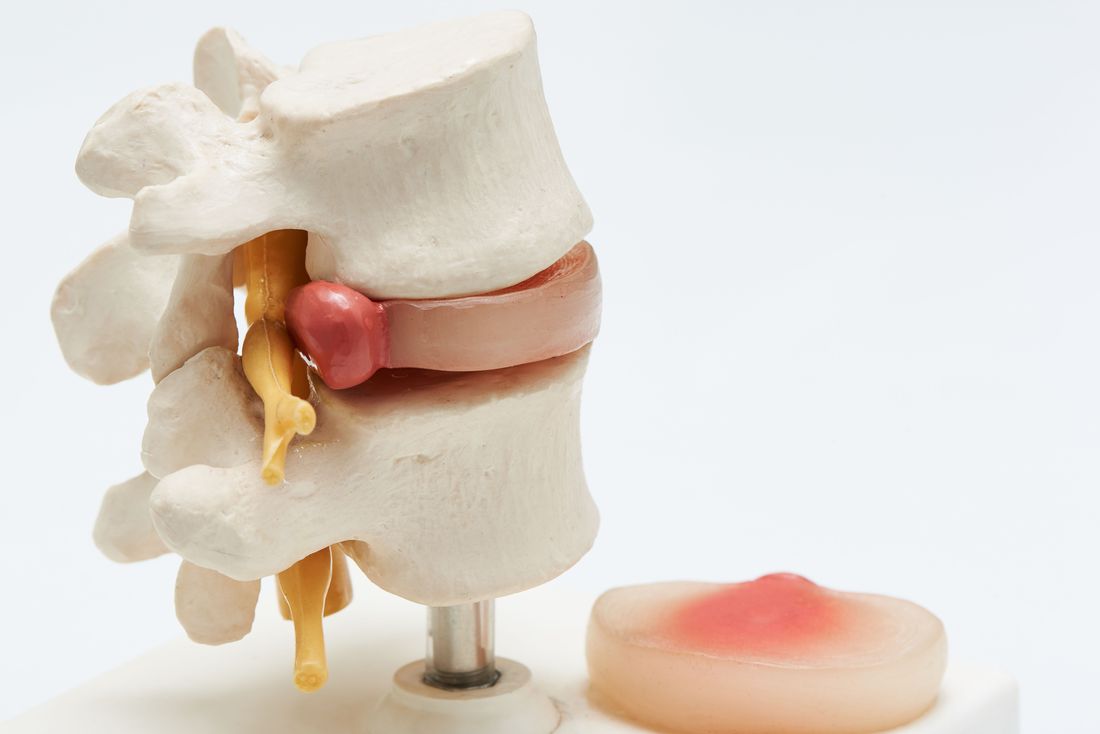
A teaching model showing a disc protrusion (red) pressing toward a nerve root (yellow). Images like this are what most people picture when they are told they have a "disc problem" — but a protrusion of this kind is present on scans of roughly 29% of 20-year-olds and 43% of 80-year-olds who have no back pain at all. [2] The picture explains the anatomy; it does not, on its own, explain anyone's pain.
What is increasingly clear is that persistent back pain is not simply a readout of tissue damage. Central pain-modulating mechanisms and a person's beliefs about their pain both play an important part in whether an episode becomes persistent and disabling — as do initial pain intensity, psychological distress, and pain at several sites in the body. [1]
What it feels like
- Ache, stiffness or spasm across the lower back, sometimes to one side, often spreading into the buttock or upper thigh.
- Worse with certain positions — commonly prolonged sitting, standing, or bending forward — and eased by changing position.
- Stiff and sore first thing, loosening as you move about.
- A sense that the back might "go" if you move the wrong way. This fear is extremely common and is itself a target of treatment.
- Episodes that come and go over years. Recurrence is common and is not evidence that the back is deteriorating. [1]
How it is diagnosed
By history and examination. The clinician's first job is not to name the structure but to sort your pain into one of three groups: the small number of cases caused by serious pathology, the smaller group with nerve root involvement, and the large remainder — non-specific low back pain. [1] The examination and the questions about red flags are what does this.
Why a scan usually does not help
Imaging is appropriate when the history raises the possibility of a specific cause, or when surgery is genuinely being considered. Used routinely, it mostly finds things that were going to be there anyway.
A systematic review pooled imaging from 3,110 people with no symptoms at all and reported how often each degenerative finding turned up, by age. [2]
Spine "abnormalities" found on scans of people with no back pain
The review's own conclusion is that many of these findings "are likely part of normal ageing and unassociated with pain", and must be read in the context of the person's clinical condition. [2] A report describing degeneration, bulging or a protrusion is, for most people, describing a spine that looks its age.
How physiotherapy and rehabilitation help
For most low back pain there is no damaged structure to repair, and the useful question is not what is broken but what restores normal movement and confidence fastest. Exercise does that. The reason it is prescribed rather than simply recommended is that dose, type and progression are what separate a programme that works from a sheet of exercises that gets abandoned in a fortnight.
A network meta-analysis of 118 trials and 9710 participants compared exercise types directly in chronic low back pain. Compared with control, all types of physical exercise were effective for pain and disability, with two exceptions: stretching exercises did not reduce pain, and the McKenzie method did not reduce disability. The most effective for pain were Pilates, mind-body and core-based exercise; for disability, Pilates, strength and core-based exercise. Pilates had the highest likelihood of being best for both pain (93%) and disability (98%). [6]
Before that becomes an argument for buying Pilates classes, read the dose the reviewers actually recommend. The most beneficial programmes involved at least one to two sessions per week of Pilates or strength exercise; sessions of under 60 minutes of core-based, strength or mind-body exercise; and training programmes lasting 3 to 9 weeks for Pilates and core-based exercise. [6] Those are modest, achievable numbers, and they matter more than the label on the class.
What is actually offered, and what it is worth
- Assessment to rule out the small number of serious causes — then reassurance, which is treatment rather than politeness.
- A specific exercise programme with a stated dose — the active ingredient. If nobody tells you how often and for how many weeks, that is the question to ask. [6]
- Advice on staying active and on work — returning to normal activity is part of recovery, not a reward for it.
- Passive treatments alone — heat, ultrasound and similar have no claim to be the substance of a course of care, whatever else they are used for.
The strongest practical finding here is that the differences between exercise types are small next to the difference between exercising and not. Choose something you will still be doing in six weeks.
If the pain travels below the knee, with numbness or weakness in the leg, that is a different problem — see sciatica. The pelvic floor is part of the same trunk system, and problems there often accompany back pain; see pelvic floor rehabilitation.
What treatment involves
For a new episode, the priorities are staying active, keeping working if you can, and controlling the pain enough to do both. Bed rest is not treatment. The American College of Physicians recommends that for acute and subacute pain, clinicians and patients first choose non-drug options — superficial heat, massage, acupuncture or spinal manipulation — because most people improve over time regardless of what is done. [4]
For pain that has lasted beyond about twelve weeks, the same guideline recommends starting with non-drug treatment: exercise, multidisciplinary rehabilitation, acupuncture, mindfulness-based stress reduction, tai chi, yoga, motor control exercise, progressive relaxation, biofeedback, cognitive behavioural therapy or spinal manipulation. Drugs come after that, with NSAIDs first-line and tramadol or duloxetine second-line. [4]
In practice, a physiotherapy programme for persistent back pain combines graded exercise with education about what pain does and does not mean, and a plan for getting back to the specific things you have stopped doing. The Cochrane review found exercise was no more effective than manual therapy for pain, but clearly better than education alone or than non-exercise physical therapy. [5]
What the evidence supports — and what it does not
Supported
- Exercise therapy for chronic low back pain — moderate-certainty evidence of a clinically important reduction in pain against no treatment, usual care or placebo (mean difference −15.2 points on a 0–100 scale, 95% CI −18.3 to −12.2), across 249 trials. [5]
- Staying active and non-drug first-line care in acute pain — a strong ACP recommendation, on the reasoning that most acute episodes improve regardless of treatment. [4]
- Multidisciplinary rehabilitation, CBT, yoga, tai chi and motor control exercise for chronic pain — all named in the ACP's strong first-line recommendation. [4]
- NSAIDs where a drug is wanted — first-line in the ACP guideline for both acute and chronic pain. [4]
Not supported
- Paracetamol for acute low back pain — against placebo, median recovery was 17 days on regular dosing, 17 as-needed and 16 on placebo (regular vs placebo hazard ratio 0.99, 95% CI 0.87 to 1.14). [3]
- Routine imaging — the findings it produces are present in most pain-free people of the same age and are likely part of normal ageing. [2]
- Bed rest — nowhere in the ACP's first-line recommendations, which are built around active treatment. [4]
- Reading "degeneration" as damage — 96% of pain-free 80-year-olds have it. [2]
Note what is not claimed here. Exercise reduced pain by a clinically important margin, but its effect on functional limitation (−6.8 points, 95% CI −8.3 to −5.3) did not reach the threshold the reviewers had set for clinical importance, and against other conservative treatments its advantage was smaller still. [5] Exercise is the best-supported option; it is not a cure.
How certain is this?
Evidence grade: Moderate. The epidemiology is solid and the guideline recommendations are consistent across bodies. The Cochrane review of exercise rated its own evidence moderate-certainty, downgraded for heterogeneity and, for the functional outcome, for evidence of publication bias. 79% of its trials were at risk of performance bias, because you cannot blind someone to whether they are exercising. [5]
The imaging review is cross-sectional: it establishes that degenerative findings are common in people without pain, which is enough to undercut a causal reading of a scan report, but it does not prove such findings never matter in an individual. [2] The paracetamol result is a single large, well-conducted, placebo-controlled trial in acute pain and should not be extended to other drugs or to chronic pain. [3]
What to expect
Most new episodes settle substantially within weeks. In the paracetamol trial, where everyone received best-evidence advice, the median time to recovery was about two and a half weeks regardless of which tablets they took. [3]
Recurrence is common, and a recurrence is not a relapse into damage. [1] A smaller group develops persistent, disabling pain; the risk of that is higher when the initial pain is severe, when there is psychological distress, and when pain is present at several body sites. [1] Those are among the reasons a good assessment asks about more than the back.
When back pain is not ordinary back pain — seek urgent assessment
Seek immediate medical attention if you have:
- Numbness around the back passage, genitals or inner thighs, difficulty passing or controlling urine, or loss of bowel control — this needs emergency assessment the same day.
- Progressive weakness in one or both legs, or a foot that drags.
- Back pain after a significant fall or accident, or in anyone with osteoporosis or on long-term steroids.
- Fever, night sweats, or unexplained weight loss with back pain.
- A history of cancer, with new back pain.
- Pain that is constant, severe, unrelated to position, and worst at night.
These point to the small proportion of cases with a specific and serious cause. [1] This list is not exhaustive. If you are worried about a symptom, seek professional advice.
Common questions
Should I get an MRI to find out what is wrong?
Usually not, unless your history suggests a specific cause or surgery is being considered. Scans of people with no pain at all show disc degeneration in 37% of 20-year-olds rising to 96% of 80-year-olds, and disc bulges in 30% rising to 84%. [2] A scan will very likely find something, and that something will very likely not be the explanation.
Is my back damaged? Should I stop lifting?
For nearly everyone with back pain, no specific damaged structure can be identified at all. [1] Guidelines are built around returning to normal activity rather than protecting the back from it, and exercise is the first-line treatment for persistent pain. [4][5] How you return to lifting should be graded, which is what an assessment is for.
Which painkiller should I take?
That is a question for your doctor or pharmacist, not a website. What the evidence shows is that paracetamol was no better than placebo for acute low back pain in a trial of over 1,600 people [3], and that where a drug is wanted, guidelines put NSAIDs first-line and reserve tramadol or duloxetine for chronic pain that has not responded to non-drug treatment. [4] Opioids are not a first-line option.
Is a particular exercise best?
No single type stood out. What the Cochrane review found is that exercise beat education alone and non-exercise physical therapy, but was no better than manual therapy for pain. [5] The programme that works is the one matched to what you need to get back to, and that you will actually do.
Does back pain mean I will end up disabled?
Most episodes settle, and most people recover quickly. [1][3] A minority develop persistent disabling pain, and the predictors of that are known — high initial pain, psychological distress, and pain at multiple sites. [1] They are part of why treatment addresses more than the back itself.
References
- Hartvigsen J, Hancock MJ, Kongsted A, et al. What low back pain is and why we need to pay attention. Lancet. 2018 Jun 9;391(10137):2356–2367. doi:10.1016/S0140-6736(18)30480-X PMID 29573870 Review · Lancet Low Back Pain Series
- Brinjikji W, Luetmer PH, Comstock B, et al. Systematic literature review of imaging features of spinal degeneration in asymptomatic populations. American Journal of Neuroradiology. 2015 Apr;36(4):811–816. doi:10.3174/ajnr.A4173 PMID 25430861 Systematic review
- Williams CM, Maher CG, Latimer J, et al. Efficacy of paracetamol for acute low-back pain: a double-blind, randomised controlled trial. Lancet. 2014 Nov 1;384(9954):1586–1596. doi:10.1016/S0140-6736(14)60805-9 PMID 25064594 Randomised controlled trial
- Qaseem A, Wilt TJ, McLean RM, Forciea MA. Noninvasive treatments for acute, subacute, and chronic low back pain: a clinical practice guideline from the American College of Physicians. Annals of Internal Medicine. 2017 Apr 4;166(7):514–530. doi:10.7326/M16-2367 PMID 28192789 Clinical practice guideline
- Hayden JA, Ellis J, Ogilvie R, Malmivaara A, van Tulder MW. Exercise therapy for chronic low back pain. Cochrane Database of Systematic Reviews. 2021 Sep 28;9(9):CD009790. doi:10.1002/14651858.CD009790.pub2 PMID 34580864 Systematic review
- Fernández-Rodríguez R, Álvarez-Bueno C, Cavero-Redondo I, et al. Best Exercise Options for Reducing Pain and Disability in Adults With Chronic Low Back Pain: Pilates, Strength, Core-Based, and Mind-Body. A Network Meta-analysis. Journal of Orthopaedic & Sports Physical Therapy. 2022 Aug;52(8):505–521. doi:10.2519/jospt.2022.10671 PMID 35722759 Systematic review and network meta-analysis
About this guide
If you need assessment
This page explains. It does not diagnose.
The main clinical task in back pain is sorting the small number of people who need investigation from the large number who need to be got moving — and that requires a history and an examination, not a website. Physiotherapist India publishes information and takes no bookings. Ask a qualified physiotherapist to examine your own case before acting on anything written here.