
Condition guide · Spine
Sciatica
Leg pain from an irritated nerve root. What causes it, why most cases settle without surgery, and what the trials show about the operation, the injection and the nerve-pain tablets.
In plain words. Sciatica is not a diagnosis so much as a description: pain that travels down the leg along the path of the sciatic nerve, usually because one of the nerve roots leaving the lower spine has become compressed or inflamed. The commonest cause is a disc bulging back onto that root.
The important thing to know at the start is that the natural history is good. In the trial that compared operating early against waiting, 95% of people in both groups reported themselves recovered at one year — including the group that mostly did not have surgery. [4]
Key points
- Sciatica means leg pain from an irritated nerve root, not back pain. Where the pain travels tells the clinician which root is involved.
- Most people recover. At one year, 95% reported recovery whether they were assigned to early surgery or to conservative care. [4]
- Surgery works faster, not better. Its advantage on leg pain shrinks from moderate in the first six weeks to negligible at twelve months. [1]
- Epidural steroid injections give small, short-lived relief — about 5 points on a 0–100 pain scale, which the reviewers say may not be clinically important. [2]
- Pregabalin did not work. In a placebo-controlled trial it gave no benefit at 8 or 52 weeks, and caused more adverse events. [3]
- Because time is on your side, the real decision is usually how long to wait, not whether to operate. [1][4]
What is actually happening
Five pairs of nerve roots leave the lower spine and merge to form the sciatic nerve, the thickest nerve in the body, which runs through the buttock and down the back of the thigh before dividing below the knee. Anything that presses on or inflames one of those roots where it exits the spine can produce pain felt along the whole length of its territory — which is why a problem in your back is felt in your calf.
Where the pain comes from, and where it is felt
Not all sciatica is caused by a disc. A narrowed spinal canal, arthritic changes around the exit gap, and less commonly other conditions can irritate the same roots. The pattern of symptoms and the examination are what separate them.
A disc fragment displaced against a spinal nerve
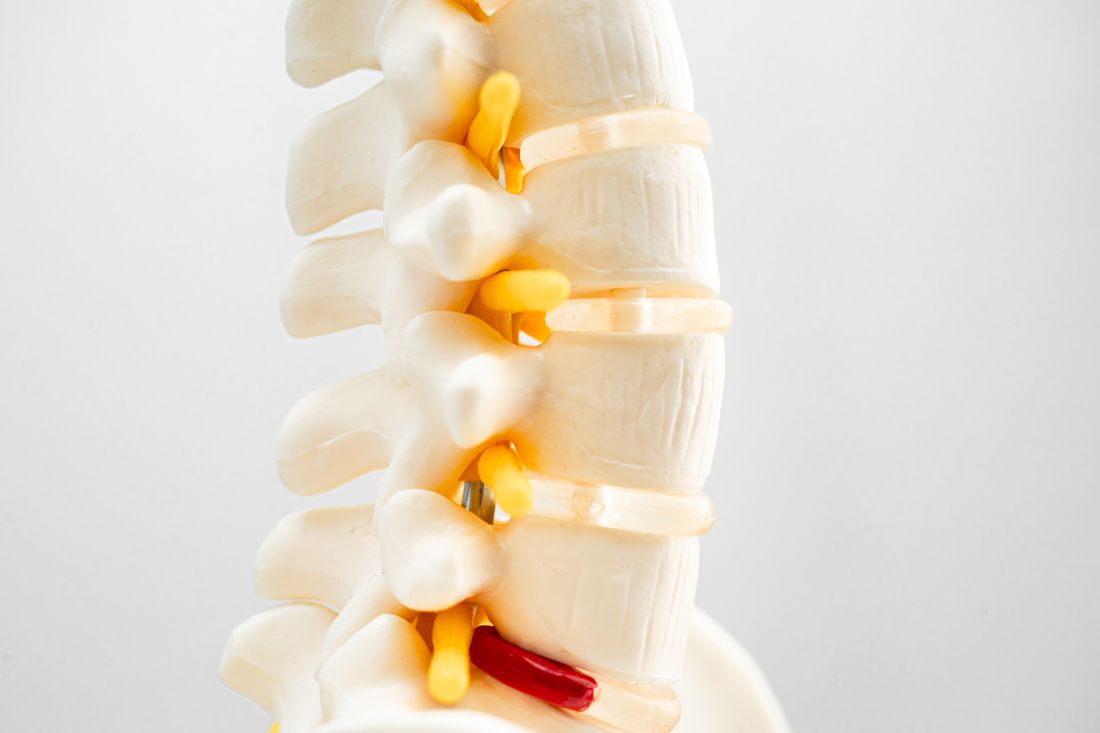
The mechanism in disc-related sciatica: material from the disc displaces backwards and contacts the nerve root. Note that in most people this settles without the fragment being removed — nerve roots tolerate a great deal, and the inflammation around them subsides with time. [1][4]
What it feels like
- Pain travelling from the buttock down the back or side of the leg, often past the knee. Leg pain that is worse than the back pain is the characteristic pattern.
- Sharp, burning, electric or shooting in quality, rather than the dull ache of ordinary back pain.
- Pins and needles or numbness in a band down the leg, or in part of the foot.
- Worse with coughing, sneezing or straining; often worse sitting.
- Sometimes weakness — difficulty pushing the foot down, lifting the front of the foot, or rising onto tiptoe.
How it is diagnosed
Clinically. The distribution of the pain, the sensory changes, the reflexes and the strength tests together identify which nerve root is involved, and nerve tension tests reproduce the symptom. That examination is what establishes the diagnosis.
When imaging is and is not useful
An MRI is appropriate when surgery is being considered, or when the picture suggests something other than a disc. It is not needed to make the diagnosis, and its findings need care: disc protrusions appear on the scans of 29% of 20-year-olds and 43% of 80-year-olds who have no back pain at all. [5] The scan confirms and localises what the examination already found — it does not replace it.
How physiotherapy and rehabilitation help
This section has to begin with a finding that does not favour physiotherapy, because leaving it out would misrepresent the evidence.
A systematic review and meta-analysis of 18 trials and 2699 participants compared physiotherapy interventions against control interventions in sciatica. It found no difference in pain in the short term (SMD -0.34, 95% CI -1.05 to 0.37), medium term (0.15, -0.09 to 0.38) or long term (0.09, -0.18 to 0.36), and no difference in disability at any of those time points. [6] That is not a marginal result; it is a consistent absence of difference.
Three things qualify it, and none of them rescues a strong claim. All 18 trials were at high or unclear risk of bias. Heterogeneity was very high, and the authors describe substantial uncertainty around the estimates. And in the subgroup comparing physiotherapy against minimal intervention, physiotherapy was favoured for pain at long-term follow-up — while many trials comparing it against a substantial intervention did not use contemporary physiotherapy. [6]
So the honest position is: physiotherapy for sciatica is not established as better than the alternatives it has been tested against, and the trials are not good enough to settle the question either way. Anyone quoting a success rate for sciatica physiotherapy is quoting something the literature does not currently support.
What it is still reasonable to expect
- Assessment and triage — identifying the small number of people who need urgent investigation is valuable regardless of what the treatment trials show.
- Explanation of the natural course — most sciatica improves over time, and knowing that changes how the weeks are endured.
- Guidance on staying active and managing symptoms — modest, and better supported than any specific technique.
- Anything sold as fixing the nerve — treat with scepticism. The evidence above is the reason.
Where the pain stays in the back and does not travel down the leg, the evidence is considerably more favourable — see low back pain, where exercise has clear support.
What treatment involves
Early on, the aim is to keep you moving and manage the pain while the inflammation settles. Physiotherapy typically combines advice about positions and activity, graded movement and nerve mobility work, and progressive strengthening as symptoms allow. Staying as active as the pain permits is the general principle.
If severe pain persists for six to twelve weeks despite that, surgery becomes a reasonable conversation — and the evidence about what it does is unusually clear.
What the evidence supports — and what it does not
Discectomy versus non-surgical care: the advantage in leg pain over time
Supported
- Time and conservative care for most people — 95% of both the early-surgery and the conservative group reported themselves recovered at one year, and only 39% of the conservative group ended up having surgery at all. [4]
- Surgery for faster relief of severe, persisting leg pain — discectomy relieved leg pain sooner (mean difference 12.1 points in the first six weeks) and produced faster perceived recovery. [1][4]
- Epidural corticosteroid injection, modestly — probably slightly better than placebo for leg pain in the short term (−4.93 points, 95% CI −8.77 to −1.09). [2]
Not supported
- Pregabalin — no significant difference from placebo in leg pain at 8 weeks (adjusted mean difference 0.5, 95% CI −0.2 to 1.2) or at 52 weeks, no benefit on any secondary outcome, and 227 adverse events versus 124 on placebo. [3]
- Surgery as a way to be better off in the long run — by twelve months the leg-pain difference is 2.3 points, and the effect on disability was small, negligible or absent throughout. [1]
- Injections as a lasting solution — the reviewers state the effects are small and may not be considered clinically important, and the evidence is limited to short-term follow-up. [2]
- Imaging to make the diagnosis — the examination does that; scan findings are common in people with no symptoms. [5]
How certain is this?
Evidence grade: Low to moderate. This is a case where the honest answer varies by question.
The surgical comparison rests on 24 randomised trials, but the reviewers graded the certainty as very low to low — largely because you cannot blind a patient to whether they have had an operation, and expectation powerfully affects reported pain. [1] The direction of the finding (faster relief, converging outcomes) is consistent across trials, but the size of the early advantage should be held loosely.
The injection evidence is moderate-quality, downgraded for risk of bias, and the effect is small enough that the review says so explicitly. [2] The pregabalin trial is a well-conducted, double-blind, placebo-controlled study with a clearly negative result, which is the most reliable kind of evidence here — though with 209 participants it is a single trial. [3]
What to expect
Most sciatica improves over weeks to a few months. Leg pain usually settles before any numbness does, and residual patches of altered sensation can persist after the pain has gone without meaning anything is wrong.
In the Dutch trial, the conservative group caught up with the early-surgery group over the first year, reaching the same 95% perceived recovery — the difference was in how quickly they got there, not where they ended up. [4] That is the trade-off to discuss with a surgeon: not better versus worse, but sooner versus later, weighed against the risks of an operation.
When sciatica needs emergency assessment
Go to an emergency department the same day if you have:
- Numbness around the back passage, genitals or inner thighs — the area that would contact a saddle.
- Difficulty starting or stopping urination, or loss of bladder or bowel control.
- Sciatica affecting both legs at once, or rapidly worsening.
- Progressive weakness — a foot that is dragging, or a leg that is giving way.
These can indicate cauda equina syndrome, where the whole bundle of nerve roots is compressed. It is uncommon, but it is time-critical.
Also seek prompt assessment for sciatica with fever, unexplained weight loss, a history of cancer, or after significant trauma. This list is not exhaustive.
Common questions
Do I need surgery?
Most people do not. In the trial that randomised people with six to twelve weeks of severe sciatica, 61% of those assigned to conservative treatment never had an operation, and at one year 95% of both groups considered themselves recovered. [4] Surgery is a reasonable option when severe pain persists, or when there is progressive weakness — and it works faster, rather than better. [1]
How long will this take?
Usually weeks to a few months. The evidence cannot give you a personal timeline, and anyone who offers one without examining you is guessing. What the trials show is a steady convergence: the gap between operated and non-operated groups closed over twelve months. [1][4]
Will an injection fix it?
It may take the edge off in the short term. Pooled across 25 trials, epidural corticosteroid injections beat placebo by about 5 points on a 0–100 pain scale and 4 points for disability — effects the reviewers describe as small and possibly not clinically important. [2] It is a way to buy comfort while things settle, not a repair.
My doctor mentioned pregabalin or gabapentin.
For pregabalin specifically in sciatica, the placebo-controlled trial was negative at both 8 and 52 weeks, on every outcome measured, with more adverse events including dizziness. [3] That is a decision for your prescriber, but it should be made knowing that result.
Is it safe to exercise with sciatica?
Generally yes, guided and graded. The principle in all the conservative arms of these trials was to keep people active rather than resting them. What matters is the dose and the direction of movement, which is what an assessment establishes. Stop and seek advice if you develop new weakness or any of the red flags above.
References
- Liu C, Ferreira GE, Abdel Shaheed C, et al. Surgical versus non-surgical treatment for sciatica: systematic review and meta-analysis of randomised controlled trials. BMJ. 2023 Apr 19;381:e070730. doi:10.1136/bmj-2022-070730 PMID 37076169 Systematic review and meta-analysis
- Oliveira CB, Maher CG, Ferreira ML, et al. Epidural corticosteroid injections for lumbosacral radicular pain. Cochrane Database of Systematic Reviews. 2020 Apr 9;4(4):CD013577. doi:10.1002/14651858.CD013577 PMID 32271952 Systematic review
- Mathieson S, Maher CG, McLachlan AJ, et al. Trial of pregabalin for acute and chronic sciatica. New England Journal of Medicine. 2017 Mar 23;376(12):1111–1120. doi:10.1056/NEJMoa1614292 PMID 28328324 Randomised controlled trial
- Peul WC, van Houwelingen HC, van den Hout WB, et al. Surgery versus prolonged conservative treatment for sciatica. New England Journal of Medicine. 2007 May 31;356(22):2245–2256. doi:10.1056/NEJMoa064039 PMID 17538084 Randomised controlled trial
- Brinjikji W, Luetmer PH, Comstock B, et al. Systematic literature review of imaging features of spinal degeneration in asymptomatic populations. American Journal of Neuroradiology. 2015 Apr;36(4):811–816. doi:10.3174/ajnr.A4173 PMID 25430861 Systematic review
- Dove L, Jones G, Kelsey LA, et al. How effective are physiotherapy interventions in treating people with sciatica? A systematic review and meta-analysis. European Spine Journal. 2023 Feb;32(2):517–533. doi:10.1007/s00586-022-07356-y PMID 36580149 Systematic review and meta-analysis
About this guide
If you need assessment
This page explains. It does not diagnose.
Which nerve root is involved, whether there is weakness, and whether anything here needs urgent attention are all questions answered by examination, not by reading. Physiotherapist India publishes information and takes no bookings. Ask a qualified physiotherapist to examine your own case before acting on anything written here.