
Condition guide · Women's health
Antenatal and Postnatal Physiotherapy
Pelvic floor muscle training during pregnancy prevents incontinence. Started after it has already appeared, the same training has much less to show for itself — and that asymmetry is the single most useful thing on this page.
In plain words. Pregnancy loads the pelvic floor for nine months and childbirth stretches it in minutes. The abdominal wall separates at the midline; the spine and pelvis change alignment; and the cardiovascular system works harder throughout. Most of this recovers. Some of it does not, and the parts that do not are largely predictable and partly preventable.
The most consistent finding across a large body of evidence is about timing. Training the pelvic floor before a problem exists works well. Training it after incontinence is established, in this particular population, has much weaker evidence — which is not what most people are told.
Prevention and treatment are not the same question. The Cochrane review of 46 trials and 10,832 women in 21 countries found that continent pregnant women doing antenatal pelvic floor muscle training probably have a 62% lower risk of reporting urinary incontinence in late pregnancy (risk ratio 0.38, 95% CI 0.20 to 0.72, moderate quality), and a 29% lower risk in the mid-postnatal period (0.71, 0.54 to 0.95, high quality). For women who were already incontinent, there was no evidence that antenatal training decreased incontinence at any time point. [1]
Key points
- Antenatal pelvic floor training prevents incontinence. The high-quality finding is a 29% reduction in the mid-postnatal period. [1]
- It also reduces severe perineal tearing. Risk ratio 0.50 (95% CI 0.31 to 0.80) for third- or fourth-degree tear. [2]
- It does not reduce episiotomy. Risk ratio 0.95 (0.85 to 1.07). [2]
- Postpartum pelvic floor training reduces urinary incontinence by 37% and prolapse by 56%, on moderate-certainty evidence. [3]
- Resistance training in pregnancy is associated with fewer complications — gestational hypertension, gestational diabetes, perinatal mood disorders and macrosomia. [4]
- Exercise in pregnancy reduces gestational diabetes and hypertensive disorders, particularly when supervised and started in the first trimester. [5]
- The benefit does not last for ever. At seven years there was no difference between women who trained antenatally and those who did not. [6]
- Incontinence during pregnancy is the strongest predictor of incontinence years later — a five-fold increase in odds. [6]
What is actually happening
The pelvic floor is a sling of muscle across the base of the pelvis. It supports the bladder, uterus and bowel, and it contributes to the closure mechanism that keeps urine in. During pregnancy it carries a steadily increasing load, and hormonal change alters the connective tissue around it. During vaginal birth it stretches far beyond its normal range, and the nerve supply can be affected.
Two consequences follow. Stress urinary incontinence — leaking with cough, sneeze, laugh or exertion — happens when the closure mechanism cannot resist a sudden rise in abdominal pressure. Pelvic organ prolapse happens when the support fails and the pelvic organs descend.
Separately, the two halves of the rectus abdominis move apart at the midline as the abdomen expands. This separation is normal in pregnancy and largely reverses afterwards; it is covered in detail under diastasis recti, including why the size of the gap turns out to matter less than most people expect.
The reason timing dominates this page is that a muscle trained before it is stretched behaves differently from one trained after it has been damaged. The evidence pattern — strong for prevention, weak for treatment in this population — is consistent with that.
What it feels like
- Leaking urine with coughing, sneezing, laughing, lifting or exercise.
- Urgency, and needing to reach a toilet quickly.
- A dragging or heavy feeling in the vagina, often worse by the end of the day.
- A visible or palpable bulge.
- Pain at the front of the pelvis or in the low back, particularly on single-leg activities.
- A soft or doming midline in the abdomen when sitting up.
- Difficulty controlling wind or stool — less often reported and more often distressing.
- Pain with intercourse after birth.
None of these is something to accept as the price of having had a baby.
How it is diagnosed
By history and by examination. A women's health physiotherapy assessment establishes what the symptoms actually are, when they happen, and whether the pelvic floor muscles can contract, relax and sustain a contraction. Vaginal examination is the standard way to assess that, and it is done with consent and explanation, or not at all.
Getting this right matters because the same symptom has different causes. A pelvic floor that cannot relax presents very differently from one that cannot contract, and a programme of squeezes is wrong for the first. That distinction is one of the main arguments for assessment rather than a downloaded exercise sheet.
Red flags — bleeding, severe pain, reduced fetal movements, signs of pre-eclampsia — belong to the obstetric team, not to physiotherapy.
How physiotherapy and rehabilitation help
Before birth: prevention
The Cochrane review is the anchor. Forty-six trials, 10,832 women, 21 countries. Its findings separate cleanly by whether the woman was continent to start with. [1]
For continent pregnant women, antenatal pelvic floor muscle training probably reduces the risk of urinary incontinence in late pregnancy by 62% (risk ratio 0.38, 95% CI 0.20 to 0.72; 6 trials, 624 women; moderate-quality evidence) and slightly decreases the risk in the mid-postnatal period, more than three to six months after birth, by 29% (0.71, 0.54 to 0.95; 5 trials, 673 women; high-quality evidence). [1]
Where trials recruited pregnant women regardless of continence status — a population approach — the effect was smaller: a 22% reduction in late pregnancy (0.78, 0.64 to 0.94; 11 trials, 3,307 women; moderate quality). [1] The signal is consistent: training works best in those who do not yet have the problem.
A separate meta-analysis of 30 randomised trials covering 6,691 women adds a second outcome. Pelvic floor muscle training during pregnancy, whether alone or as part of a general physical activity programme, was an effective preventive intervention for urinary incontinence (risk ratio 0.72, 95% CI 0.59 to 0.87) and for third- or fourth-degree perineal tear (0.50, 0.31 to 0.80) — but not for episiotomy (0.95, 0.85 to 1.07). [2]
A halving of the risk of severe perineal tearing is a substantial claim, and it is the finding least often mentioned when antenatal pelvic floor training is discussed.
Exercise in pregnancy more generally
An umbrella review of 23 systematic reviews and meta-analyses, together with an updated meta-analysis of 63 randomised trials, found that single exercise interventions reduced the incidence of gestational diabetes and hypertensive disorders of pregnancy in most of the reviews examined — particularly when the exercise was supervised, of low to moderate intensity, and initiated during the first trimester. [5]
Resistance training specifically has been examined in a 2025 review of 50 studies covering 47,619 participants across 14 countries. Resistance training, alone or as part of a multicomponent programme, was associated with reduced odds of gestational hypertension (odds ratio 0.42, 95% CI 0.27 to 0.66), gestational diabetes (0.62, 0.48 to 0.79), perinatal mood disorders (0.48, 0.32 to 0.73) and macrosomia (0.67, 0.50 to 0.88). [4]
The authors add an important qualification and it is worth passing on: 90% of the studies were multicomponent programmes, the resistance training dosage was generally low to moderate, and reporting of prescription, progression and loading was poor. [4] So the evidence supports resistance training being part of pregnancy exercise; it does not establish how it should be prescribed.
After birth
A 2025 systematic review with meta-analysis examined exercise during the first year postpartum across 65 studies and 21,334 participants from 24 countries. On moderate-certainty evidence, pelvic floor muscle training reduced the odds of urinary incontinence by 37% (7 randomised trials, 1,930 women; odds ratio 0.63, 95% CI 0.41 to 0.97) and the odds of pelvic organ prolapse by 56% (1 randomised trial, 123 women; 0.44, 0.21 to 0.91). On low-certainty evidence, abdominal muscle training produced a greater reduction in inter-rectus distance, measured at rest and during a head lift, than no exercise. [3]
Note the prolapse finding rests on a single trial of 123 women, which is why the odds ratio is impressive and the evidence is not. And note the honest limitation the reviewers state: evidence on the effect of exercise on the risk of anal incontinence and diastasis recti, and on the severity of several outcomes, is limited. [3]
How long does it last?
Not indefinitely, and this deserves to be said plainly. A seven-year follow-up of a two-centre randomised trial contacted 855 women and received 298 responses, a 35% response rate. Urinary incontinence was reported by 51% of the antenatal training group and 57% of the control group — not a significant difference (p = 0.539). [6]
What did predict incontinence seven years later was having had it during pregnancy: those women had a five-fold increase in the odds (odds ratio 5.4, 95% CI 2.6 to 11.5). Regular exercise was not significantly associated with incontinence at seven years, though women with incontinence were more than twice as likely to exercise at lower intensity (2.4, 1.2 to 4.6). [6]
Two readings, both fair. The pessimistic one: a 12-week antenatal programme does not protect you for a decade. The realistic one: a 35% response rate limits what can be concluded, and the same data identify who is at risk — which is a useful thing to know at the time rather than seven years later.
What a programme involves
| Component | What it is for | Evidence |
|---|---|---|
| Antenatal pelvic floor muscle training started early, in women who are still continent |
Preventing urinary incontinence in late pregnancy and after birth, and reducing severe perineal tearing. | Supported 62% lower risk in late pregnancy (moderate quality) and 29% lower in the mid-postnatal period (high quality) [1]; third- or fourth-degree tear risk ratio 0.50 (0.31 to 0.80) [2] |
| Postpartum pelvic floor muscle training | Reducing urinary incontinence and prolapse in the first year after birth. | Supported Odds of urinary incontinence reduced 37% (0.63, 0.41 to 0.97) and prolapse 56% (0.44, 0.21 to 0.91), moderate certainty — though the prolapse estimate rests on one trial of 123 women [3] |
| Aerobic exercise in pregnancy supervised, low to moderate intensity, from the first trimester |
Reducing gestational diabetes and hypertensive disorders. | Supported Reduced incidence across most of 23 systematic reviews and an updated meta-analysis of 63 randomised trials, particularly when supervised and started early [5] |
| Resistance training in pregnancy | The strength component of a pregnancy exercise programme. | Supported, poorly prescribed Reduced odds of gestational hypertension (0.42), gestational diabetes (0.62), perinatal mood disorders (0.48) and macrosomia (0.67) across 50 studies; but dosage was generally low to moderate and reporting of prescription and progression was poor [4] |
| Abdominal muscle training after birth | Reducing the inter-rectus distance and rebuilding trunk function. | Supported, low certainty Greater reduction in inter-rectus distance at rest and during head lift than no exercise, on low-certainty evidence [3]; see diastasis recti for why the gap matters less than expected |
| Pelvic floor training to treat established incontinence in pregnancy or after birth | The most common reason women are referred. | Uncertain in this population No evidence that antenatal training decreases incontinence in already-incontinent women, and no evidence of a difference in postnatal women with persistent incontinence at 6 to 12 months; the review contrasts this with the more established effectiveness in mid-life women [1] |
| Antenatal training as long-term protection | Preventing incontinence years later. | Not supported No group difference at seven years, 51% versus 57% (p = 0.539), in a follow-up with a 35% response rate [6] |
An amber badge is a statement about the evidence cited on this page, not a verdict on the treatment.
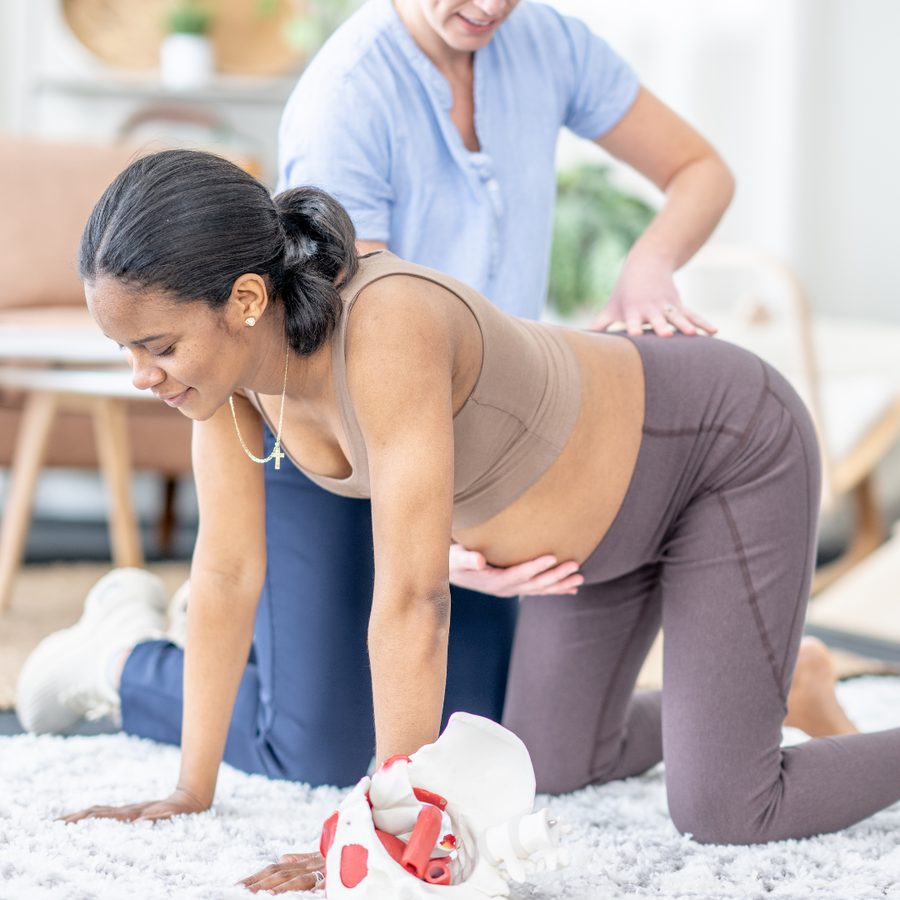
Supervised exercise begun in the first trimester is the pattern associated with reduced gestational diabetes and hypertensive disorders. [5] Resistance training is part of it, and is the part most poorly prescribed in the trials. [4]
What a course of treatment looks like
In pregnancy: assessment early rather than late, because the prevention finding depends on starting before problems appear. [1] Then a pelvic floor programme taught and checked rather than described, alongside general exercise — aerobic and resistance work, supervised where possible, from the first trimester. [4][5] Education about posture, lifting and pelvic girdle pain comes with it.
Around birth: preparation for labour positions, breathing, and what to expect of the pelvic floor immediately afterwards.
After birth: early gentle reactivation of the pelvic floor, then progressive loading over months. Abdominal training is included and progressed, with the reassurance that curl-ups have been tested and did not worsen the separation — the detail is under diastasis recti. Return to running and impact activity is graded rather than dated.
Where symptoms persist beyond the first months, the honest position is that the evidence for treatment in this population is weaker than the evidence for prevention. [1] That is not a reason to do nothing — the postpartum meta-analysis does show reduced incontinence and prolapse odds [3] — but it is a reason to expect assessment, individualisation and review rather than a standard sheet of exercises.
For a fuller account of pelvic floor assessment and treatment outside the perinatal period, see pelvic floor rehabilitation, where the evidence in mid-life women is stronger. For low back and pelvic girdle pain, see low back pain.
What the evidence supports — and what it does not
Supported
- Antenatal pelvic floor training in continent women to prevent incontinence. [1]
- Antenatal pelvic floor training to reduce severe perineal tearing. [2]
- Postpartum pelvic floor training for incontinence and prolapse. [3]
- Supervised exercise from the first trimester to reduce gestational diabetes and hypertensive disorders. [5]
- Resistance training as part of pregnancy exercise. [4]
Not supported
- Antenatal training to reduce episiotomy. Risk ratio 0.95 (0.85 to 1.07). [2]
- Antenatal training as treatment for women already incontinent. [1]
- A population-based postnatal training programme to reduce incontinence — not likely to. [1]
- Expecting the benefit to last seven years. No group difference at that point. [6]
- Any specific resistance training prescription. Dosage and progression were poorly reported throughout. [4]
How certain is this?
Evidence grade: Moderate.
The prevention evidence is the strongest thing here. One finding — a 29% reduction in mid-postnatal incontinence with antenatal training in continent women — is rated high quality by Cochrane, which is unusual in rehabilitation. [1] The corresponding late-pregnancy finding is moderate quality.
The same review is candid about what is not known. Trials were small to moderately sized, the programmes and control conditions varied considerably and were often poorly described, and many trials were at moderate to high risk of bias. Uncertainty surrounds the effects of training as a treatment in antenatal and postnatal women, which the authors contrast with the more established effectiveness in mid-life women. Data on faecal incontinence are few. [1]
Safety is worth recording: across 46 trials, two participants in a study of 43 pregnant women withdrew because of pelvic floor pain, and no other trial reported any adverse effects of training. [1]
Heterogeneity is high in places. The perineal tear meta-analysis had an I-squared of 48% for its positive finding and 75% for the null episiotomy finding, [2] and the postpartum incontinence estimate had 72%. [3] High heterogeneity means the pooled number summarises studies that disagreed with each other.
The pregnancy exercise findings are consistent and come from very large samples, but 90% of the resistance training studies were multicomponent programmes, which makes it impossible to isolate what the resistance component contributed. [4] Observational and non-randomised studies are included in that total.
The seven-year follow-up has a 35% response rate. [6] That is low enough that the null result should be treated as a caution rather than a conclusion — women who responded may differ systematically from those who did not.
What to expect
Expect prevention to be the better investment. If you are pregnant and not yet leaking, this is the moment with the strongest evidence behind it. [1]
Expect improvement after birth to take months rather than weeks, and expect the programme to be progressive. The postpartum trials ran across the first year. [3]
Expect exercise in pregnancy to be encouraged rather than restricted, and expect it to include strength work. [4][5]
Expect to need to maintain it. Antenatal training did not protect against incontinence seven years later, [6] which argues for continuing the habit rather than completing a course.
Expect the persistent problems to be treatable but less certainly so. If symptoms are not settling by six months, that is a reason for reassessment — possibly including referral onwards — rather than for repeating the same programme.
Common questions
When should I start pelvic floor exercises?
In pregnancy, and preferably before any leaking starts. That is where the evidence is strongest: continent pregnant women doing antenatal pelvic floor muscle training probably have a 62% lower risk of incontinence in late pregnancy and a 29% lower risk three to six months after birth, the latter on high-quality evidence. [1] If you are already leaking, still get assessed — but know that the evidence for training as a treatment in this population is weaker. [1]
Will pelvic floor training stop me tearing?
It appears to halve the risk of a severe tear. In a meta-analysis of 30 randomised trials and 6,691 women, pelvic floor muscle training during pregnancy reduced third- or fourth-degree perineal tear (risk ratio 0.50, 95% CI 0.31 to 0.80). It did not reduce episiotomy (0.95, 0.85 to 1.07). [2]
Is it safe to exercise during pregnancy?
Yes, in the absence of an obstetric contraindication, and the evidence favours doing so. Exercise interventions reduced the incidence of gestational diabetes and hypertensive disorders across most of 23 systematic reviews, particularly when supervised, of low to moderate intensity, and started in the first trimester. [5] Resistance training was associated with reduced odds of gestational hypertension, gestational diabetes, perinatal mood disorders and macrosomia. [4] On pelvic floor training specifically, across 46 trials the only adverse effect reported was pelvic floor pain causing two women to withdraw from one study. [1]
Can I lift weights while pregnant?
The evidence supports resistance training as part of a pregnancy exercise programme, with the honest caveat that nobody can tell you exactly how to prescribe it. Across 50 studies and 47,619 participants, resistance training was associated with reduced odds of several complications — but 90% of those studies were multicomponent programmes, the resistance dosage was generally low to moderate, and reporting of prescription, progression and loading guidance was poor. [4] Get it individualised, and cleared by your obstetric team.
I am still leaking six months after the birth. What now?
Get assessed properly rather than repeating a generic exercise sheet. Postpartum pelvic floor muscle training does reduce the odds of urinary incontinence by 37% on moderate-certainty evidence. [3] But the Cochrane review found no evidence of a difference in postnatal women with persistent incontinence at more than six to twelve months postpartum, and it explicitly contrasts this with the more established effectiveness of the same training in mid-life women. [1] That combination argues for individual assessment and, if needed, referral onwards.
If I do the exercises now, am I protected for life?
No, and it is better to know that. At seven years after childbirth there was no difference in urinary incontinence between women randomised to antenatal training and those who were not — 51% against 57%, p = 0.539 — though only 35% of those contacted responded. [6] The same study found that women who had incontinence during pregnancy had five times the odds of incontinence at seven years. [6] The practical implication is to keep the habit rather than complete a course.
What about the gap in my stomach muscles?
Abdominal muscle training after birth does reduce the inter-rectus distance more than no exercise, though the certainty of that evidence is low. [3] The more useful point is that the size of the gap predicts less than most people assume — the detail, including why curl-ups turn out not to be the danger they are made out to be, is on the diastasis recti page.
References
- Woodley SJ, Lawrenson P, Boyle R, et al. Pelvic floor muscle training for preventing and treating urinary and faecal incontinence in antenatal and postnatal women. Cochrane Database of Systematic Reviews. 2020 May 6;5(5):CD007471. doi:10.1002/14651858.CD007471.pub4 PMID 32378735 Cochrane systematic review
- Zhang D, Bo K, Montejo R, et al. Influence of pelvic floor muscle training alone or as part of a general physical activity program during pregnancy on urinary incontinence, episiotomy and third- or fourth-degree perineal tear: Systematic review and meta-analysis of randomized clinical trials. Acta Obstetricia et Gynecologica Scandinavica. 2024 Jun;103(6):1015–1027. doi:10.1111/aogs.14744 PMID 38140841 Systematic review and meta-analysis
- Beamish NF, Davenport MH, Ali MU, et al. Impact of postpartum exercise on pelvic floor disorders and diastasis recti abdominis: a systematic review and meta-analysis. British Journal of Sports Medicine. 2025 Mar 31;59(8):562–575. doi:10.1136/bjsports-2024-108619 PMID 39694630 Systematic review and meta-analysis
- Prevett C, Gingerich J, Sivak A, et al. Resistance training in pregnancy: systematic review and meta-analysis of pregnancy, delivery, fetal and pelvic floor outcomes and call to action. British Journal of Sports Medicine. 2025 Jul 31;59(16):1173–1182. doi:10.1136/bjsports-2024-109123 PMID 40610191 Systematic review and meta-analysis
- Martínez-Vizcaíno V, Sanabria-Martínez G, Fernández-Rodríguez R, et al. Exercise during pregnancy for preventing gestational diabetes mellitus and hypertensive disorders: An umbrella review of randomised controlled trials and an updated meta-analysis. BJOG: An International Journal of Obstetrics and Gynaecology. 2023 Feb;130(3):264–275. doi:10.1111/1471-0528.17304 PMID 36156844 Umbrella review and updated meta-analysis
- Stafne SN, Dalbye R, Kristiansen OM, et al. Antenatal pelvic floor muscle training and urinary incontinence: a randomized controlled 7-year follow-up study. International Urogynecology Journal. 2022 Jun;33(6):1557–1565. doi:10.1007/s00192-021-05028-x PMID 34936023 Randomised controlled trial, 7-year follow-up
About this guide
If you need assessment
This page explains. It does not diagnose.
A pelvic floor that cannot relax needs the opposite of a pelvic floor that cannot contract, and the two cannot be told apart from symptoms alone. Bleeding, severe pain, reduced fetal movements or signs of pre-eclampsia are matters for your obstetric team, urgently. Physiotherapist India publishes information and takes no bookings. Ask a qualified physiotherapist to examine your own case before acting on anything written here.