
Condition guide · Geriatric rehabilitation
Falls Prevention in Older Adults
Exercise reduces the rate of falls by 23%, on high-certainty evidence from 108 trials. That is an unusually firm finding — and it comes with a second finding that is just as firm and far less comfortable.
In plain words. Falling is not an inevitable part of ageing, and it is not simply bad luck. It is the end point of measurable things — leg strength, balance reactions, walking pattern, eyesight, medication, blood pressure, footwear, the house itself. Most of those can be changed.
This is one of the few areas in rehabilitation where the evidence reaches high certainty. Exercise prevents falls. What it does not do is prevent them after you stop.
Key points
- Exercise reduces the rate of falls by 23% (rate ratio 0.77, 95% CI 0.71 to 0.83) on high-certainty evidence from 59 studies. In practical terms, roughly 195 fewer falls per 1,000 people over a year. [1]
- It reduces the number of people who fall at all by 15% (risk ratio 0.85, 95% CI 0.81 to 0.89), also high certainty — about 72 fewer fallers per 1,000 people per year. [1]
- The benefit does not outlast the programme. In aged care settings exercise reduced falls while it was running (rate ratio 0.68) but had little or no effect afterwards (rate ratio 1.01, 95% CI 0.80 to 1.28) — and that null result is itself high-certainty evidence. [4]
- It works whether or not you are already considered high risk. Subgroup analysis found no difference in effect between trials that selected people at increased risk and those that did not. [1]
- Guidelines agree on exercise and disagree on the rest. The USPSTF recommends exercise (a B recommendation) but tells clinicians only to individualise multifactorial interventions, judging their net benefit small (a C recommendation). [3]
- Community-wide programmes are unproven. A 2024 Cochrane review of population-level interventions found nine studies, mostly non-randomised, and could not pool them. [5]
What is actually happening
Staying upright is an active process, not a passive one. It requires the body to detect that it is moving away from balance, decide what to do, and produce enough force in time to correct it. Three systems feed the detection — the inner ear, vision, and sensation from the feet and joints — and the muscles produce the correction.
Ageing degrades each of these gradually and independently. Leg muscles lose power faster than they lose bulk, and power is what a recovery step needs. Reaction time lengthens. Sensation in the feet dulls. Vision changes. Any one of these on its own is usually survivable; the risk rises sharply when several coincide, which is why falls tend to begin in a person's seventies rather than at a particular birthday.
Two further contributors are commonly missed. Medications — particularly sedatives, some blood pressure drugs and anything causing dizziness on standing — account for a substantial share of risk and can be reviewed. And fear itself: after a fall, people move less and more cautiously, which weakens the muscles and slows the reactions that would have caught them next time. The fear is rational and it is also part of the mechanism.
What it feels like
- Needing to use the arms to get out of a chair.
- Holding furniture or walls when moving around the house.
- Feeling unsteady turning around, or when carrying something in both hands.
- Slowing down, taking shorter steps, or avoiding uneven ground and stairs.
- Near-misses — catching yourself on something. These matter as much as actual falls and are almost never reported.
- Avoiding going out because of the possibility of falling.
A fall that produced no injury is still a fall, and is still the single strongest predictor of the next one. It is worth mentioning to a clinician even when nothing was hurt except pride.
How it is assessed
The World Guidelines recommend opportunistic case finding for falls risk in community-dwelling older adults, and a comprehensive multifactorial falls risk assessment for those found to be at high risk. [2] In practice that means being asked whether you have fallen in the past year, whether you feel unsteady, and whether you worry about falling — then testing rather than assuming.
A physiotherapy assessment typically covers how you rise from a chair, how you walk and turn, standing balance under progressively harder conditions, leg strength, and what you can currently manage at home. It also covers the things that are not about the legs at all: medications, blood pressure lying and standing, vision, footwear, and the hazards in the house.
How physiotherapy and rehabilitation help
Physiotherapy is the intervention with the strongest evidence in this field, and it is worth being precise about which part carries the effect. It is not advice, and it is not general activity. It is targeted, progressive training of balance and leg strength, delivered at enough difficulty and for long enough to change the systems involved.
The Cochrane review pooled 108 randomised trials with 23,407 participants across 25 countries and found exercise reduces both how often people fall and how many people fall, both at high certainty. [1] Very few rehabilitation questions have evidence of that grade. The USPSTF reached the same conclusion independently and recommends exercise interventions for community-dwelling adults 65 and over at increased risk of falling. [3]
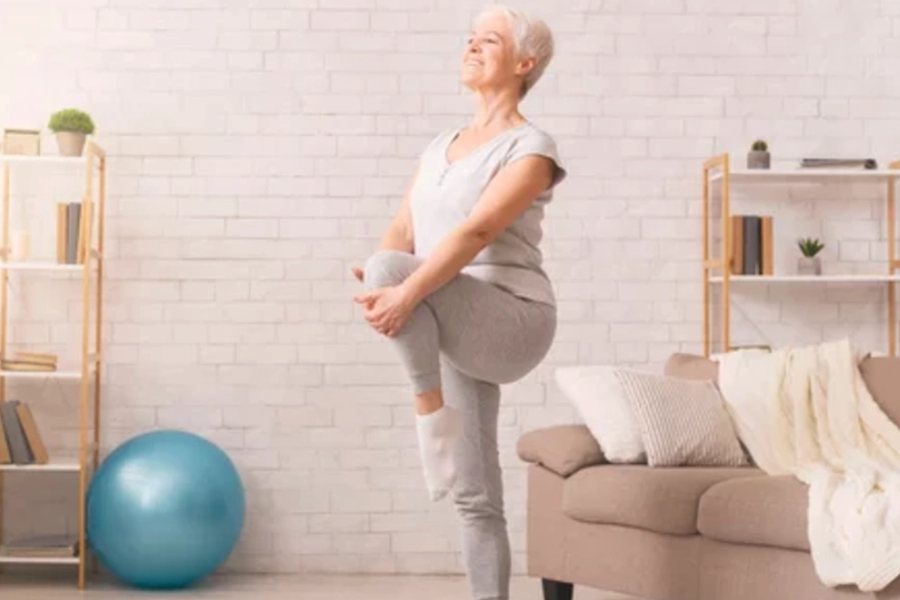
Balance training has to be genuinely challenging to work — which means reducing support, narrowing the base, and moving rather than standing still. Held at a comfortable level it becomes an activity rather than a treatment.
What a programme involves
| Component | What it is for | Evidence |
|---|---|---|
| Progressive balance training the core; it must keep getting harder as you improve |
Training the system that detects and corrects a loss of balance, at a difficulty high enough to force it to adapt. | Supported, high certainty Exercise reduces both the rate of falls and the number of people falling, from 108 trials and 23,407 participants [1] |
| Leg strengthening chair rises and step-based work |
Building the power needed to make a fast recovery step and to stand up without help. | Supported A component of the exercise programmes that produced the high-certainty reduction in falls [1]; recommended by the USPSTF for those at increased risk [3] |
| Gait and turning practice | Most falls happen during movement and changes of direction, not during quiet standing. | Not separately tested Included within the exercise packages reviewed, not isolated as its own comparison [1] |
| Multifactorial assessment medication review, vision check, home hazard assessment |
Finding and removing the contributing causes that exercise alone cannot reach. | Guidelines disagree Recommended for people at high risk by the World Guidelines [2]; the USPSTF judges the net benefit small and advises individualising rather than offering it routinely [3] |
| Walking aids | Support for a specific, identified problem with stability or endurance. | Not separately tested Useful when prescribed and fitted for a specific problem, and a hazard at the wrong height or as the wrong device |
| Community-wide falls programmes | Reducing falls at population level rather than person by person. | Unproven Nine studies, mostly non-randomised, not poolable, very low certainty [5] |
An amber badge means the sources cited on this page did not test that component separately, or that the guidelines genuinely disagree about it — not that it fails.
The finding that changes how you should plan this
A 2023 systematic review in aged care settings looked separately at what happened during a programme and after it ended. During the intervention, exercise probably reduced the number of falls (rate ratio 0.68, 95% CI 0.49 to 0.95). After the programme finished, it had little or no effect (rate ratio 1.01, 95% CI 0.80 to 1.28) — and the reviewers rate that second finding as high-certainty evidence. The pattern for risk of falling was the same. [4]
Read plainly: a twelve-week falls programme buys you twelve weeks. The gains are real while training continues and fade when it stops, because the underlying strength and balance decline resumes. That is not a criticism of the treatment; it is how training works in every other context too. But it means the question to ask is not "how long is the course?" — it is "what am I going to do afterwards, and who is going to keep me doing it?"
Anyone offering falls prevention as a course that finishes is describing something with a known expiry date.
What a course of treatment looks like
Assessment first: balance tested at a level that actually challenges it, leg strength, how you walk and turn, what you have already stopped doing, and any previous falls and their circumstances. Where risk is high, that extends to medication, vision and the home. [2]
Then progressive balance and strength training, at a difficulty that has to be raised as you improve. This is the part people most often get wrong: balance work held at a comfortable level stops being a treatment and becomes an activity. Reviews are for making it harder, not for repeating it.
And then — because of the finding above — a maintenance plan, decided at the start rather than at the end. A group, a class, a home programme with someone checking in, whatever will still be happening in a year. The evidence says the protection lasts as long as the training does. [4] Planning a course without planning what follows it is planning for the benefit to expire.
Where the guidelines differ, and why it matters
The World Guidelines recommend that all older adults be advised on falls prevention and physical activity, that risk be identified opportunistically, and that people at high risk receive a multifactorial assessment leading to personalised multidomain interventions. [2] The USPSTF agrees about exercise but is more reserved about the multifactorial package: it concluded the net benefit is small and advises individualising the decision rather than offering it routinely, weighing prior falls, other conditions, and the person's own preferences. [3]
Both are defensible readings of the same literature, and the disagreement is genuine rather than a matter of emphasis. Where they agree completely is on exercise, which is the part a physiotherapist delivers.
The World Guidelines were also written with an eye to settings where resources are limited, including low- and middle-income countries. [2] That matters here: the intervention with the best evidence is also the one that needs least equipment.
What the evidence supports — and what it does not
Supported
- Exercise to reduce falls — 23% fewer falls and 15% fewer people falling, both high-certainty. [1] Independently recommended by the USPSTF. [3]
- Offering it regardless of assessed risk level — no subgroup difference between trials that selected high-risk participants and those that did not. [1]
- Reduction in fall-related fractures (RR 0.73, 95% CI 0.56 to 0.95) and in falls requiring medical attention (RR 0.61, 95% CI 0.47 to 0.79) — though both on low-certainty evidence. [1]
- Assessment and personalised planning for people at high risk. [2]
Not supported
- Any expectation that benefit persists after the programme ends. High-certainty evidence of little or no lasting effect. [4]
- Improvement in quality of life. The pooled effect was smaller than the minimally important difference on both EQ-5D and SF-36. [1]
- Confidence about hospital admissions. The effect on falls requiring admission is unclear, on very low-certainty evidence from two trials. [1]
- Population-wide falls programmes. Nine studies, mostly non-randomised, not poolable, very low certainty. [5]
- Routine multifactorial packages for everyone. Small net benefit; the USPSTF advises individualising rather than offering routinely. [3]
How certain is this?
Evidence grade: High for the central claim, and it is worth explaining what that rests on.
The Cochrane review included 108 randomised trials and 23,407 participants in 25 countries, with a mean age of 76 and 77% women, and graded both primary outcomes as high certainty. [1] High certainty in GRADE means further research is very unlikely to change the estimate. On this site only pulmonary rehabilitation has a comparable footing.
The honest qualifications sit around the edges rather than at the centre. Most trials had unclear or high risk of bias on at least one item. [1] The secondary outcomes — fractures, medical attention, admissions — rest on far fewer studies and drop to low or very low certainty. And the population is skewed: three quarters of participants were women, and the trials come predominantly from high-income countries, so the effect size in an Indian community setting is an extrapolation rather than a measurement.
On harms, adverse events were reported to some degree in 27 trials but closely monitored in both groups in only one. Fourteen trials reported none at all. Aside from two serious events in a single trial, the rest were non-serious and mostly musculoskeletal. [1] That is reassuring but not the same as a properly measured safety profile.
What to expect
Balance and strength change over weeks, not days, and the first thing most people notice is not steadiness but confidence — going out again, using the stairs normally, not planning routes around handrails.
Falls will not stop entirely. A 23% reduction in the rate of falling is a large effect and still means most of the falls happen. The realistic goal is fewer falls and less injury from the ones that occur, not immunity.
The part worth planning for from the beginning is what happens after the supervised programme. On current evidence that is where the benefit is lost. [4] A plan that continues — a class, a group, a home routine someone checks on — is not an optional extra; it is the difference between a temporary gain and a lasting one.
Common questions
I have not fallen yet. Is this still relevant to me?
Yes. The Cochrane subgroup analysis found no difference in effect between trials that recruited people already at increased risk and those that did not, [1] and the World Guidelines recommend that all older adults be advised on falls prevention and physical activity. [2] Unsteadiness, holding furniture, or struggling to rise from a chair are reasons to act now rather than after a fall.
Is walking enough?
Walking is good for many things but it is not, on its own, balance training. The effect in the trials comes from exercise that specifically challenges balance and builds leg strength, progressed as it becomes easier. Brisk walking on flat ground does not challenge the balance system in the way that produces the reduction in falls.
How long do I need to keep doing it?
Indefinitely, on the honest reading of the evidence. Exercise reduced falls during the programme but had little or no effect once it ended, on high-certainty evidence. [4] The format can change — supervised sessions to a group or a home routine — but stopping altogether returns you to where you started.
Should I be doing a full multifactorial assessment?
It depends on your risk. The World Guidelines recommend comprehensive multifactorial assessment for those found to be at high risk. [2] The USPSTF is more cautious about multifactorial interventions generally, rating their net benefit small and advising that the decision be individualised. [3] What both support without reservation is the exercise component.
I feel dizzy as well as unsteady. Is that the same problem?
Not necessarily, and the distinction matters because one of the causes is quickly treatable. A spinning sensation triggered by rolling over in bed or looking up is likely to be BPPV, which is often resolved in one or two appointments. Persistent unsteadiness after an inner-ear illness is covered under vestibular neuritis.
Will exercise stop me breaking a hip?
It may reduce fractures — the pooled estimate was a 27% reduction (RR 0.73, 95% CI 0.56 to 0.95) — but that comes from ten trials at low-certainty evidence, unlike the falls findings themselves. [1] Bone health is managed medically and is a separate question from falls risk; both matter and they are not the same conversation.
References
- Sherrington C, Fairhall NJ, Wallbank GK, et al. Exercise for preventing falls in older people living in the community. Cochrane Database of Systematic Reviews. 2019 Jan 31;1(1):CD012424. doi:10.1002/14651858.CD012424.pub2 PMID 30703272 Systematic review and meta-analysis
- Montero-Odasso M, van der Velde N, Martin FC, et al. World guidelines for falls prevention and management for older adults: a global initiative. Age and Ageing. 2022 Sep 2;51(9):. doi:10.1093/ageing/afac205 PMID 36178003 Clinical practice guideline
- Nicholson WK, Silverstein M, Wong JB, et al. Interventions to Prevent Falls in Community-Dwelling Older Adults: US Preventive Services Task Force Recommendation Statement. JAMA. 2024 Jul 2;332(1):51–57. doi:10.1001/jama.2024.8481 PMID 38833246 US Preventive Services Task Force recommendation
- Dyer SM, Suen J, Kwok WS, et al. Exercise for falls prevention in aged care: systematic review and trial endpoint meta-analyses. Age and Ageing. 2023 Dec 1;52(12):. doi:10.1093/ageing/afad217 PMID 38109410 Systematic review and meta-analysis
- Lewis SR, McGarrigle L, Pritchard MW, et al. Population-based interventions for preventing falls and fall-related injuries in older people. Cochrane Database of Systematic Reviews. 2024 Jan 5;1(1):CD013789. doi:10.1002/14651858.CD013789.pub2 PMID 38180112 Systematic review
About this guide
If you need assessment
This page explains. It does not diagnose.
Falls risk is assessed rather than guessed at, and the assessment covers more than the legs — medications, blood pressure on standing, vision, footwear and the home all contribute. Physiotherapist India publishes information and takes no bookings. Ask a qualified physiotherapist to examine your own case before acting on anything written here.