
Condition guide · Elbow
Tennis Elbow
Pain on the outside of the elbow, usually from gripping rather than tennis. The evidence here is unusual: the treatment that works fastest is the one that leaves you worse off a year later.
In plain words. The muscles that straighten your wrist and fingers all originate from a small bony bump on the outside of the elbow. Grip hard, repeatedly, and the tendon where they attach can become painful and lose its tolerance for load. Most people who get it have never held a racket.
The word "tennis elbow" is misleading in a second way too. It sounds inflammatory — and the usual response to inflammation is a steroid injection. Two randomised trials have now tested that, and both found the same uncomfortable answer.
Key points
- Corticosteroid injection works quickly and then backfires. At one year, 83% of the injected group had recovered or much improved, versus 96% of those given a placebo injection. [2]
- Recurrence after injection was 54%, against 12% after placebo. [2]
- The earlier trial found the same shape: steroid was better at six weeks, but 47 of 65 successes subsequently regressed, and long-term outcomes were significantly worse than physiotherapy. [1]
- Physiotherapy helps early, then time catches up. It beat wait-and-see in the first six weeks, but by 52 weeks there was no difference — most people in both groups had recovered. [1]
- In the placebo-injection group, adding physiotherapy raised recovery at four weeks from 10% to 39%. [2] Early on, it matters.
- Most tennis elbow gets better either way. The decision is about how you spend the intervening months — and about avoiding a treatment that makes the year worse.
What is actually happening
The common extensor origin is a small, densely loaded attachment point on the lateral epicondyle of the humerus. Gripping loads it, because to grip you must simultaneously stabilise the wrist with the very muscles that attach there — which is why the pain shows up when you lift a kettle, turn a key or shake hands, and not when the arm is at rest.
Why gripping hurts the outside of the elbow
Despite the "-itis" in the older name, the tissue changes are degenerative rather than classically inflammatory — which is part of why an anti-inflammatory injection turns out to be a poor long-term answer. What the tendon has lost is capacity, and capacity is rebuilt by loading it, not by quietening it.
What it feels like
- Pain on the bony outer point of the elbow, sometimes spreading down the top of the forearm.
- Provoked by gripping: kettles, jars, door handles, tools, a heavy shopping bag, a handshake.
- Tender to press on one small spot, which is often startlingly precise.
- Worse after a bout of unaccustomed work — painting, gardening, DIY, a new job, a new racket.
- Grip strength that fades, so things get dropped.
- Usually a gradual onset over weeks, not a sudden injury.
How it is diagnosed
Clinically. Tenderness over the lateral epicondyle, pain reproduced by resisted wrist or finger extension, and pain on gripping together make the diagnosis. Both trials cited here used a clinical diagnosis with symptoms of at least six weeks' duration, and no imaging requirement. [1][2]
Scans are reserved for atypical presentations. The main alternatives to consider are pain referred from the neck, irritation of the radial nerve as it passes through the forearm, and problems within the elbow joint itself — all distinguished by examination.
How physiotherapy and rehabilitation help
The tendon has lost capacity: it can no longer tolerate the gripping load being asked of it. Rehabilitation is aimed squarely at that. It does not repair the tendon in the sense of patching a hole — it rebuilds the tissue's tolerance by loading it deliberately, in doses it can handle, increasing over weeks. Everything else in a programme exists to make that loading possible.
The physiotherapy arm of the earlier trial was eight sessions of elbow manipulation plus exercise, and it outperformed wait-and-see over the first six weeks and corticosteroid injection thereafter. [1] That is the treatment this page is describing.
What a programme involves
| Component | What it is for | Evidence |
|---|---|---|
| Graded loading of the wrist extensors | Rebuilding the tendon's tolerance to grip. Progressed over weeks by increasing load, not repetitions alone. The core of treatment. | Supported Part of the protocol that beat wait-and-see early and injection long-term [1] |
| Mobilisation with movement a manual technique at the elbow |
Reducing pain during gripping so that loading can begin sooner and be tolerated. | Supported Tested as part of the same protocol [1] |
| Grip and load modification | Temporarily reducing what provokes it — wider grips, lighter tools, sharing loads, breaking up long spells of gripping — while capacity is rebuilt. | Not separately tested Standard practice; not isolated in these trials |
| Education about the condition and its course | Knowing that most people recover, and that flare-ups after a heavy day are not damage, changes how the months are managed. | Not separately tested Base rates are well established [1][2] |
| Counterforce brace or strap | Making gripping tasks more comfortable during the day. | Not tested here Neither cited trial evaluated it |
| Corticosteroid injection | Short-term pain relief. Effective for about six weeks. | Not supported Lower recovery and higher recurrence at one year [1][2] |
| Ultrasound, laser, shockwave and other electrotherapy | Commonly offered for tendon pain. | Not tested here Neither cited trial included them, so this page makes no claim either way |
"Not tested here" means exactly that — the two trials on which this page rests did not evaluate it, so we are not going to tell you it works or that it does not. "Not supported" means it was tested and performed worse.
What a course of treatment looks like
An assessment first: confirming the diagnosis, establishing which loads provoke it, measuring grip strength, and ruling out the neck and the radial nerve as sources. That baseline matters, because grip strength is one of the few objective measures of progress in this condition — it was one of the outcome measures in the earlier trial. [1]
Then a programme built around exercise you do at home most days, with periodic appointments to progress the load and adjust technique rather than to receive passive treatment. Eight sessions was the tested dose. [1] Expect the working timeframe to be months, and expect to be discharged with the programme continuing, not stopped.
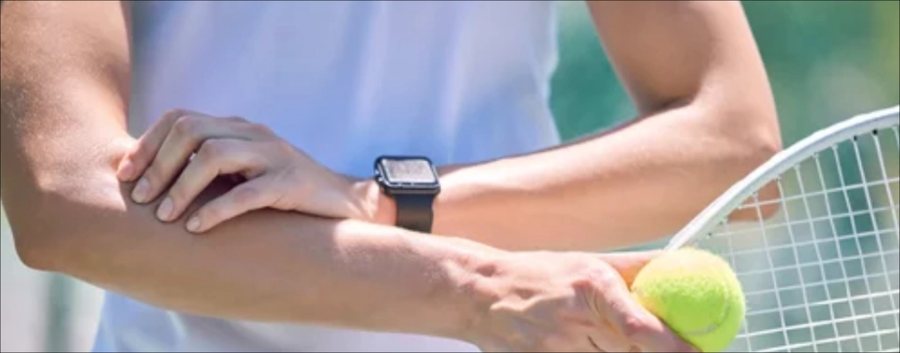
The tendon on the outside of the elbow, where the wrist extensors attach. Load is what irritates it and, in a graded dose, load is also what settles it.
What the evidence supports — and what it does not
Corticosteroid injection versus placebo injection, at one year
Supported
- Physiotherapy in the early weeks — superior to wait-and-see in the first six weeks [1], and in the placebo-injection group it raised recovery at four weeks from 10% to 39% (RR 4.00, 99% CI 1.07 to 15.00). [2]
- Waiting, if you are prepared to — by 52 weeks most participants in the wait-and-see group reported a successful outcome, no different from physiotherapy. [1]
- Physiotherapy as an alternative to injection — it produced significantly better long-term outcomes than corticosteroid, and those who had it sought less additional treatment such as anti-inflammatories. [1]
Not supported
- Corticosteroid injection — lower recovery at one year than a placebo injection (83% vs 96%) and far higher recurrence (54% vs 12%). [2] The earlier trial reached the same conclusion, warning the treatment "should be used with caution". [1]
- Injection plus physiotherapy as a combination — adding physiotherapy did not rescue the injection's one-year outcome; overall, physiotherapy and no physiotherapy did not differ at one year (91% vs 88%, RR 1.04, 99% CI 0.90 to 1.19). [2]
- Physiotherapy as a long-run advantage over doing nothing — at 52 weeks there was no difference. Its value is in the early months, not the destination. [1]
- Treating it as an inflammatory problem — the anti-inflammatory injection is precisely the intervention that performed worst over a year. [1][2]
What the most recent evidence adds — including a real disagreement
Three recent syntheses cover this condition, and they do not agree with each other. Rather than pick the one that suits a physiotherapy website, here is the disagreement as it stands.
The two meta-analyses both find against injections. A meta-analysis of 58 randomised trials found electrophysiotherapy improved pain (mean difference -10.0, 95% CI -13.8 to -6.1) and physical therapy improved pain (-6.0, -9.7 to -2.3) compared with placebo, while injections did not improve any outcome measure. Patients receiving electrophysiotherapy and injections reported more adverse effects than those receiving physical therapy. [3] A second meta-analysis went further: across seven studies the control group had statistically superior pain (mean difference 0.70, 95% CI 0.22 to 1.18) and function (SMD -0.35, -0.54 to -0.16) than the corticosteroid injection group — that is, injection did worse than doing nothing. It also found no significant difference between strengthening physiotherapy and no active treatment. [4]
An umbrella review reaches the opposite conclusion on injections. A 2023 umbrella review of 40 meta-analyses reports that injection therapies, especially autologous blood and platelet-rich plasma, are effective, while finding acupuncture and shockwave therapy ineffective and supporting conventional physical therapy. [5]
How to hold that. The two disagreeing conclusions are not about the same injections — the meta-analyses that find harm are largely about corticosteroid, while the umbrella review's positive finding is about autologous blood and PRP. On corticosteroid specifically the evidence is reasonably consistent and unflattering: short-term relief, worse outcomes later. On PRP the picture is genuinely unsettled, and it is expensive. All three agree on one thing worth acting on — shockwave therapy does not earn its place, and neither does acupuncture. [3][5]
Tennis elbow can be mimicked by referred pain from the neck, so if your symptoms extend past the elbow or come with pins and needles, read neck pain as well.
How certain is this?
Evidence grade: Moderate to high. The corticosteroid finding is unusually secure: two independent randomised trials, run by overlapping groups in Brisbane, reached the same conclusion by different designs, and the later one was injection-blinded and placebo-controlled with a pre-specified one-year endpoint. [1][2] A placebo-controlled injection trial is exactly the design needed to answer this question.
The limits are real. Both trials come from one research environment, which is a reason for some caution about generalising. They enrolled people with symptoms of more than six weeks, so they say nothing about the first fortnight. And the physiotherapy tested was a specific protocol — elbow manipulation with exercise, eight sessions [1] — so "physiotherapy did not differ at one year" is a statement about that protocol, not proof that no programme could do better.
What we cannot tell you is which individuals will be among the minority whose symptoms persist beyond a year.
What to expect
Most people recover. In the wait-and-see arm of the earlier trial, most participants reported a successful outcome by 52 weeks without any active treatment at all [1], and in the later trial 96% of the placebo-injection group had recovered or much improved at a year. [2] That is a genuinely reassuring base rate.
It is also a slow one. Expect months rather than weeks, expect grip-heavy days to provoke it, and expect progress to be uneven. The realistic aim of treatment is to make those months more bearable and more functional, and to avoid the one intervention shown to make the year worse.
When elbow pain needs assessment rather than self-management
Seek medical attention if you have:
- Elbow pain after a fall or direct blow, particularly with swelling, deformity or inability to straighten the arm.
- A hot, red, swollen elbow, or fever and feeling unwell.
- Numbness, pins and needles or weakness in the hand — this suggests nerve involvement rather than tendon pain.
- Pain that is worse at night and unrelated to using the arm.
- Locking, catching, or the elbow giving way.
- Neck or shoulder symptoms alongside the elbow pain.
- No improvement at all after several months of appropriate treatment.
This list is not exhaustive. If you are worried about a symptom, seek professional advice.
Common questions
Should I have a steroid injection?
The evidence argues against it for this condition. At one year, 83% of people given a corticosteroid injection had recovered or much improved against 96% given a placebo injection, and recurrence was 54% versus 12%. [2] The earlier trial found the same pattern and recommended caution. [1] It will very likely make the next few weeks better — that part is real — and the trade-off is a worse year.
If it gets better anyway, why have physiotherapy?
For the months in between. Physiotherapy beat wait-and-see over the first six weeks [1], and in the placebo group it lifted four-week recovery from 10% to 39%. [2] By a year the groups converge, so it is honest to say the benefit is in getting there more comfortably rather than in a better final outcome.
Do I have to stop using my arm?
No, and complete rest tends to be counterproductive — the tendon has lost load tolerance, and tolerance is rebuilt by loading. What helps is reducing the provoking load temporarily while progressively rebuilding capacity, which is what a programme is for.
Is a tennis elbow strap worth it?
Neither trial cited here tested one, so we cannot make an evidence claim either way. In practice many people find a strap makes gripping tasks more comfortable. Treat it as a way of managing the day rather than something that changes the course of the condition.
I don't play tennis. Why do I have this?
Most people who get it do not. The load that matters is gripping, so trades, DIY, gardening, lifting at work and desk work with a firm mouse grip are all commoner causes than racket sports.
References
- Bisset L, Beller E, Jull G, et al. Mobilisation with movement and exercise, corticosteroid injection, or wait and see for tennis elbow: randomised trial. BMJ. 2006 Nov 4;333(7575):939. doi:10.1136/bmj.38961.584653.AE PMID 17012266 Randomised controlled trial
- Coombes BK, Bisset L, Brooks P, et al. Effect of corticosteroid injection, physiotherapy, or both on clinical outcomes in patients with unilateral lateral epicondylalgia: a randomized controlled trial. JAMA. 2013 Feb 6;309(5):461–469. doi:10.1001/jama.2013.129 PMID 23385272 Placebo-controlled randomised trial
- Kim YJ, Wood SM, Yoon AP, et al. Efficacy of Nonoperative Treatments for Lateral Epicondylitis: A Systematic Review and Meta-Analysis. Plastic and Reconstructive Surgery. 2021 Jan 1;147(1):112–125. doi:10.1097/PRS.0000000000007440 PMID 33002980 Systematic review and meta-analysis
- Lapner P, Alfonso A, Hebert-Davies J, et al. Nonoperative treatment of lateral epicondylitis: a systematic review and meta-analysis. JSES International. 2022 Mar;6(2):321–330. doi:10.1016/j.jseint.2021.11.010 PMID 35252934 Systematic review and meta-analysis
- Bonczar M, Ostrowski P, Plutecki D, et al. Treatment Options for Tennis Elbow - An Umbrella Review. Folia Medica Cracoviensia. 2023 Oct 30;63(3):31–58. doi:10.24425/fmc.2023.147213 PMID 38310528 Umbrella review
About this guide
If you need assessment
This page explains. It does not diagnose.
Pain on the outside of the elbow can come from the tendon, from a nerve in the forearm, or from the neck, and the three are managed differently. Which loads to reduce and which to build is also an individual judgement. Physiotherapist India publishes information and takes no bookings. Ask a qualified physiotherapist to examine your own case before acting on anything written here.