Condition guide · Spine
Neck Pain
Common, usually mechanical, and rarely a sign of anything serious. What the evidence supports — and why the disc bulge on your report is present in most people who feel nothing at all.
In plain words. Your neck carries the weight of your head on seven small vertebrae, moved and stabilised by a lot of muscle. It is mobile by design, and that mobility comes at the cost of being easy to irritate — by a sustained posture, an awkward night, an unaccustomed load, or a period of stress.
Most neck pain is mechanical: it varies with position and movement, and it settles. The treatment with the best evidence behind it is not a machine, a collar or a manipulation. It is exercise for the neck, shoulder blade and upper limb. [2]
Key points
- Disc bulging is normal. On MRI of 1,211 people with no neck symptoms, 87.6% had disc bulging — including about three quarters of those in their twenties. [1]
- Genuine cord compression is rare in people without symptoms: 5.3%, and increased cord signal 2.3%. The scan can distinguish the ordinary from the important — but only alongside the examination. [1]
- Exercise is the best-supported treatment for chronic neck pain, particularly strengthening that includes the shoulder blade and arm, not just the neck. [2]
- For acute neck pain, the Cochrane review found no evidence on exercise at all — an absence of evidence, not evidence of absence. [2]
- Manipulation is not clearly better than mobilisation. Across 446 participants in moderate-to-high quality trials the two produced similar changes in pain, function and satisfaction. [3]
- A single manipulation relieved pain immediately but not at short-term follow-up — the benefit did not persist. [3]
What is actually happening
The cervical spine is seven vertebrae, cushioned by discs and guided by small paired facet joints, with nerve roots exiting at each level to supply the arm. Layered around them are muscles running from the skull to the shoulder blade and ribs. Almost all of these structures are capable of producing pain, and in everyday neck pain it is usually not possible — or necessary — to say which one is responsible.
The muscles that move and hold up the neck
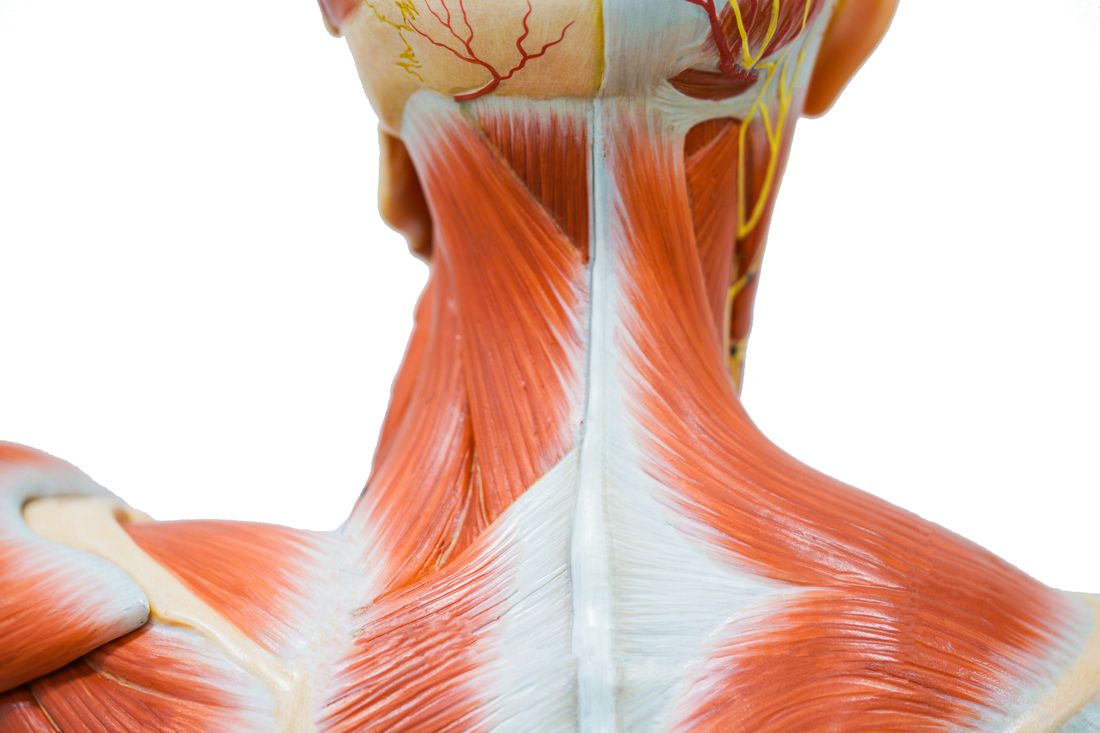
Neck pain is usually a problem of this system rather than of a single damaged part. That is why the exercise with the best evidence works the neck, shoulder blade and arm together rather than the sore spot alone. [2]
Neck pain that travels down the arm in a defined band, with numbness or weakness, is different: that suggests a nerve root is involved. So does clumsiness of the hands or a change in walking — which points to the spinal cord and needs prompt assessment.
What it feels like
- Ache or tightness across the back of the neck and into the top of the shoulder, often one side more than the other.
- Stiffness, and difficulty turning the head fully — commonly noticed when reversing a car.
- Worse after sustained positions, at the end of the working day, or after a poor night's sleep.
- Headache starting at the base of the skull. Where that is the dominant symptom, see our guide to cervicogenic headache.
- Sometimes pain, pins and needles or weakness travelling into the arm — which changes the assessment.
How it is diagnosed
By examination. The clinician establishes how the neck moves, what reproduces and eases the symptom, whether the arm is involved, and whether anything suggests a cause needing investigation. That last question is the one that determines whether imaging is warranted.
What an MRI of a normal neck looks like
In a cross-sectional study, 1,211 healthy volunteers aged 20 to 70 — all without symptoms — had cervical MRI scans. The great majority had findings that sound alarming on a report. [1]
Cervical MRI findings in 1,211 people with no neck symptoms
That contrast is the useful part. A report describing disc bulging is describing something that most people your age have and cannot feel. A report describing cord compression or cord signal change is describing something uncommon that needs to be interpreted properly — and in that study, cord compression became more frequent after age 50 and mainly affected the C5–C6 and C6–C7 levels. [1]
How physiotherapy and rehabilitation help
For neck pain without a structural cause, the useful summary of the whole evidence base is one word: activation. A 2025 clinical practice guideline puts it directly — activating therapeutic measures focused on self-management have shown high effect sizes, up to d greater than 1.0, and activation is recommended as the central element of treatment. [4]
That guideline also puts a number on something usually treated as a courtesy rather than a treatment: the success of those measures may depend on patient education, which itself carries a moderate effect size (d = 0.73). [4] Being told what is wrong, what it means and what to do about it is part of the treatment, not the preamble to it.
Two further points from the same guideline. In acute neck pain of 0 to 3 weeks with no evidence of a structural cause, imaging should generally not be performed. For chronic neck pain beyond 12 weeks, exercise therapy is recommended. Painkillers may give short-term relief, with a low effect size. [4]
What is actually offered, and what it is worth
- Explanation and reassurance — on the guideline's own numbers, one of the higher-value components. [4]
- Exercise therapy — recommended for chronic neck pain, and the component with the best claim on your time. [4]
- Manual therapy added to exercise — useful for function, weaker for pain. A 2025 Cochrane review found that against placebo it may produce a moderate increase in function (10.20 points on a 0 to 100 scale, 95% CI 16.84 to 3.56 better) but little or no difference in pain (0.91 points on a 0 to 10 scale, 95% CI 1.85 better to 0.04 worse). Against no treatment, both pain and function improved. [5]
- Imaging in the first three weeks — not recommended without signs of a structural cause. [4] A scan that finds age-related change you were always going to have can make things worse rather than better.
On safety, the Cochrane review reported only non-serious adverse events — a 2% absolute increase in things like transient soreness, headache or dizziness. Data on serious adverse events were not available, which is a gap rather than a reassurance. All of its data reflect short-term follow-up at around four weeks. [5]
If the pain is felt mainly in the head rather than the neck, see cervicogenic headache. If it travels down the arm with pins and needles into the hand, the source may still be the neck — compare carpal tunnel syndrome.
Where pain travels down the arm with numbness, tingling or weakness, the problem is likely a compressed nerve root rather than mechanical neck pain — see cervical radiculopathy, where the treatment and the surgical evidence are different.
What treatment involves
For persistent mechanical neck pain, the core of treatment is graded exercise. The Cochrane review of 27 trials found that the exercise which helped was not isolated neck movement but strengthening across the neck, shoulder blade and upper limb, and combined strengthening with stretching. [2] In practice that means a programme you progress over weeks, alongside advice about how to vary positions and manage load through the working day.
Manual therapy — mobilisation or manipulation — is commonly used alongside exercise to make movement more comfortable. What the evidence does not support is using it as the treatment in itself, or expecting a single session to hold. [3]
What the evidence supports — and what it does not
Supported
- Neck, shoulder-blade and upper-limb strength training for chronic neck pain — moderate-quality evidence of a moderate to large effect on pain immediately after treatment (pooled SMD −0.71, 95% CI −1.33 to −0.10) and at short-term follow-up. [2]
- Combined strengthening and stretching of the neck, shoulder and shoulder blade — benefit on pain sustained to long-term follow-up (SMD −0.33, 95% CI −0.55 to −0.10) and a medium effect on function (SMD −0.45, 95% CI −0.72 to −0.18). [2]
- Thoracic manipulation for acute and subacute neck pain — improved pain at short-term follow-up across five trials (346 participants, moderate quality, pooled SMD −1.26, 95% CI −1.86 to −0.66). [3]
Not supported
- Reading disc bulging as the cause — 87.6% of people with no neck symptoms have it. [1]
- A single cervical manipulation as treatment — it relieved pain immediately but not at short-term follow-up, on very low to low quality evidence. [3]
- Manipulation as superior to mobilisation — across 446 participants in moderate-to-high quality trials, multiple sessions of each produced similar changes in pain, function, quality of life and satisfaction. [3]
- Exercise for acute neck pain — not because it fails, but because the review found no trials. Anyone claiming certainty here is going beyond the evidence. [2]
How certain is this?
Evidence grade: Moderate. The exercise findings rest on 27 trials with 2,485 analysed participants and were graded moderate quality, but the confidence interval on the headline strength-training result (−1.33 to −0.10) is wide — the true effect could be large or barely perceptible. [2]
The manual therapy evidence is weaker and more mixed: the manipulation-versus-inactive-control comparison rested on three small trials of very low to low quality, and the review's stronger findings are for thoracic rather than cervical manipulation. [3] The MRI study is cross-sectional and Japanese, so the exact percentages may not transfer precisely to other populations — but the central point, that these findings are common in people without symptoms, is not in doubt. [1]
What to expect
Most episodes of mechanical neck pain settle over days to weeks. Recurrence is common, and does not mean the neck is wearing out. Where pain has become persistent, the exercise trials measured benefit over weeks to months of consistent training rather than after a handful of sessions.
Arm symptoms from an irritated nerve root usually improve too, though more slowly than neck pain alone, and residual numbness can outlast the pain without meaning treatment has failed.
When neck pain needs urgent assessment
Seek immediate medical attention if you have:
- Neck pain after a significant accident, fall or blow to the head.
- Clumsiness of the hands, dropping things, difficulty with buttons, or a change in walking or balance — these can indicate pressure on the spinal cord.
- Progressive weakness or numbness in an arm or leg.
- Loss of bladder or bowel control.
- Severe neck stiffness with fever, headache or a rash.
- Sudden severe neck pain with dizziness, visual disturbance, slurred speech or facial weakness.
- Neck pain with unexplained weight loss, night pain, or a history of cancer.
This list is not exhaustive. If you are worried about a symptom, seek professional advice.
Common questions
My MRI shows a bulging disc in my neck. Is that the cause?
Probably not on its own. In 1,211 people with no neck symptoms at all, 87.6% had disc bulging, including roughly three quarters of those in their twenties. [1] The finding is so common that its presence tells you very little. What matters is whether the examination findings match the level and pattern the scan shows.
Is my posture causing this?
Sustained positions can certainly provoke symptoms, and varying them helps. But be cautious of anyone who tells you a particular posture has damaged your neck — the exercise trials that worked improved strength and endurance rather than correcting a shape. [2] The useful framing is load and tolerance, not right and wrong posture.
Should I have my neck manipulated?
It can help make movement more comfortable, but it is not clearly better than gentler mobilisation, and a single manipulation's effect did not persist past the immediate follow-up. [3] It is reasonable as an adjunct to exercise, not as the treatment. Discuss it with your clinician, particularly if you have any of the red flags above.
Should I wear a collar?
Neither Cochrane review cited here supports immobilising the neck as treatment, and the interventions with evidence behind them all involve active movement and loading. [2][3] If a collar has been prescribed for a specific reason after injury, follow that advice.
What exercises actually help?
The ones that worked in the trials involved the neck, shoulder blade and upper limb together — strength training, and strengthening combined with stretching — rather than isolated neck movements. [2] The specific programme should be matched to your findings and progressed over weeks, which is what an assessment is for.
References
- Nakashima H, Yukawa Y, Suda K, et al. Abnormal findings on magnetic resonance images of the cervical spines in 1211 asymptomatic subjects. Spine. 2015 Mar 15;40(6):392–398. doi:10.1097/BRS.0000000000000775 PMID 25584950 Cross-sectional study
- Gross A, Kay TM, Paquin JP, et al. Exercises for mechanical neck disorders. Cochrane Database of Systematic Reviews. 2015 Jan 28;1(1):CD004250. doi:10.1002/14651858.CD004250.pub5 PMID 25629215 Systematic review
- Gross A, Langevin P, Burnie SJ, et al. Manipulation and mobilisation for neck pain contrasted against an inactive control or another active treatment. Cochrane Database of Systematic Reviews. 2015 Sep 23;2015(9):CD004249. doi:10.1002/14651858.CD004249.pub4 PMID 26397370 Systematic review
- El-Allawy A, Hecht N, Luedtke K, et al. Clinical Practice Guideline: Nonspecific Neck Pain. Deutsches Ärzteblatt International. 2025 Oct 3;122(20):552–557. doi:10.3238/arztebl.m2025.0119 PMID 40665902 Clinical practice guideline
- Chacko N, Gross AR, Miller J, et al. Manual therapy with exercise for neck pain. Cochrane Database of Systematic Reviews. 2025 Dec 9;12(12):CD011225. doi:10.1002/14651858.CD011225.pub2 PMID 41363159 Systematic review and meta-analysis
About this guide
If you need assessment
This page explains. It does not diagnose.
Separating ordinary mechanical neck pain from nerve root involvement or the small number of causes that need investigation is done by examination. So is working out which exercise programme fits your findings. Physiotherapist India publishes information and takes no bookings. Ask a qualified physiotherapist to examine your own case before acting on anything written here.