
Condition guide · Wrist and hand
Carpal Tunnel Syndrome
Numbness and tingling in the hand from a compressed nerve at the wrist. The evidence about what to do — splint, injection or surgery — is less settled than most people are told.
In plain words. The carpal tunnel is a narrow passage at the front of your wrist, floored by the small wrist bones and roofed by a tough band of ligament. Nine tendons and one nerve — the median nerve — pass through it. There is very little spare room. If pressure inside rises, the nerve is the structure that suffers, and it complains by producing numbness, tingling and pain in the thumb, index, middle and half the ring finger.
Why it wakes you at night is the giveaway: we tend to sleep with the wrist curled, which raises the pressure inside the tunnel further. Shaking the hand out to relieve it is so characteristic that it has a name — the flick sign.
Key points
- The problem is pressure on the median nerve inside a tunnel that cannot expand — which is why wrist position matters so much.
- Surgery produced clinical improvement about twice as often as splinting in the long term (RR 2.10, 95% CI 1.04 to 4.24). [1]
- But the size of that difference is small. On the symptom scale, surgery was 0.26 points better than splinting against a threshold of 1 point for a difference patients notice. [1]
- Injection versus surgery cannot be called. The 2024 review rated the evidence very low-certainty with severe inconsistency, and found no clear advantage either way. [2]
- Everyone improved. In every study in the injection review, both groups improved from before to after treatment. [2]
- 84% of participants across the surgical trials were women, and symptom duration ranged from 31 weeks to 3.5 years — so this evidence is about established, not brand-new, symptoms. [1]
What is actually happening
The median nerve supplies sensation to the thumb, index and middle fingers and half the ring finger, and powers some of the small muscles at the base of the thumb. It has no room to move aside. When the pressure inside the tunnel rises — through swelling of the tendon linings, fluid retention, sustained wrist positions, or simply an anatomically tight tunnel — the nerve's blood supply and its ability to conduct signals are both affected.
A cross-section of the carpal tunnel, and where the pressure falls
That anatomy explains the two main treatment strategies. A splint holds the wrist near neutral so the pressure stays as low as possible. Surgery cuts the ligament that forms the roof, permanently enlarging the tunnel. An injection aims to reduce swelling of the tissues inside it.
What it feels like
- Numbness, tingling or burning in the thumb, index and middle fingers and the thumb side of the ring finger. The little finger is usually spared — it is supplied by a different nerve.
- Waking at night, often in the early hours, needing to shake or hang the hand out of bed.
- Symptoms provoked by sustained grip or a bent wrist — riding a motorcycle, holding a phone, driving, reading a book.
- Clumsiness: dropping things, difficulty with buttons, coins or a key.
- In longstanding cases, visible wasting of the fleshy pad at the base of the thumb and weakness of thumb movement.
- Sometimes aching that travels up the forearm, which can be confusing.
How it is diagnosed
Clinically, from the pattern of symptoms and an examination that tests sensation in the median nerve's territory, the strength of the thumb muscles, and whether the symptoms can be provoked. Nerve conduction studies measure how well the nerve is conducting across the wrist and are used to confirm the diagnosis and gauge severity, particularly when surgery is being considered.
The important distinctions to make are pain referred from the neck, a nerve compressed higher up the arm, and generalised nerve problems such as those seen in diabetes — all of which can produce hand numbness but are managed differently.
How physiotherapy and rehabilitation help
Non-surgical treatment is aimed at lowering the pressure inside the tunnel and keeping it low for long enough that the nerve settles. That is mostly a matter of wrist position — at night, at work, and during whatever activity provokes it. It is unglamorous, and it performed closer to surgery than most people expect.
The comparison worth understanding is this: surgery produced clinical improvement roughly twice as often as splinting in the long term, yet the actual difference in symptom scores was 0.26 points on a five-point scale where a full point is the smallest difference patients reliably notice. [1] Both things are true at once. More people cross the line into "improved" after surgery; the average person's symptoms are not much further improved.
What a programme involves
| Component | What it is for | Evidence |
|---|---|---|
| Night splinting in a neutral wrist position | Preventing the wrist from curling during sleep, which is when tunnel pressure peaks and symptoms wake you. | Supported The comparator surgery was measured against; the difference in symptoms fell below the threshold patients notice [1] |
| Activity and workstation modification | Reducing sustained wrist flexion or extension, forceful grip and vibration during the day. | Not separately tested Standard practice; not isolated in these reviews |
| Nerve and tendon gliding exercises | Encouraging the median nerve to move freely through the tunnel rather than becoming tethered. | Not separately tested Included within "multimodal non-operative treatment" in the review, not reported alone [1] |
| Manual therapy to the wrist and forearm | Improving mobility and reducing symptoms in the surrounding tissues. | Not separately reported One of the comparators in the review; no separate result quoted here [1] |
| Monitoring for progression | Catching constant numbness, thumb weakness or muscle wasting, which change the decision toward surgery. | Clinical judgement Not a trial question; severity guides referral |
| Local corticosteroid injection | Reducing swelling inside the tunnel to relieve symptoms. | Too uncertain to call Versus surgery: very low-certainty evidence, no clear advantage either way [2] |
| Carpal tunnel release surgery | Cutting the ligament that forms the roof, permanently enlarging the tunnel. | Supported, with caveats Higher rate of improvement than splinting (RR 2.10), but symptom and function gains below the thresholds that matter to patients [1] |
| Ultrasound, laser and other electrotherapy | Commonly offered for wrist symptoms. | Not tested here Not evaluated in either cited review, so this page makes no claim |
"Too uncertain to call" is a real finding, not a hedge. The 2024 review of injection versus surgery found severe inconsistency between trials and rated its own evidence very low-certainty — anyone telling you confidently which is better is going beyond what has been shown. [2]
What a course of treatment looks like
Assessment first: confirming the pattern is median, testing thumb strength and sensation, and establishing severity — because severity, not preference, is what should drive the decision about surgery. Then a splint fitted properly for night use, a review of the activities and positions that provoke it, and a programme of nerve and tendon movement.
The realistic timeframe is weeks to a few months before you know whether non-surgical management is going to hold. What matters more than the calendar is the direction of travel: intermittent symptoms improving is a good sign; numbness becoming constant, or the thumb weakening, is a reason to escalate rather than persist.
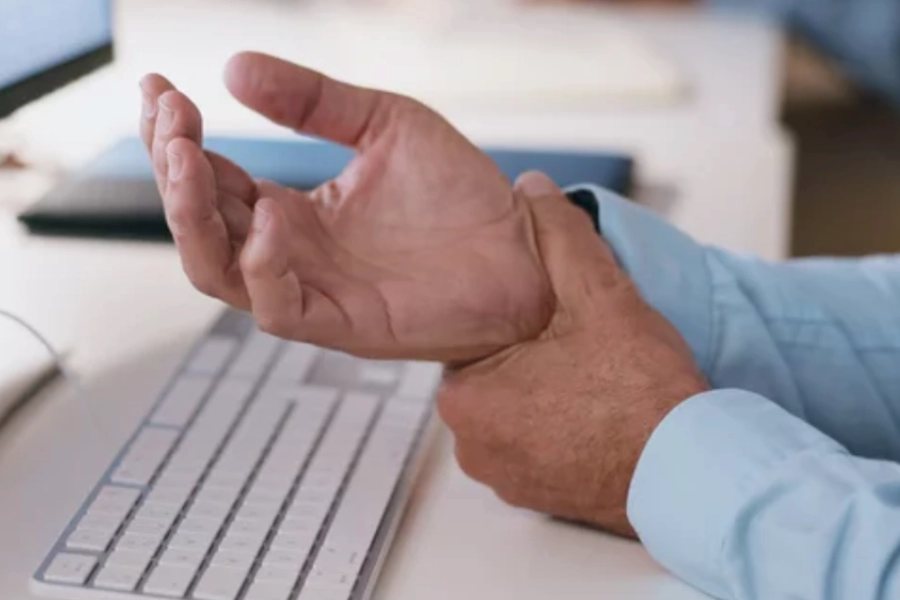
The median nerve passes through a tunnel bounded by the carpal bones and the transverse carpal ligament. Symptoms come from pressure on the nerve inside that space — which is why night splinting, holding the wrist neutral, is a first-line measure.
What the evidence supports — and what it does not
Surgery versus splinting: two true statements at once
Supported
- Surgery for a higher chance of improvement — clinical improvement about twice as often as splinting in the long term (RR 2.10, 95% CI 1.04 to 4.24), moderate-certainty evidence. [1]
- Splinting as a serious first option — it is the comparator against which surgery's advantage proved smaller than the threshold patients notice, on both symptoms and function. [1]
- Expecting improvement either way — in every study in the injection review, both the injection and the surgery groups improved from before to after treatment. [2]
Not supported
- Presenting surgery as a decisively better result — the symptom gain was 0.26 points against a 1-point threshold, and function 0.36 against 0.7. [1]
- Claiming injection beats surgery, or the reverse — very low-certainty evidence with severe inconsistency and no clear advantage either way. [2]
- Promising better quality of life from surgery — surgery may not provide better health-related quality of life than splinting, on low-certainty evidence. [1]
What the most recent evidence adds
There is now a current guideline. The American Academy of Orthopaedic Surgeons and the American Society for Surgery of the Hand published a joint clinical practice guideline in 2025, covering diagnosis and treatment in nine recommendations. It is the reference standard for this condition, and it is written for all qualified clinicians managing it, not only surgeons. [3]
Among conservative treatments, manual therapy ranks well. A 2025 systematic review and network meta-analysis concluded that manual therapy and dextrose 5% in water injection were the most effective conservative treatments, while noting that long-term efficacy and cost-effectiveness still need assessing. [4] A network meta-analysis ranks options against each other indirectly, so treat that as a reasonable ordering rather than a settled result.
Nerve gliding has direct trial evidence. A randomised trial compared neurodynamic therapy against exercise therapy and followed patients out to a year. Both improved, but neurodynamics was superior for function, strength and pain, with significant between-group differences in pain at one month and in function and shortened-DASH score at six months. No patient in the study needed surgery within the following year. [5] It is a small trial — 41 individuals, 52 hands — so the effect size should be held loosely, but the direction is useful.
Numbness and tingling in the hand does not always start at the wrist. When it follows a whole-arm pattern or comes with neck symptoms, the source may be higher up — see neck pain.
Hand numbness that comes with neck pain, or that follows a whole-arm pattern rather than the median nerve territory, may be coming from the neck instead — see cervical radiculopathy. The two can also occur together.
How certain is this?
Evidence grade: Low to moderate. This is one of the less settled areas on this site, and it is worth saying so plainly.
The surgery-versus-splinting comparison is moderate-certainty, but it rests on small numbers — the symptom and function estimates come from 2 studies and 195 participants, and the improvement-rate estimate from 3 studies and 210 participants, with a confidence interval running from 1.04 to 4.24. That interval is compatible with surgery being barely better or four times better. [1]
The injection-versus-surgery evidence is worse: seven studies, several with unusable data, and heterogeneity of 93–95%, meaning the trials disagreed with each other profoundly. The reviewers rated it very low-certainty and declined to draw a conclusion. [2] We follow them in that.
Neither review tells you which individual patients do best with which treatment, and neither addresses severe carpal tunnel syndrome with established nerve damage, where the clinical reasoning is different.
What to expect
With non-surgical management, night symptoms are usually the first thing to change. Intermittent numbness that becomes less frequent is the pattern you want. Where symptoms are longstanding, improvement is slower and less complete.
After surgery, recovery of sensation depends heavily on how long and how severely the nerve has been compressed — which is the main argument for not letting progressive symptoms drift. Both cited reviews measured outcomes beyond three months, so the honest framing is that this is a decision measured in months, not days.
When hand symptoms need prompt assessment
Seek medical attention if you have:
- Constant numbness rather than intermittent — particularly if it no longer comes and goes.
- Visible wasting of the muscle pad at the base of the thumb, or weakness moving the thumb away from the palm.
- Symptoms in both hands with numbness elsewhere, or alongside diabetes or thyroid disease.
- Hand symptoms with neck pain, or numbness that includes the little finger — this suggests a different source.
- Sudden onset after a wrist injury or fracture, or with marked swelling.
- Symptoms rapidly worsening over days.
- Hand pain with fever, redness or feeling unwell.
Constant numbness and thumb weakness matter because recovery of a nerve depends partly on how long it has been compressed. This list is not exhaustive; if you are worried about a symptom, seek professional advice.
Common questions
Should I just have the surgery?
It is a reasonable option, and it does produce clinical improvement about twice as often as splinting in the long term. [1] What the same review shows is that the size of the improvement over a splint was 0.26 points on the symptom scale, where a full point is the smallest difference patients notice. [1] So it is a genuine choice rather than an obvious one — unless you have constant numbness or thumb weakness, which shifts the reasoning.
Is a splint actually worth wearing?
Yes, and it is worth wearing properly. Splinting is the treatment surgery was measured against, and surgery's advantage over it turned out to be smaller than the threshold patients notice. [1] The splint should hold the wrist near neutral and be worn at night, which is when tunnel pressure peaks.
Would an injection avoid surgery?
Honestly, we cannot tell you. The 2024 Cochrane review comparing local corticosteroid injection with surgery found the evidence too uncertain to draw reliable conclusions, with the trials disagreeing profoundly with one another. [2] Both groups improved in every study — but that is not the same as knowing which is better.
Will exercises fix it?
Nerve and tendon gliding exercises are a standard part of non-surgical care, but they were bundled inside "multimodal non-operative treatment" in the review rather than tested alone [1], so we are not going to claim a specific effect for them. The best-evidenced non-surgical element here is positioning — principally the night splint.
Is it caused by typing?
Sustained wrist positions and forceful, repetitive grip are plausible contributors, and modifying them is standard advice. But neither review cited here tested causes, and carpal tunnel syndrome is common in people who do no keyboard work at all. Pregnancy, thyroid disease, diabetes and simply having a narrow tunnel all matter.
References
- Lusa V, Karjalainen TV, Pääkkönen M, et al. Surgical versus non-surgical treatment for carpal tunnel syndrome. Cochrane Database of Systematic Reviews. 2024 Jan 8;1(1):CD001552. doi:10.1002/14651858.CD001552.pub3 PMID 38189479 Systematic review
- Ashworth NL, Bland JD, Chapman KM, et al. Local corticosteroid injection versus surgery for carpal tunnel syndrome. Cochrane Database of Systematic Reviews. 2024 Aug 29;8(8):CD015101. doi:10.1002/14651858.CD015101 PMID 39206746 Systematic review
- Shapiro LM, Kamal R, Brault J, et al. American Academy of Orthopaedic Surgeons/ASSH Clinical Practice Guideline Summary Management of Carpal Tunnel Syndrome. Journal of the American Academy of Orthopaedic Surgeons. 2025 Apr 1;33(7):e356–e366. doi:10.5435/JAAOS-D-24-01179 PMID 39637428 Clinical practice guideline
- Chen Y, Han B, Zhang X, et al. Conservative Treatments of Carpal Tunnel Syndrome: A Systematic Review and Network Meta-analysis. Archives of Physical Medicine and Rehabilitation. 2025 Sep;106(9):1447–1458. doi:10.1016/j.apmr.2025.04.002 PMID 40315975 Systematic review and network meta-analysis
- Hamzeh H, Madi M, Alghwiri AA, et al. The long-term effect of neurodynamics vs exercise therapy on pain and function in people with carpal tunnel syndrome: A randomized parallel-group clinical trial. Journal of Hand Therapy. 2021 Oct-Dec;34(4):521–530. doi:10.1016/j.jht.2020.07.005 PMID 32893098 Randomised controlled trial
About this guide
If you need assessment
This page explains. It does not diagnose.
Hand numbness can come from the wrist, the neck, higher up the arm, or from a generalised nerve problem, and the treatments differ entirely. Severity also matters here in a way it does not for most conditions, because it changes whether waiting is reasonable. Physiotherapist India publishes information and takes no bookings. Ask a qualified physiotherapist to examine your own case before acting on anything written here.