Condition guide · Prosthetics and orthotics
Amputation and Prosthetic Rehabilitation
Learning to walk again after losing a limb is a training problem, not only a fitting problem. Exercise improves gait at every stage of recovery — and the evidence is much thinner for the group most likely to need it.
In plain words. After a lower limb amputation, walking has to be rebuilt from three separate things: a socket that fits, a prosthesis that suits how you move, and a body retrained to use them. The first two are the prosthetist's work. The third is rehabilitation, and it is the part that continues long after the fitting appointments end.
Most people who are going to walk with a prosthesis learn to do so. How well they walk — speed, endurance, confidence on uneven ground, whether they can get up from a chair without help — is what training changes.
An honest note about who was studied. Most amputations worldwide follow diabetes and peripheral arterial disease. Most rehabilitation research does not study those patients. The Cochrane review of motor rehabilitation after amputation for peripheral arterial disease or diabetes found two randomised trials with 30 participants in total, and describes a paucity of research in the field. [4] A separate review found that 423 potential participants — 65% of those screened — were inequitably excluded from the trials it examined, limiting how far the findings generalise. [3] Read everything below with that in mind.
Key points
- Exercise improves gait at both stages of recovery. Standardised mean difference 0.42 (95% CI 0.06 to 0.79) in the subacute phase and 0.67 (0.40 to 0.94) in the chronic phase. [2]
- Mixed programmes are what works — aerobic exercise combined with strengthening or balance work. [1]
- The dose is achievable. One to three sessions of 20 to 60 minutes a week improved balance, walking speed, walking endurance and transfer ability, on moderate confidence. [1]
- Later is not too late. The chronic-phase effect was larger than the subacute one, with no heterogeneity between studies. [2]
- Supervision and intensity matter. Interventions that were tailored, supervised and of higher intensity showed greater promise. [3]
- More responsive prosthetic feet help, at least in the short term. [5]
- Phantom limb pain affects up to 80% of people after amputation. Mirror therapy reduces it, on low-quality evidence. [6]
- For dysvascular amputation specifically, almost nothing has been tested. [4]
What is actually happening
Three things change at once, and rehabilitation addresses all three.
Mechanically, the limb has lost the joints and muscles that did part of the work of walking. A transtibial (below-knee) prosthesis replaces the ankle; a transfemoral (above-knee) one replaces the knee as well, which is a far harder problem because the knee has to be stable in stance and free in swing. The remaining muscles must generate more of the propulsion and control that the missing segment used to provide, and the sound limb takes more load.
Physiologically, walking with a prosthesis costs more energy than walking without one, and the cost rises the higher the level of amputation. That is why cardiorespiratory fitness is a limiting factor for walking distance, and why aerobic work belongs in the programme rather than only strength work.
Neurologically, the map of the limb in the brain does not disappear when the limb does. That mismatch between the map and the body is the leading explanation for phantom sensation and phantom limb pain, and it is the reasoning behind mirror therapy. [6]
What it feels like
- The residual limb changing shape over the first months, so a socket that fitted stops fitting.
- Skin problems where the socket bears load — redness, blistering, breakdown.
- Phantom sensation: a vivid feeling that the limb is still there.
- Phantom limb pain: burning, cramping or shooting pain felt in the absent limb.
- Pain in the residual limb itself, which is a different problem with different causes.
- Fatigue disproportionate to the distance walked.
- Loss of confidence on stairs, slopes, uneven ground and in crowds.
- Pain in the sound limb and the lower back from the changed loading pattern.
How it is diagnosed
The diagnosis is not in question; the assessment is about capability. A prosthetic rehabilitation assessment covers the condition of the residual limb and skin, joint range and strength on both sides, balance in standing and moving, cardiorespiratory capacity, the fit and alignment of the socket, and what you actually need to do at home and at work.
The reason to be systematic about it is that the components are trainable to different degrees, and the evidence is stronger for some outcomes than others. The review of exercise programmes found moderate confidence that exercise improves balance, walking speed, walking endurance and transfer ability — but only low confidence for flexibility, cardiorespiratory health, lower-limb muscle strength and functional capacity, because there were too few studies. [1] That is a statement about the research, not about the patient.
How physiotherapy and rehabilitation help
Gait: what the meta-analysis found
A systematic review and meta-analysis examined randomised trials of exercise interventions assessing gait outcomes in people who use a prosthesis for walking. Sixteen articles were included: four examined the subacute phase of recovery and twelve the chronic phase.
Subacute interventions ran 30 minutes, one to seven times a week, for two to twelve weeks; chronic interventions ran 15 to 60 minutes, two to three times a week, for four to sixteen weeks. Low-to-moderate level evidence showed a small improvement in the subacute phase (standardised mean difference 0.42, 95% CI 0.06 to 0.79) and a moderate improvement in the chronic phase (0.67, 95% CI 0.40 to 0.94), both favouring exercise. Multicomponent programmes consisting of gait, balance and strength training were effective at both stages. [2]
Two details are worth noticing. The chronic-phase result was both larger and more consistent — heterogeneity was zero across those studies, against 46.0% in the subacute group. And the authors state that the optimal duration and frequency remain unclear because interventions varied so much. [2] So: training helps, including years after the amputation; nobody can tell you precisely how much is best.
Fitness, balance and function
A separate systematic review asked what type and minimum dose of physical activity improves fitness, mobility and functional capacity in community-dwelling adults with lower limb amputation. Twenty-three studies covering 408 adults were included.
The highest evidence was for mixed exercise programmes — combining aerobic exercise with strengthening or balance exercise. There was moderate confidence that one to three sessions of 20 to 60 minutes of exercise per week improves balance, walking speed, walking endurance and transfer ability in adults with amputation above the ankle. For flexibility, cardiorespiratory health, lower-limb muscle strength and functional capacity, confidence was low because of the lack of studies. [1]
That dose is worth repeating because it is modest: one to three sessions a week, of 20 to 60 minutes. It is not an unattainable programme.
Community and home-based rehabilitation
Most rehabilitation happens outside hospital, and the evidence there is weaker. A systematic review of exercise-based interventions delivered in the community or at home after transfemoral or transtibial amputation found eight completed trials of low to moderate quality, two protocols and three registered ongoing trials, with 351 participants across trials. Interventions combined exercise with cognitive behavioural therapy, education or video games. Effects on pain, physical function and quality of life were inconsistent. [3]
What the reviewers did identify is a pattern in which interventions worked better: intervention intensity, time of delivery and degree of supervision influenced reported effectiveness, and interventions that were tailored, supervised, of higher intensity and not delivered in the immediate post-acute phase showed greater promise for specific physical function outcomes. [3] That is a useful practical steer even from inconsistent data.
The same review made the equity finding quoted at the top of this page: 423 potential participants, 65% of those considered, were inequitably excluded from the trials, limiting the generalisability of the interventions to the underlying population. [3] People with more comorbidity, worse baseline function or dysvascular causes are systematically the ones left out.
Phantom limb pain and mirror therapy
Up to 80% of patients are affected by phantom limb pain after amputation. [6] Mirror therapy uses a mirror to create the illusion that the absent limb is present and moving, on the reasoning that restoring the correspondence between the brain's map and apparent sensory feedback reduces pain.
A systematic review searched for trials in adults after unilateral lower limb amputation and found four from 234 articles. A reduction in pain intensity with mirror therapy was reported in all of them, but there were significant differences between mirror therapy and the comparison after four weeks in only two (p < 0.001 and p < 0.05), and that difference persisted at three and six months in only one. Pain frequency, pain duration and activities of daily living improved without statistical significance at four and ten weeks; at six months there was a significant improvement in pain duration and in activities of daily living. The reviewers conclude that mirror therapy of high frequency and duration is effective, but that superiority over other interventions cannot be concluded because the evidence was of low quality. [6]
What a programme involves
| Component | What it is for | Evidence |
|---|---|---|
| Multicomponent gait, balance and strength training | Rebuilding walking itself — speed, endurance, symmetry and confidence. | Supported Gait outcomes improved in both the subacute (SMD 0.42, 0.06 to 0.79) and chronic (0.67, 0.40 to 0.94) phases across 16 randomised trials [2] |
| Mixed aerobic and strengthening or balance exercise 1–3 sessions of 20–60 minutes weekly |
Balance, walking speed, walking endurance and the ability to transfer. | Supported Moderate confidence across 23 studies and 408 adults, for amputation above the ankle [1] |
| Supervised, tailored, higher-intensity delivery and not in the immediate post-acute period |
Getting more out of the same programme. | Associated with better outcomes Intensity, timing and supervision influenced effectiveness across eight community-based trials whose overall results were inconsistent [3] |
| Mirror therapy for phantom limb pain | Reducing pain felt in the absent limb. | Effective at high frequency and duration; superiority unproven Pain intensity fell in all four included studies, but significantly against comparison in only two at four weeks; evidence rated low quality [6] |
| Quasi-passive or active prosthetic feet a prosthetic prescription decision, not a therapy |
Reducing the effort and improving the quality of walking. | Favoured, short term only Favoured over passive prostheses on biomechanical, physiological, performance and subjective measures across 34 studies, all at moderate or high risk of bias, with long-term benefit not established [5] |
| Motor imagery added to walking practice, after dysvascular amputation | Proposed as a way to enhance gait retraining. | Not established One randomised trial with eight participants showed no clear difference in mobility measures, very low certainty [4] |
An amber badge is a statement about the evidence cited on this page, not a verdict on the treatment.
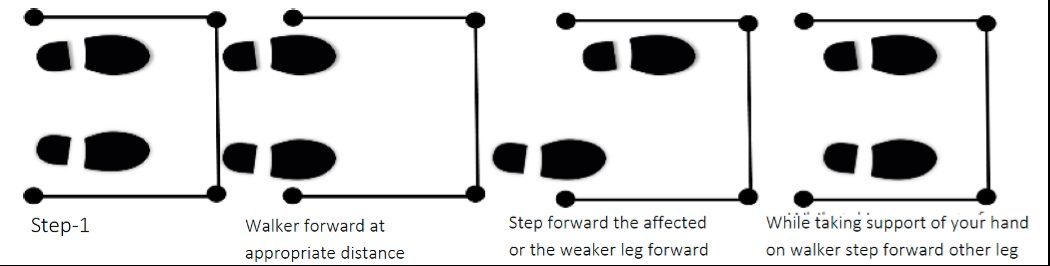
Walking is rebuilt in stages, often through a frame before a prosthesis. Multicomponent programmes of gait, balance and strength training improved gait outcomes in both the subacute and chronic phases — the chronic-phase effect being the larger of the two. [2]
What a course of treatment looks like
Before the prosthesis: care of the residual limb and its shaping, joint range at the hip and knee, strengthening on both sides, balance and transfers, and independence with a wheelchair. Contracture at the hip or knee makes prosthetic fitting harder, so preventing it is time well spent.
Early prosthetic phase: wearing tolerance built up gradually, skin checked every time the socket comes off, and walking retrained — weight transfer, step length, stance time, and the confidence to load the prosthetic side properly. The exercise trials in this phase ran 30 minutes, one to seven times a week, for two to twelve weeks. [2]
Then the longer phase, which is where the larger effects were found: progressive strengthening, aerobic conditioning, balance work and practice on the surfaces you actually meet — slopes, stairs, kerbs, uneven ground, crowds. Chronic-phase interventions ran 15 to 60 minutes, two to three times a week, for four to sixteen weeks. [2] Supervision continues to be worth something at this stage. [3]
Alongside all of it: management of phantom limb pain if it is present, [6] review of socket fit as the limb changes shape, and attention to the sound limb, which is now doing more work. Where the amputation followed diabetes or vascular disease, protecting the remaining foot is a priority in its own right.
Where back or sound-limb pain develops from the altered gait, see low back pain and knee osteoarthritis. Where cardiorespiratory capacity is the main limit on walking distance, the principles in cardiac rehabilitation apply. Falls risk is covered under falls prevention.
What the evidence supports — and what it does not
Supported
- Multicomponent exercise for gait, in both the subacute and chronic phases. [2]
- Mixed aerobic and strengthening or balance programmes for balance, walking speed, endurance and transfers. [1]
- Training years after the amputation. The chronic-phase effect was larger and more consistent. [2]
- Supervised, tailored, higher-intensity delivery. [3]
- Mirror therapy for phantom limb pain, at sufficient frequency and duration. [6]
Not supported
- Any confident protocol after dysvascular amputation. Two trials, 30 participants, very low certainty. [4]
- A specific optimal exercise duration or frequency. Unclear because interventions varied so widely. [2]
- Claims that mirror therapy is better than other treatments for phantom limb pain. Superiority cannot be concluded. [6]
- Long-term claims for advanced prosthetic feet. The benefits shown were short-term, from studies at moderate or high risk of bias. [5]
- Assuming trial results apply to everyone. 65% of potential participants were excluded from the community-based trials. [3]
How certain is this?
Evidence grade: Low.
The gait meta-analysis is the strongest thing here and its authors describe the evidence as low-to-moderate level. [2] Sixteen randomised trials is a reasonable base; the chronic-phase pooled estimate with zero heterogeneity is the most trustworthy single number on this page.
The dose evidence carries moderate confidence for four specific outcomes and low confidence for four others, and the reason given for the low confidence is simply the lack of studies. [1] Twenty-three studies across 408 adults is a small literature for a population this large.
The community rehabilitation review found effects on pain, physical function and quality of life to be inconsistent across eight trials of low to moderate quality. [3] Its most useful contribution is the observation about which delivery characteristics were associated with benefit, and the equity finding — which is a limitation on everything else rather than a result in itself.
The Cochrane review is the clearest statement of the gap. For transtibial amputation due to peripheral arterial disease or diabetes — the commonest cause — it found two randomised trials with 30 participants between them, could not assess prosthesis use because both trials recruited existing prosthesis users, and found no data at all on mortality, quality of life or phantom limb pain. It rated the evidence very low certainty and describes a paucity of research in the field. [4]
The mirror therapy review rests on four studies and states plainly that superiority over other interventions cannot be concluded because the evidence was of low quality. [6] The prosthetic device review included 34 studies, all of which had moderate or high risk of bias, and its conclusions are explicitly short-term. [5]
What to expect
Expect the residual limb to change shape over the first months, and expect sockets to need adjusting or replacing as it does. That is normal, not a failure of the fitting.
Expect walking to cost more energy than it did, and expect endurance to be a limiting factor before strength is. That is why aerobic work belongs in the programme.
Expect progress to continue well beyond the first few months. The larger and more consistent effect in the meta-analysis was in the chronic phase, [2] which means late training is not a consolation prize.
Expect phantom sensation, and know that phantom pain affects up to 80% of people after amputation and is treatable. [6] It is worth raising rather than enduring.
Expect the sound limb and the back to need attention too. They are now doing more than they were designed for.
Common questions
How much exercise do I actually need to do?
Less than most people fear. There is moderate confidence that one to three sessions of 20 to 60 minutes a week improves balance, walking speed, walking endurance and transfer ability in adults with amputation above the ankle, and the strongest evidence is for mixed programmes combining aerobic exercise with strengthening or balance work. [1] The exact optimum has not been established. [2]
Is it too late to improve? My amputation was years ago.
No — and the evidence points the other way. In the meta-analysis of 16 randomised trials, the improvement in gait outcomes was larger in the chronic phase (standardised mean difference 0.67, 95% CI 0.40 to 0.94) than in the subacute phase (0.42, 0.06 to 0.79), and the chronic-phase result was completely consistent across studies. [2] A review of community-based programmes also found that interventions delivered outside the immediate post-acute period showed greater promise. [3]
Does mirror therapy work for phantom limb pain?
It appears to, at sufficient frequency and duration — but the evidence is weak and it has not been shown to be better than the alternatives. Across four studies, pain intensity fell with mirror therapy in every one, but the difference against the comparison was statistically significant after four weeks in only two, and persisted at three and six months in only one. At six months there were significant improvements in pain duration and in activities of daily living. The reviewers conclude that superiority over other interventions cannot be concluded, as the evidence was of low quality. [6]
Is an expensive prosthetic foot worth it?
On short-term measures, more responsive feet do better. A systematic review of 34 studies found quasi-passive and active ankle-foot prostheses favoured over passive ones on biomechanical, physiological, performance and subjective measures in the short term — while noting that all included studies were at moderate or high risk of bias and that long-term benefit has not been investigated. [5] This is a prescription decision to make with your prosthetist, taking cost, activity level and terrain into account.
My amputation was because of diabetes. Does this evidence apply to me?
Partly, and you deserve to know that it is the weakest part of the literature. The Cochrane review of motor rehabilitation specifically after transtibial amputation due to peripheral arterial disease or diabetes found only two randomised trials with 30 participants in total, reported very low-certainty evidence, and describes a paucity of research in the field. [4] The general principles of progressive, supervised, multicomponent training are still the sensible approach — they are just borrowed from populations that were more often studied.
Why does my other leg and my back hurt now?
Because the loading pattern has changed and the sound limb is doing more of the work. This is common and it is worth assessing rather than accepting. A programme that improves the symmetry and efficiency of walking is treating the cause, not just the symptom.
Does supervision really matter, or can I do this at home?
Home programmes are normal and necessary; supervision seems to add something. In the review of community and home-based interventions, intervention intensity, time of delivery and degree of supervision all influenced reported effectiveness, and interventions that were tailored, supervised and of higher intensity showed greater promise for physical function. [3] The realistic model is a supervised programme that you carry out mostly independently between reviews.
References
- Dupuis F, Ginis KAM, MacKay C, et al. Do Exercise Programs Improve Fitness, Mobility, and Functional Capacity in Adults With Lower Limb Amputation? A Systematic Review on the Type and Minimal Dose Needed. Archives of Physical Medicine and Rehabilitation. 2024 Jun;105(6):1194–1211. doi:10.1016/j.apmr.2023.10.011 PMID 37926223 Systematic review
- Madou E, Sureshkumar A, Payne MW, et al. The effect of exercise interventions on gait outcomes in subacute and chronic rehabilitation from lower-limb amputation: A systematic review and meta-analysis. Prosthetics and Orthotics International. 2024 Apr 1;48(2):128–148. doi:10.1097/PXR.0000000000000255 PMID 37615607 Systematic review and meta-analysis
- Wijekoon A, Jayawardana S, Milton-Cole R, et al. Effectiveness and Equity in Community-Based Rehabilitation on Pain, Physical Function, and Quality of Life After Unilateral Lower Limb Amputation: A Systematic Review. Archives of Physical Medicine and Rehabilitation. 2023 Sep;104(9):1484–1497. doi:10.1016/j.apmr.2023.02.009 PMID 36893877 Systematic review
- B Aledi L, Flumignan CD, Trevisani VF, et al. Interventions for motor rehabilitation in people with transtibial amputation due to peripheral arterial disease or diabetes. Cochrane Database of Systematic Reviews. 2023 Jun 5;6(6):CD013711. doi:10.1002/14651858.CD013711.pub2 PMID 37276273 Cochrane systematic review
- Lathouwers E, Díaz MA, Maricot A, et al. Therapeutic benefits of lower limb prostheses: a systematic review. Journal of NeuroEngineering and Rehabilitation. 2023 Jan 13;20(1):4. doi:10.1186/s12984-023-01128-5 PMID 36639655 Systematic review
- Scholl L, Schmidt A, Alfuth M. Efficacy of Mirror Therapy in Patients with Phantom Pain after Amputation of a Lower Limb: A Systematic Literature Review. Zeitschrift fur Orthopadie und Unfallchirurgie. 2024 Dec;162(6):566–577. doi:10.1055/a-2188-3565 PMID 37967831 Systematic review
About this guide
If you need assessment
This page explains. It does not diagnose.
Prosthetic rehabilitation depends on socket fit, the level of amputation, the condition of the residual limb and the reason for the amputation, and it needs a physiotherapist and prosthetist working together. Skin breakdown inside the socket, or any new problem in the remaining foot, needs assessment promptly. Physiotherapist India publishes information and takes no bookings. Ask a qualified physiotherapist to examine your own case before acting on anything written here.