
Condition guide · Spine
Cervicogenic Headache
A headache that originates in the neck rather than the head. It is frequently mistaken for migraine, and the distinction matters because the treatment is completely different.
In plain words. The nerves supplying the top three joints of your neck share a relay station in the brainstem with the nerve that supplies your face and scalp. When something in the upper neck is irritated, the brain can misread where the signal came from and you feel it as a headache.
So the pain is in your head, but the problem is in your neck. That is why painkillers aimed at migraine often disappoint, and why treatment that addresses the neck can help.
Key points
- The pain is usually one-sided and starts at the back of the head or neck, spreading forward — not switching sides between attacks.
- It is provoked by neck movement or sustained postures, not typically by light, sound or diet.
- The flexion-rotation test is the single most useful physical test for telling it apart from migraine. [3]
- Both manual therapy and specific neck exercise reduce headache frequency and intensity, with effects maintained at 12 months. [1]
- The evidence base is genuinely thinner here than for many conditions, and the authors of the most recent review say so explicitly. [2]
What is actually happening
The upper cervical spine — the joints, discs, ligaments and muscles of the top of the neck — is supplied by the upper cervical nerves. Those nerves converge in the brainstem with the trigeminal nerve, which carries sensation from the face and much of the head.
Because the two systems share that relay, the brain cannot always tell which one a signal came from. Pain arising from an upper cervical structure is therefore referred and perceived in the head. This is why the headache is real and severe while the source is somewhere you are not feeling pain at all.
What it feels like
- Pain that starts in the neck or back of the head and spreads forward toward the forehead, temple or behind the eye
- Usually one-sided, and typically the same side each time
- Triggered or worsened by neck movement, or by holding one position — desk work, driving, sleeping awkwardly
- Often accompanied by reduced neck movement and tenderness in the upper neck
- Usually a steady, non-throbbing ache rather than the pulsating pain of migraine
How it is told apart from migraine
This is the most useful thing on this page, because the two are confused constantly and the treatments differ.
A meta-analysis of 62 studies compared physical examination findings across cervicogenic headache, migraine and people with no headache. Two measures stood out as discriminating cervicogenic headache from migraine: [3]
- The flexion-rotation test. People with cervicogenic headache had markedly less rotation available — a difference of 17.67° (95% CI 13.69–21.65) compared with migraine.
- Neck flexion strength. Reduced by 23.81 N (95% CI 8.78–38.85) compared with migraine.
Compared with people who have no headache at all, those with cervicogenic headache showed substantially reduced neck flexion strength (−33.70 N, 95% CI −47.23 to −20.16) and extension strength (−55.78 N, 95% CI −77.56 to −34.00). [3]
The review's authors are careful, and so are we: these tests "could support the differential diagnosis", and they call for additional high-quality studies to confirm the findings. [3] No single test diagnoses cervicogenic headache on its own.
Why a neck problem is felt as a headache
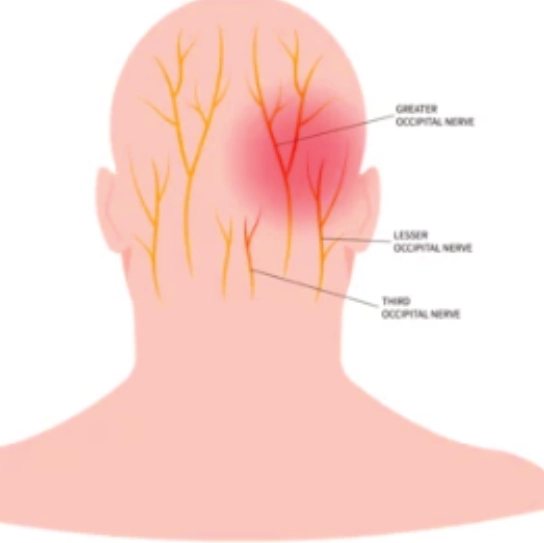
The pain is felt in the head but arises from the upper cervical segments, which is why treatment is directed at the neck rather than at the headache itself.
How physiotherapy and rehabilitation help
A cervicogenic headache is head pain referred from structures in the upper neck. It follows that treating the head does not help and treating the neck can. That is the reason physiotherapy has a genuine role here that it does not have in migraine.
The evidence supports two things in particular, and is honest about their limits. Manual therapy reduces headache frequency compared with sham manual therapy in the short term (mean difference -0.93 episodes per week, 95% CI -1.40 to -0.46, moderate-certainty evidence), and reduces both frequency (-1.23 episodes per week) and intensity (-1.63 on a 0 to 10 scale) compared with no treatment. [2] The short-term benefit is real.
The long-term picture is different, and it matters more for how you should think about a course of treatment. At 12-month follow-up, manual therapy did not produce a greater reduction in headache intensity (-0.12, 95% CI -0.49 to 0.26) or frequency (-0.32, 95% CI -0.91 to 0.28) than sham manual therapy. [2] Hands-on treatment relieves; it does not appear to be what keeps the headaches away.
What is actually offered, and what it is worth
- Assessment to confirm the neck is the source — the step that decides whether any of this applies to you at all.
- Manual therapy to the upper cervical segments — effective in the short term, not shown to hold at a year. [2]
- Neck and shoulder-girdle exercise — the part that plausibly carries the long-term result, and the part most often dropped once the headaches settle.
- Combined approaches — a network meta-analysis of 23 studies ranked manipulation plus dry needling highest for reducing short-term headache intensity (MD -4.87, 95% CI -8.51 to -1.24) and frequency (-3.09, -4.93 to -1.25), with soft tissue techniques plus exercise and dry needling plus exercise also ranking well. All of it rests on low-certainty evidence, and the authors state plainly that no conclusive recommendation can be made. [5]
Because the source is the neck, this page is best read alongside neck pain, which covers the same structures when the pain stays local.
What treatment involves
The landmark trial in this field randomised patients to manipulative therapy, specific exercise, both, or a control. At 12-month follow-up, both manipulative therapy and specific exercise had significantly reduced headache frequency and intensity and neck pain, and those effects were maintained. Effect sizes were described as at least moderate and clinically relevant. [1]
The exercise component is not general fitness work. It targets the deep neck flexor muscles that stabilise the upper cervical spine and are typically weak and poorly controlled in this condition — low-load, precise, and progressed gradually.
A 2023 systematic review of physiotherapy for cervicogenic headache concluded that manual therapy may help in the short term and neck exercise in the long term. [2] That split is practically useful: hands-on treatment to settle things, exercise to keep them settled.
Flexion-rotation test — rotation available, viewed from above
What the evidence supports — and what it does not
Supported
- Specific neck exercise — reduced headache frequency and intensity, maintained at 12 months. [1] Favoured for longer-term benefit. [2]
- Manual therapy — similar 12-month reductions in the trial [1]; the 2023 review favours it for short-term benefit. [2]
- The flexion-rotation test as a discriminator from migraine. [3]
- Cervical manipulation appears low-risk for mild adverse events — a meta-analysis of 14 RCTs found no significant difference versus control, and all reported events were mild. [4]
Not supported
- "Combining manual therapy and exercise is clearly better than either alone." The combination was not significantly superior to either therapy by itself; about 10% more patients gained relief. [1]
- Confident claims about how well physiotherapy works. The 2023 review states plainly that more high-quality evidence is needed and that "future results may change the current conclusions". [2]
- Any single test as a stand-alone diagnosis. [3]
- Treating the reassuring safety data as complete. The adverse-event meta-analysis notes that randomised trials are not an appropriate design for detecting rare serious events. [4]
How certain is this?
Evidence grade: Low to moderate — the lowest grade we have assigned so far, and deliberately so.
The direction of the evidence is consistent: treatment aimed at the neck helps, and the benefit lasts. But the trial base is small, and the most recent systematic review says outright that "more high-quality evidence is needed and future results may change the current conclusions". [2] The diagnostic meta-analysis reaches a similar verdict on the physical tests. [3]
We would rather tell you the evidence is thin than imply a certainty that is not there. If a clinic offers you a guaranteed outcome for cervicogenic headache, the literature does not support it.
What to expect
The trial that followed patients for a year found benefits that persisted at 12 months, which is genuinely encouraging for a headache disorder. [1] Improvement is usually gradual rather than immediate, and the exercise component only works if it is actually done between appointments.
Because posture and sustained neck positions provoke symptoms, the changes that hold gains are often unglamorous: how your workstation is set up, how long you stay in one position, how you sleep.
Headache features that need urgent assessment
Cervicogenic headache is a mechanical problem. Seek immediate medical attention if a headache comes with any of the following, which point toward a different and potentially serious cause:
- Sudden, severe headache reaching maximum intensity within seconds — unlike any you have had
- Headache with fever, neck stiffness or a rash
- New weakness, numbness, difficulty speaking, or facial droop
- Sudden change in vision, or double vision
- Headache following a significant head or neck injury
- Headache that is consistently worse on lying flat, coughing or straining
- A new or clearly different headache pattern beginning after the age of 50
This list is not exhaustive, and these are general headache warning signs rather than findings from the studies cited on this page. If you are worried about a symptom, seek professional advice.
Common questions
How do I know it is not migraine?
You cannot reliably tell on your own, and the two can coexist. The pattern is suggestive — one-sided, starting in the neck, provoked by neck movement or posture, without the light and sound sensitivity typical of migraine — but confirmation needs a physical examination. The flexion-rotation test is the most useful single discriminator. [3]
Do I need a scan?
Imaging does not diagnose cervicogenic headache. Age-related changes on a neck scan are extremely common in people with no headache at all, so a positive finding does not establish the cause. Imaging is for excluding other pathology when something in the history or examination warrants it.
Is neck manipulation safe?
A meta-analysis of 14 randomised trials found no significant increase in adverse events compared with control interventions, and every reported event was mild. [4] The same authors caution that randomised trials cannot detect rare serious events, so that finding should not be read as a guarantee. Discuss it with your clinician, who should screen you before any manipulation.
Which is better, hands-on treatment or exercise?
The trial found both effective and the combination not significantly better than either alone. [1] The 2023 review suggests manual therapy helps more in the short term and exercise more in the long term. [2] In practice most clinicians use both, sequenced — but the evidence does not show the combination is clearly superior.
References
- Jull G, Trott P, Potter H, et al. A randomized controlled trial of exercise and manipulative therapy for cervicogenic headache. Spine. 2002 Sep 1;27(17):1835–1843. doi:10.1097/00007632-200209010-00004 PMID 12221344 Randomised controlled trial
- Demont A, Lafrance S, Gaska C, Kechichian A, Bourmaud A, Desmeules F. Efficacy of physiotherapy interventions for the management of adults with cervicogenic headache: A systematic review and meta-analyses. PM&R. 2023 May;15(5):613–628. doi:10.1002/pmrj.12856 PMID 35596553 Systematic review
- Anarte-Lazo E, Carvalho GF, Schwarz A, Luedtke K, Falla D. Differentiating migraine, cervicogenic headache and asymptomatic individuals based on physical examination findings: a systematic review and meta-analysis. BMC Musculoskeletal Disorders. 2021 Sep 3;22(1):755. doi:10.1186/s12891-021-04595-w PMID 34479514 Meta-analysis
- Pankrath N, Nilsson S, Ballenberger N. Adverse Events After Cervical Spinal Manipulation — A Systematic Review and Meta-Analysis of Randomized Clinical Trials. Pain Physician. 2024 May;27(4):185–201. PMID 38805524 Meta-analysis
- Jung A, Carvalho GF, Szikszay TM, et al. Physical Therapist Interventions to Reduce Headache Intensity, Frequency, and Duration in Patients With Cervicogenic Headache: A Systematic Review and Network Meta-Analysis. Physical Therapy. 2024 Feb 1;104(2):. doi:10.1093/ptj/pzad154 PMID 37941472 Systematic review and network meta-analysis
About this guide
If you need assessment
This page explains. It does not diagnose.
Distinguishing cervicogenic headache from migraine requires physical examination of the neck, including the flexion-rotation test. Physiotherapist India publishes information and takes no bookings. Ask a qualified physiotherapist to examine your own case before acting on anything written here.