Condition guide · Neurological rehabilitation
Stroke Rehabilitation
What rehabilitation after stroke involves, when it should start, and what the largest trials actually found — including one widely repeated claim that the evidence contradicts.
In plain words. A stroke damages part of the brain, and the abilities that part controlled — moving an arm, walking, speaking, swallowing, balancing — are affected. Rehabilitation is the structured process of relearning those abilities, or finding workable ways around what cannot be fully recovered.
It is not one treatment. It is a team — physiotherapy, occupational therapy, speech and language therapy, nursing, medicine, and the family — working toward goals the person actually wants. Most of the work happens in ordinary repetition, not in any single technique.
Key points
- Rehabilitation is a coordinated team effort, and the guideline is explicit that communication between team members underpins everything. [1]
- Earlier is not automatically better. The largest trial found high-dose mobilisation started within 24 hours produced worse three-month outcomes than usual care. [2]
- Timing and amount are clinical decisions for the treating team, matched to the individual, not a race.
- Recovery varies enormously between people. Any confident timeline for an individual should be treated with suspicion.
- Safe handling matters. Never pull on a weak arm — the shoulder is vulnerable after stroke.
What rehabilitation actually involves
Rehabilitation after stroke is delivered by a team that typically includes the patient and their goals, family and other caregivers, physicians, nurses, physiotherapists, occupational therapists, speech-language pathologists, psychologists, nutritionists and social workers. The AHA/ASA guideline states that communication and coordination among these members is "paramount", and that without it, isolated efforts are unlikely to achieve their full potential. [1]
In practice the work is repetitive and task-specific: practising the actual thing you want to be able to do — standing up, reaching, gripping, stepping, swallowing, forming words — many times, with the difficulty adjusted as you improve.
When should rehabilitation start?
This is the question where the evidence has genuinely changed practice, and where a lot of published patient information is still wrong.
The intuition is that starting as early and as intensively as possible must be better. The largest randomised trial in this field tested that and found the opposite.
What AVERT found
AVERT randomised 2,104 patients to very early, high-dose mobilisation or usual care. In the intervention group 92% were mobilised within 24 hours, compared with 59% under usual care. At three months: [2]
- Fewer patients had a favourable outcome in the very early mobilisation group — 480 (46%) versus 525 (50%); adjusted odds ratio 0.73, 95% CI 0.59–0.90, p=0.004.
- Deaths: 88 (8%) versus 72 (7%); OR 1.34, 95% CI 0.93–1.93, p=0.113.
- Serious adverse events were similar (19% versus 20%), and there was no reduction in immobility-related complications with very early mobilisation.
The trialists concluded that the higher-dose, very early protocol "was associated with a reduction in the odds of a favourable outcome at 3 months". [2]
AVERT — favourable outcome at 3 months (n=2,104)
What the Cochrane review found
A Cochrane review pooled nine randomised trials with 2,958 participants. Very early mobilisation did not increase the number of people who survived or made a good recovery (poor outcome or death 51% versus 49%; OR 1.08, 95% CI 0.92–1.26; moderate-quality evidence). It may have shortened hospital stay by about a day, on low-quality evidence. The authors recorded concern that mobilisation commencing within 24 hours "may carry an increased risk, at least in some people with stroke". [3]
What this does and does not mean
It does not mean rehabilitation should be delayed, or that lying still is good for you. Prolonged immobility carries its own well-known harms, and stroke unit care remains strongly supported.
It means the dose and timing are a clinical judgement made by the treating team for the individual patient — not a target to be maximised. If you are told that more and earlier is always better, that is not what the trials found.
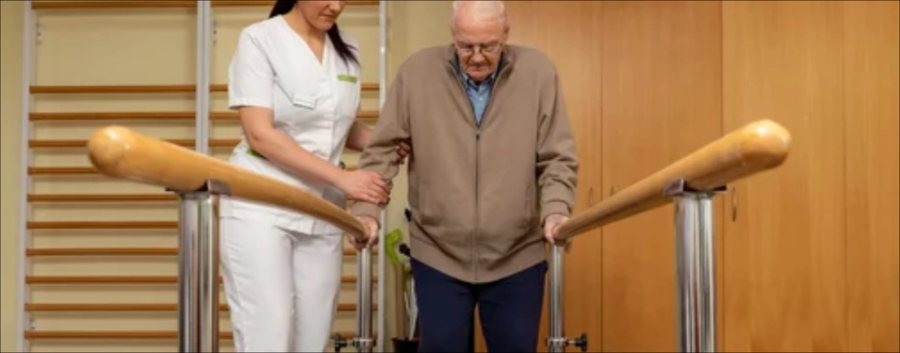
Task-specific practice, repeated at sufficient volume, is the active ingredient. Approaches focused on functional task training may improve daily activities and motor function compared with other approaches, and that benefit was sustained long term. [5]
How physiotherapy and rehabilitation help
After a stroke the surviving brain reorganises around the damage, and it does that in response to practice. Rehabilitation is how that practice is chosen, dosed and progressed. There is no passive treatment that substitutes for it, which is why the two questions worth asking about any programme are what you will practise and how much of it you will do.
The 2025 Cochrane review is now very large — 267 studies and 21,838 participants across 36 countries. Compared with no physical rehabilitation, it may improve daily activities (SMD 1.32, 95% CI 1.08 to 1.56) and motor function (SMD 1.01, 95% CI 0.80 to 1.22), with evidence of long-term benefit, and likely improves gait velocity. Crucially, additional rehabilitation may further improve daily activities (SMD 1.26, 95% CI 0.82 to 1.71), motor function (SMD 0.69, 95% CI 0.46 to 0.92), balance and gait velocity. [5] More practice is better, within what a person can tolerate.
On what to practise, the same review found that approaches focused on functional task training may improve daily activities (SMD 0.58, 95% CI 0.29 to 0.87) compared with other approaches, and that this benefit was sustained long term. [5] Practising the actual task tends to beat preparing to do the task.
What is actually offered, and what it is worth
- Task-specific practice of real activities — walking, reaching, standing up, dressing. The core of it.
- High-intensity gait training — the strongest recommendation in the 2025 European guideline: moderate-quality evidence supports it to improve walking endurance in people with chronic stroke and stable cardiovascular status. [4]
- Enough repetition to matter — the guideline suggests an additional minimum of 20 hours of repetitive upper limb practice to improve arm capacity, and expert consensus suggests a similar additional 20 hours of walking practice. [4] Treat 20 hours as a floor, not a target.
- Sit-to-stand training — additional practice is suggested to improve balance, on moderate-quality evidence. [4]
- Group therapy — not a lesser option. Task-specific group-based therapy is suggested to be non-inferior to individual therapy for balance, gait speed and walking endurance. [4] Where one-to-one time is scarce, that is a practical route to more practice rather than a compromise.
Balance problems after a stroke are not always of central origin. Vestibular rehabilitation added to usual care improves balance in stroke survivors, so where dizziness is prominent it is worth reading vestibular neuritis alongside this page.
What the evidence supports — and what it does not
Supported
- Coordinated multidisciplinary rehabilitation with adequate resources, dose and duration, described by the guideline as an essential aspect of stroke care. [1]
- Mobilisation as part of usual stroke unit care — the comparator arm in AVERT still had 59% of patients mobilised within 24 hours and achieved the better outcome. [2]
- Timing and intensity individualised by the treating team, rather than driven by a protocol target.
- Task-specific, repetitive practice of the abilities the person is trying to regain.
Not supported
- "Earlier and more intensive mobilisation speeds recovery." High-dose mobilisation within 24 hours produced worse three-month outcomes. [2][3]
- "Early mobilisation prevents immobility complications." AVERT found no reduction in those complications. [2]
- A specific universal daily dose such as "at least three hours a day". None of the sources cited on this page establishes such a threshold.
- "Recovery follows a predictable trajectory." Outcome varies with lesion size and site, initial severity, age, comorbidity and complications.
- "Progress continues in motivated patients." Recovery potential is determined largely by the injury, not by willingness. Framing a plateau as insufficient effort is both wrong and cruel.
How good is the recent evidence?
Better than it was, and still not as good as the volume suggests. The 2025 European Stroke Organisation guideline was developed using GRADE, and is candid about where it is standing on thin ground: the 20-hour dose recommendations rest on very low quality evidence for the upper limb and on expert consensus for gait, and several other recommendations are weak. Only high-intensity gait training carries a strong recommendation. [4]
The Cochrane reviewers are equally direct. Of the studies in their meta-analyses, only 14 were at low risk of bias across all domains, and on average around a third of studies in the primary outcome analyses were at high risk. Half of the 267 included studies were conducted in a single country, and reporting was often poor. [5] The direction of these findings is dependable. The precise effect sizes are not, and should not be quoted to you as though they were a prognosis.
How certain is this?
Evidence grade: Moderate. The mobilisation findings rest on a large, well-conducted multicentre randomised trial and a Cochrane review that graded its primary outcome as moderate-quality evidence. [2][3]
Two honest limitations. The Cochrane authors note that several of the review authors were also trialists in the included trials, and describe steps taken so that no one decided on their own trial. [3] And the length-of-stay finding rests on low-quality evidence. The direction of the main result is reliable; the precise size of the effect is less so.
What recovery actually looks like
Recovery after stroke usually passes through recognisable phases, but the pace and the endpoint vary considerably between individuals. Gains are often fastest in the early months and continue more slowly afterwards, sometimes for years.
We deliberately do not publish a week-by-week timeline. A substantial minority of people will not match any such schedule, and being handed a forecast you then fail to meet is its own harm. Your treating team, who can see your specific deficits, are the only people positioned to give you a realistic picture.
Safety for families and caregivers
Never pull on the affected arm when helping someone move or transfer. After a stroke the muscles that hold the shoulder joint together may be weak, and pulling can partially dislocate it. Support from underneath, at the trunk, following the technique your therapist has shown you.
Stop and seek help if the person reports dizziness, chest pain, breathlessness or severe fatigue during activity.
Call emergency services immediately for any sudden new weakness, facial droop, difficulty speaking, or sudden change in consciousness or vision — these may signal a further stroke.
Common questions
Should therapy start the same day?
That is a decision for the treating team, based on how medically stable the person is. What the evidence does not support is treating "within 24 hours" as a target to hit regardless of the individual — the trial that tested a high-dose version of exactly that found worse outcomes at three months. [2][3]
Is more therapy always better?
More task-specific practice is generally helpful, but "more is always better" is not what the mobilisation trials found, and none of the sources cited here establishes an optimal daily dose. The guideline calls for adequate dose and duration without our being able to quote a universal number from it. [1]
How long does recovery take?
It varies more than almost any question in rehabilitation. Gains are typically fastest early and continue more slowly afterwards. Anyone who gives you a precise timeline without examining the person is guessing.
If progress has stopped, does that mean not trying hard enough?
No. How much recovery is possible is determined largely by which part of the brain was damaged and how extensively — not by effort or attitude. A plateau is information about the injury, not a verdict on the person.
References
- Winstein CJ, Stein J, Arena R, et al. Guidelines for Adult Stroke Rehabilitation and Recovery: A Guideline for Healthcare Professionals From the American Heart Association/American Stroke Association. Stroke. 2016 Jun;47(6):e98–e169. doi:10.1161/STR.0000000000000098 PMID 27145936 Clinical practice guideline
- AVERT Trial Collaboration group. Efficacy and safety of very early mobilisation within 24 h of stroke onset (AVERT): a randomised controlled trial. Lancet. 2015 Jul 4;386(9988):46–55. doi:10.1016/S0140-6736(15)60690-0 PMID 25892679 Randomised controlled trial
- Langhorne P, Collier JM, Bate PJ, Thuy MNT, Bernhardt J. Very early versus delayed mobilisation after stroke. Cochrane Database of Systematic Reviews. 2018 Oct 16. doi:10.1002/14651858.CD006187.pub3 PMID 30321906 Systematic review
- Alt Murphy M, Munoz-Novoa M, Heremans C, et al. European Stroke Organisation (ESO) guideline on motor rehabilitation. European Stroke Journal. 2025 Dec;10(4):1160–1188. doi:10.1177/23969873251338142 PMID 40401760 Clinical practice guideline
- Todhunter-Brown A, Sellers CE, Baer GD, et al. Physical rehabilitation approaches for the recovery of function and mobility following stroke. Cochrane Database of Systematic Reviews. 2025 Feb 11;2(2):CD001920. doi:10.1002/14651858.CD001920.pub4 PMID 39932103 Systematic review and meta-analysis
About this guide
If you need rehabilitation
This page explains. It does not treat.
Stroke rehabilitation has to be built around one person's specific deficits and goals, which requires assessment in person. Physiotherapist India publishes information and takes no bookings. Ask a qualified physiotherapist to examine your own case before acting on anything written here.