Condition guide · Paediatrics
Paediatric Physiotherapy
Cerebral palsy can now be detected before six months, and early intervention matters more than any later treatment. It also means the most widely practised therapy for it — Bobath, or neurodevelopmental therapy — has been formally recommended against.
In plain words. Paediatric physiotherapy covers everything from a baby at risk of cerebral palsy to a teenager after a sports injury. This page concentrates on cerebral palsy, because that is where the evidence is strongest, where the practice has changed most, and where the gap between what is commonly offered and what is supported is widest.
Cerebral palsy is a group of permanent disorders of movement and posture caused by something that happened to the developing brain. The brain injury does not progress. What can change — in both directions — is muscle length, joint shape, strength, and what the child learns to do.
The finding that matters most. A meta-analysis of 34 studies covering 1,332 participants found no effect of neurodevelopmental therapy — Bobath — over control, and moderate effects favouring activity-based approaches over it. Its authors made a strong recommendation against the use of neurodevelopmental therapy at any dose, and state that its deimplementation is required. [3] It remains one of the most widely delivered therapies for cerebral palsy in the world.
Key points
- Cerebral palsy can be detected before six months of age, using standardised tools rather than watching and waiting. [1]
- Referral should be immediate once a child meets the criteria for high risk — the guideline's first best-practice principle. [2]
- Parents are part of the intervention, not an audience for it. Building parental capacity for attachment and parental goal-setting are the other two principles. [2]
- Neurodevelopmental therapy is recommended against at any dose. [3]
- Activity-based and body-structure approaches outperform it. Standardised mean differences of 0.76 and 0.77 respectively. [3]
- Strength training works and does not increase spasticity in children classified at GMFCS levels I, II and III. [4]
- Occurrence is about 1 in 500 live births, and in high-income countries 2 in 3 children with cerebral palsy will walk. [1]
- Early intervention was tested in India and Bangladesh, with a result that is more nuanced than the headline. [6]
What is actually happening
An injury or malformation affects the developing brain — before birth, around birth, or in early infancy. The injury itself is static. Its consequences are not, because a growing child with altered muscle activation grows differently.
Muscles that are persistently overactive do not lengthen at the rate the bones do. Joints that are not moved through their full range stiffen. Muscles that are rarely loaded stay weak. Over years, these secondary changes — contracture, hip displacement, bony deformity — can become a bigger practical problem than the original injury.
Two consequences follow. First, the target of treatment is largely the secondary change, not the brain injury. Second, timing matters enormously, because the first two years are the period of greatest neuroplasticity and the period before most secondary change has happened. That is the reasoning behind the whole early-detection movement. [2]
The Gross Motor Function Classification System — GMFCS, levels I to V — describes how a child moves, and it appears throughout the research on this page. It is used because interventions do not work equally across levels: the strength-training evidence applies to levels I to III, [4] and the early intervention trial found its effect only in the more ambulant children. [6]
What it looks like
- Delayed motor milestones — not rolling, sitting, crawling or walking at the expected age.
- Stiffness, or unusual floppiness, or a mixture at different times.
- A strong preference for one hand well before the first birthday, which is not normal.
- Movements that look jerky, effortful, or involuntary.
- Difficulty with feeding, and with managing saliva.
- Persistent fisting, or an arm held against the body.
- Asymmetry — one side of the body consistently behaving differently.
None of these on its own makes a diagnosis. All of them are reasons to ask.
How it is diagnosed
Earlier than most families are told. Historically the diagnosis was made between 12 and 24 months; it can now be made before six months' corrected age using a combination of standardised tools alongside the clinical history. [1]
Before five months' corrected age, the most predictive tools are term-age magnetic resonance imaging (86% to 89% sensitivity), the Prechtl Qualitative Assessment of General Movements (98% sensitivity) and the Hammersmith Infant Neurological Examination (90% sensitivity). After five months' corrected age, the most predictive are magnetic resonance imaging where safe and feasible, the Hammersmith Infant Neurological Examination, and the Developmental Assessment of Young Children (83% C index). [1]
Why this matters practically: General Movements Assessment and the Hammersmith examination are observational, need no equipment, and can be learned. In settings where MRI is not routinely available, they are the tools that make early detection possible at all — and early detection is what unlocks early intervention.
How physiotherapy and rehabilitation help
The guideline, and its three principles
An international clinical practice guideline, built from 16 systematic reviews and 27 randomised trials, addressed intervention for children aged 0 to 2 years with or at high risk of cerebral palsy across nine domains: motor function, cognitive skills, communication, eating and drinking, vision, sleep, managing muscle tone, musculoskeletal health and parental support. It makes 28 recommendations — 24 for and 4 against. [2]
Three best-practice principles run across all nine domains, and they are the most useful summary of modern practice: immediate referral for intervention after a diagnosis of high risk of cerebral palsy; building parental capacity for attachment; and parental goal-setting at the commencement of intervention. [2]
Note what the second and third say. The parent is not a bystander who receives instructions. Attachment and parental goals are treatment components with their own recommendations, and the guideline devotes five of its 28 recommendations to parent support. [2]
The therapy that is recommended against
Neurodevelopmental therapy, usually called the Bobath approach, has been the dominant paradigm in paediatric neurological physiotherapy for decades. A meta-analysis screened 667 records and included 34 studies across 35 publications, covering 1,332 participants.
Four meta-analyses were conducted on motor function. There was no effect of neurodevelopmental therapy against control (pooled effect size 0.13, 95% CI -0.20 to 0.46). There was a moderate effect favouring activity-based approaches over it (0.76, 0.12 to 1.40) and favouring body function and structure interventions over it (0.77, 0.19 to 1.35). And there was no effect of higher-dose against lower-dose neurodevelopmental therapy (0.32, -0.11 to 0.75) — more of it is not better. The authors made a strong recommendation against its use at any dose. [3]
One honest caveat: the comparison against activity-based approaches had considerable heterogeneity, at 80%, which the authors attribute to varied outcome measures, and the included studies were not all compliant with reporting standards. [3] The direction of the finding is consistent; the exact size is less certain.
"Activity-based" means practising the actual activity the child needs to do, with the child doing the work — goal-directed training, constraint-induced movement therapy for one-sided weakness, bimanual training, treadmill and overground walking practice. The active ingredient is the child's own repeated, self-generated attempts at a real goal.
Strength training, and the spasticity myth
Strengthening was for many years avoided in cerebral palsy, on the theory that it would increase spasticity. A systematic review and meta-analysis of 27 studies covering 847 participants with spastic cerebral palsy demonstrated significant effects favouring strength training over other physical therapy techniques or untreated control for muscle strength at the knee flexors, knee extensors and plantarflexors, for maximum resistance, balance, gait speed, and Gross Motor Function Measure scores — global, and the D and E dimensions — and for spasticity. [4]
The conclusion is worth stating carefully: strength training has positive functional and activity effects without increasing spasticity, in children and adolescents at GMFCS levels I, II and III, when adequate dosage and specific principles are used. [4] Two conditions attach to that: the classification levels, and the dosage. A strengthening programme that is not actually strengthening — too light, too infrequent — is not what was studied.
The wider comparison, read carefully
A 2025 network meta-analysis compared non-surgical therapies for spastic cerebral palsy across 81 randomised trials, retrieved from 5,765 studies. Biofeedback, transcranial direct current stimulation, extracorporeal shockwave therapy, botulinum toxin A with casting, transcutaneous electrical nerve stimulation, casting, whole-body vibration, acupuncture and botulinum toxin A alone all significantly reduced spasticity (standardised mean differences ranging from -3.29 to -0.73). Hippotherapy, gaming, acupuncture and whole-body vibration improved gross motor function (0.91 to 6.75), and acupuncture significantly enhanced daily living and walking. [5]
Those are eye-catching numbers, and the reviewers themselves put the brakes on. They state that the limited number of randomised trials supporting the top-ranked therapies, combined with small sample sizes that may overestimate treatment effects, methodological biases and heterogeneity in key analyses, necessitates cautious interpretation of the findings in the real world. [5] An effect size of 6.75 for gross motor function is not a result to build a programme on; it is a signal that the underlying trials were small.
Early intervention, tested where most children live
Nearly all the evidence above comes from high-income countries. One randomised trial tested a parent-delivered early intervention in India and Bangladesh. Infants aged 12 to 40 weeks corrected age at risk of cerebral palsy were randomised to LEAP-CP — a multidomain, active, goal-directed programme — or to an equal dose of health advice, both delivered through 15 fortnightly home visits by a peer trainer. Of eligible infants, 153 of 165 were recruited, and final data were available for 118. [6]
On the primary outcome — mobility on the PEDI-CAT at 18 months corrected age — there was no difference between groups (mean difference 0.8, 95% CI -1.9 to 3.6). But in a modified intention-to-treat analysis of the 96 infants with confirmed cerebral palsy, those at GMFCS levels I and II who received LEAP-CP scored significantly better on PEDI-CAT mobility (mean difference 4.0, 95% CI 1.4 to 6.5). [6]
The authors' own reading is the right one: there was no overall effect against dose-matched health advice, but the intervention led to superior motor skills in ambulant children, consistent with what is known about targeted goal-directed training. [6] A subgroup finding is a weaker result than a primary outcome, and this one at least points in the same direction as everything else on this page.
What a programme involves
| Component | What it is for | Evidence |
|---|---|---|
| Early detection and immediate referral General Movements Assessment, Hammersmith examination, MRI where available |
Starting intervention during the period of greatest neuroplasticity, before secondary changes accumulate. | Recommended Diagnosis possible before six months' corrected age with tools of 90% to 98% sensitivity [1]; immediate referral is the guideline's first best-practice principle [2] |
| Goal-directed, activity-based training the child practising the real task, actively |
Building the specific skills the family has identified as mattering. | Supported Moderate effect favouring activity-based approaches over neurodevelopmental therapy (0.76, 0.12 to 1.40) [3]; consistent with the ambulant-subgroup finding in the LMIC trial [6] |
| Parent goal-setting and parent capacity building | Making the intervention part of everyday life rather than an appointment. | Recommended Two of the guideline's three best-practice principles, with five of its 28 recommendations devoted to parent support [2] |
| Progressive strength training at adequate dosage, GMFCS levels I–III |
Strength, balance, gait speed and gross motor function. | Supported Significant effects on knee flexor, knee extensor and plantarflexor strength, maximum resistance, balance, gait speed and GMFM across 27 studies and 847 participants — without increasing spasticity [4] |
| Adjuncts for spasticity casting, botulinum toxin, shockwave, vibration and others |
Reducing tone so that active training is possible. | Promising, interpret cautiously Several interventions significantly reduced spasticity in an 81-trial network meta-analysis whose authors warn that few trials, small samples, methodological bias and heterogeneity require cautious interpretation [5] |
| Neurodevelopmental therapy (Bobath) | The traditional handling-based approach to normalising movement patterns. | Recommended against No effect over control (0.13, -0.20 to 0.46); outperformed by activity-based and body-structure approaches; higher dose no better than lower. Strong recommendation against use at any dose, and deimplementation required [3] |
An amber badge is a statement about the evidence cited on this page, not a verdict on the treatment.
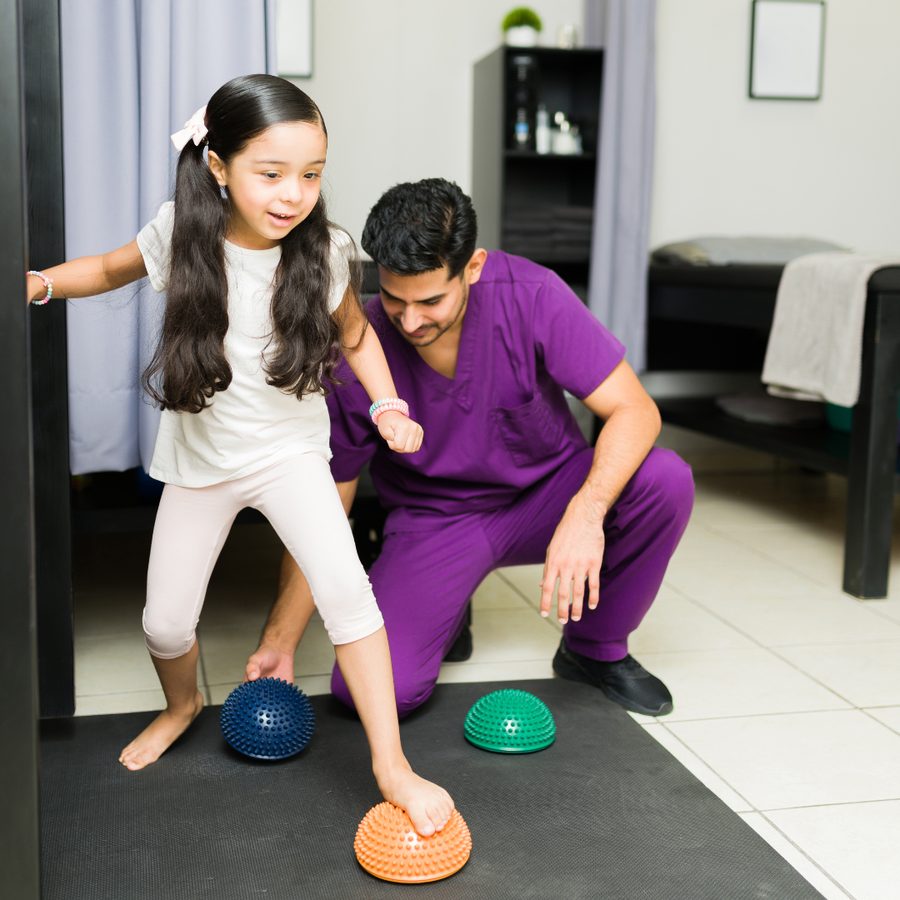
The active ingredient is the child's own attempts at a goal the family chose. Parental goal-setting at the start of intervention is one of the guideline's three best-practice principles. [2]
What a course of treatment looks like
It starts with the family's goals, not with the therapist's assessment findings. That is not a courtesy; it is the guideline's third best-practice principle and it determines what is trained. [2]
Then the training itself: the child practising the real task, actively and repeatedly, with the difficulty set so that success is possible but not automatic. Most of this happens at home, in play and daily routines, which is why parent capacity is treated as part of the intervention. [2] Appointments exist to set goals, teach, progress and problem-solve.
Strengthening is included and is progressed properly, at levels I to III. [4] Where spasticity is limiting active practice, tone management — casting, orthoses, botulinum toxin, and the other approaches examined in the network meta-analysis [5] — is used to make training possible, not as an end in itself.
Hip surveillance and musculoskeletal monitoring run in parallel throughout, because secondary change is the thing most worth preventing. The guideline covers musculoskeletal health as one of its nine domains. [2]
Goals are reviewed and reset as the child grows. A programme that has not changed in a year is unlikely to be tracking a growing child.
Where the child has a neurological injury acquired later, stroke rehabilitation and spinal cord injury rehabilitation describe related principles for adults. Feeding and swallowing difficulty is covered under dysphagia, where cerebral palsy is named as one of the populations in which screening is recommended.
What the evidence supports — and what it does not
Supported
- Early detection before six months using standardised tools. [1]
- Immediate referral, parental attachment support and parental goal-setting. [2]
- Activity-based, goal-directed training. [3][6]
- Progressive strength training at levels I to III, without increasing spasticity. [4]
Not supported
- Neurodevelopmental therapy at any dose. Strong recommendation against; deimplementation required. [3]
- More neurodevelopmental therapy. Higher dose no better than lower. [3]
- Avoiding strengthening for fear of spasticity. [4]
- Waiting to see before referring. Diagnosis is possible before six months and referral should be immediate. [1][2]
- Taking the network meta-analysis rankings at face value. Its authors specifically warn against it. [5]
How certain is this?
Evidence grade: Moderate.
The diagnostic evidence is strong. It rests on six systematic reviews and two evidence-based guidelines, all with high methodological quality ratings, and it has changed practice internationally. [1] It is the oldest source cited here and is retained because it is the foundation the 2021 guideline is explicitly built on.
The intervention guideline is a large, GRADE-based document from a broad international panel, drawing on 16 systematic reviews and 27 randomised trials — but it notes that the quality of the underlying evidence varied. [2] Its three best-practice principles are the most durable part.
The finding against neurodevelopmental therapy is consistent across four separate meta-analyses within one review, and the null result against control is the important one. Heterogeneity was considerable at 80% in the comparison with activity-based approaches, and not all studies met reporting standards. [3] The recommendation is strong; the effect sizes should be held loosely.
The strength-training evidence is good for what it covers and explicit about its boundaries: GMFCS levels I to III, adequate dosage, specific principles. [4] It does not speak to children at levels IV and V.
The network meta-analysis is the weakest item here despite being the largest, and its own limitations section says why: few randomised trials behind the top-ranked therapies, small samples that may overestimate effects, methodological biases and heterogeneity. [5] It is reported on this page because omitting a large recent analysis would be selective — not because its rankings should drive treatment.
The LMIC trial is well-conducted and its primary outcome was null. [6] The positive result is a subgroup finding in a modified intention-to-treat analysis, which is hypothesis-supporting rather than confirmatory.
What to expect
Expect a long relationship rather than a course of treatment. Goals change as the child grows, and the work shifts from motor milestones to school participation to independence.
Expect prognosis to depend heavily on classification level. In high-income countries, 2 in 3 individuals with cerebral palsy will walk, 3 in 4 will talk, and 1 in 2 will have normal intelligence. [1] Those are population figures; where an individual child sits is a conversation for the clinical team.
Expect most of the intervention to happen at home. That is by design, and it is why parent goal-setting and parent capacity are treated as components rather than courtesies. [2]
Expect the programme to include strengthening, and expect it to be real strengthening — adequate dosage was one of the conditions attached to the evidence. [4]
Expect monitoring for secondary problems, particularly hips and contractures, to continue even in periods when active therapy is not.
Common questions
My child is being given Bobath therapy. Should I be concerned?
It is a reasonable question to raise with the treating team. A meta-analysis of 34 studies and 1,332 participants found no effect of neurodevelopmental therapy over control, moderate effects favouring activity-based approaches over it, and no benefit from higher doses of it — and made a strong recommendation against its use at any dose, stating that deimplementation is required. [3] Many experienced therapists trained in that tradition now deliver goal-directed, activity-based work under a familiar name, so it is worth asking what is actually being done in the session rather than what it is called.
Should we wait until my child is older to be sure of the diagnosis?
No. Cerebral palsy can be diagnosed before six months' corrected age using a combination of standardised tools — the General Movements assessment has 98% sensitivity and the Hammersmith Infant Neurological Examination 90% before five months' corrected age. [1] The clinical practice guideline's first best-practice principle is immediate referral for intervention once a child meets the criteria for high risk. [2] Waiting spends the period of greatest neuroplasticity.
Will strengthening make the stiffness worse?
No, on the available evidence. A meta-analysis of 27 studies and 847 participants with spastic cerebral palsy found significant improvements in strength, maximum resistance, balance, gait speed and gross motor function — without increasing spasticity — in children at GMFCS levels I, II and III, when adequate dosage and specific principles were used. [4] Note the conditions: it applies to those levels, and the programme has to be genuinely progressive.
What can I do at home?
Most of the work, and that is the intended model rather than a compromise. Two of the guideline's three best-practice principles concern parents directly — building parental capacity for attachment, and parental goal-setting at the commencement of intervention — and five of its 28 recommendations address parent support. [2] What matters is that the practice is embedded in real activities and directed at a goal you chose.
I read that acupuncture and hippotherapy scored highest. Should we try them?
Discuss it, but read that analysis the way its authors ask you to. In a network meta-analysis of 81 trials, several interventions including acupuncture, hippotherapy and whole-body vibration produced large apparent effects on spasticity or gross motor function — and the authors state that the limited number of trials supporting the top-ranked therapies, small sample sizes that may overestimate treatment effects, methodological biases and heterogeneity all require cautious interpretation in the real world. [5] A very large effect size from small trials is usually a warning, not a recommendation.
Does early intervention work in settings like ours?
The one trial that tested this directly, in India and Bangladesh, is instructive. A parent-delivered, goal-directed programme delivered by peer trainers over 15 fortnightly home visits produced no overall difference against an equal dose of health advice on the primary mobility outcome. In the children with confirmed cerebral palsy at GMFCS levels I and II, it did produce significantly better mobility. [6] The authors read that as consistent with what is known about targeted goal-directed training — which is what the rest of this page also supports.
Does this page cover conditions other than cerebral palsy?
No, and that is a limitation worth stating. Paediatric physiotherapy also covers developmental coordination disorder, neuromuscular conditions, torticollis, juvenile arthritis, respiratory conditions and childhood injury. Each has its own evidence base. This page concentrates on cerebral palsy because that is where the practice has changed most and where the strongest guidelines exist.
References
- Novak I, Morgan C, Adde L, et al. Early, Accurate Diagnosis and Early Intervention in Cerebral Palsy: Advances in Diagnosis and Treatment. JAMA Pediatrics. 2017 Sep 1;171(9):897–907. doi:10.1001/jamapediatrics.2017.1689 PMID 28715518 Systematic review and clinical guideline
- Morgan C, Fetters L, Adde L, et al. Early Intervention for Children Aged 0 to 2 Years With or at High Risk of Cerebral Palsy: International Clinical Practice Guideline Based on Systematic Reviews. JAMA Pediatrics. 2021 Aug 1;175(8):846–858. doi:10.1001/jamapediatrics.2021.0878 PMID 33999106 International clinical practice guideline
- Te Velde A, Morgan C, Finch-Edmondson M, et al. Neurodevelopmental Therapy for Cerebral Palsy: A Meta-analysis. Pediatrics. 2022 Jun 1;149(6):. doi:10.1542/peds.2021-055061 PMID 35607928 Meta-analysis
- Merino-Andrés J, García de Mateos-López A, Damiano DL, et al. Effect of muscle strength training in children and adolescents with spastic cerebral palsy: A systematic review and meta-analysis. Clinical Rehabilitation. 2022 Jan;36(1):4–14. doi:10.1177/02692155211040199 PMID 34407619 Systematic review and meta-analysis
- Xu Y, Zhuang D, Chen F, et al. Nonsurgical Therapies for Spastic Cerebral Palsy: A Network Meta-Analysis. Pediatrics. 2025 Jul 1;156(1):. doi:10.1542/peds.2024-070402 PMID 40494559 Network meta-analysis
- Benfer KA, Whittingham K, Ware RS, et al. Efficacy of Early Intervention for Infants With Cerebral Palsy in an LMIC: An RCT. Pediatrics. 2024 Apr 1;153(4):. doi:10.1542/peds.2023-063854 PMID 38516717 Randomised controlled trial
About this guide
If you need assessment
This page explains. It does not diagnose.
A child with delayed or asymmetric movement needs assessment by a paediatrician and a paediatric therapist together, using standardised tools rather than reassurance and review. Diagnosis is possible before six months, and referral should not wait for certainty. Physiotherapist India publishes information and takes no bookings. Ask a qualified physiotherapist to examine your own case before acting on anything written here.