
Condition guide · Oncology rehabilitation
Lymphoedema
Persistent swelling of a limb after lymph nodes have been removed or damaged. The standard treatment works — but the component patients most associate with it, manual lymphatic drainage, is the one with the least evidence for reducing volume.
In plain words. Alongside the blood vessels runs a second network — the lymphatic system — which drains the fluid that constantly leaks out of small blood vessels into the tissues and returns it to the bloodstream. Lymph nodes sit along that network as junctions. When nodes are removed during cancer surgery, or damaged by radiotherapy or infection, the drainage capacity of that region falls. If the fluid produced exceeds what the remaining vessels can carry, it accumulates. The limb swells.
Once established, lymphoedema is a long-term condition that is managed rather than cured. What treatment does is reduce and control the swelling, protect the skin, and keep the limb usable.
Where this evidence comes from. Almost all of it concerns breast cancer-related lymphoedema of the arm, because that is where the research has been done. The lower limb is much less studied, and this page says so where it matters. [7] A systematic review of international guidelines also found that all 14 were produced in high-income countries, and that their suitability for low-resource settings is unclear. [6]
Key points
- Complete decongestive therapy is the standard of care, and current evidence supports its efficacy. [1]
- Manual lymphatic drainage adds no additional volume benefit as a component of that therapy. [1]
- It does help pain, and may reduce the incidence of lymphoedema — two findings that are often lost in the argument about volume. [4]
- Exercise is safe and is not the risk it was once thought to be. Strong evidence supports beneficial effects on strength and on upper-limb disability. [2]
- Resistance training reduces lymphoedema modestly — a standardised mean difference of -0.28 (95% CI -0.44 to -0.15) — with larger effects at higher intensity and at 12 weeks or more. [3]
- Prophylactic compression sleeves reduced arm swelling in a randomised trial of 307 women at high risk, conducted in India. [5]
- Skin care is not a footnote. It is part of the recommended self-management alongside exercise and compression. [6]
- Lower-limb lymphoedema is genuinely under-researched, and no evidence-based exercise recommendation could be made for it. [7]
What is actually happening
Lymphatic vessels carry fluid, protein and immune cells from the tissues back towards the heart. Unlike blood, lymph has no central pump: it moves by the contraction of the vessel walls, by the squeezing action of surrounding muscles, and by changes in pressure in the chest during breathing.
Removing or irradiating lymph nodes reduces the capacity of that system in the territory it drains. For a while the remaining vessels compensate. Lymphoedema appears when production of fluid outstrips the reduced transport capacity — which is why it may start months or years after the surgery rather than immediately.
The fluid that accumulates is protein-rich, and this is what makes lymphoedema different from ordinary swelling. Over time the protein drives inflammation and the deposition of fat and fibrous tissue. The limb becomes not just full of fluid but structurally changed, which is why the effect of treatment is smaller at later stages, and why later stages also show larger volume reductions from decongestive therapy simply because there is more to reduce. [1]
The skin matters throughout. Stagnant protein-rich fluid is a good medium for bacteria, and cellulitis in a lymphoedematous limb both causes damage and accelerates the underlying problem.
What it feels like
- Heaviness or tightness in the arm or leg, often before any visible swelling.
- Rings, watches, sleeves or shoes becoming tight on one side.
- Visible difference in size between the two limbs.
- Skin that feels thicker or firmer, and that pits less as time goes on.
- Aching, and reduced range at the shoulder or hip.
- Episodes of redness, heat and fever — cellulitis, which needs urgent antibiotics.
The symptoms often precede the measurements, which is why a limb that feels different is worth reporting even if it does not yet look different.
How it is diagnosed
Clinically, with measurement. The systematic review of international guidelines found that 13 of the 14 recommended an integrated medical and psychological assessment together with physical examination, and that a limb volume difference of more than 10% compared with the unaffected side confirms the diagnosis. [6]
Measurement methods differ in sensitivity, and this matters for how early the diagnosis is made. The randomised trial of compression sleeves used two: bioimpedance spectroscopy, which detects fluid changes before they are visible, and relative arm volume increase from circumference measurement. The two produced substantially different incidence figures in the same population — 42% against 52% by bioimpedance and 14% against 25% by volume, in compression and control groups respectively. [5] That gap is worth understanding: a large part of what is called "early lymphoedema" is detectable only by the more sensitive method.
Where the diagnosis is uncertain, or where swelling is bilateral, or where there is no history of node removal, other causes need excluding first. That is a medical assessment, not a physiotherapy one.
How physiotherapy and rehabilitation help
Complete decongestive therapy — and the argument inside it
Complete decongestive therapy is the standard of care. It has four components: manual lymphatic drainage, compression bandaging or garments, exercise, and skin care. Conventionally it runs in two phases — an intensive reduction phase, then a long-term maintenance phase carried out largely by the patient.
A 2024 review of systematic reviews assessed 13 reviews published between January 2018 and March 2023. Its overall conclusion is that current evidence supports the efficacy of complete decongestive therapy in breast cancer-related lymphoedema, with larger effect sizes at later stages. But it also found that only one of those reviews was of moderate quality; the rest were critically low quality on AMSTAR II. And on the components, the findings were uncomfortable: manual lymphatic drainage as a component demonstrated no additional volume benefit, and exercise's role in volume reduction was likewise limited, though it did show some benefit for pain and quality of life. [1]
Manual lymphatic drainage is the part of the treatment patients most identify with, so this deserves care. A meta-analysis of 11 randomised trials covering 1,564 patients found that manual lymphatic drainage significantly improved pain intensity (standardised mean difference -0.72, 95% CI -1.34 to -0.09) and reduced the incidence of lymphoedema (risk ratio 0.58, 95% CI 0.37 to 0.93), while its effects on limb volume and on quality of life were not statistically significant. [4]
Put those together and the picture is coherent rather than contradictory. Manual lymphatic drainage is not the component that shrinks an established limb; compression does that. It appears to help pain, and there is some evidence it reduces the chance of lymphoedema developing. It is reasonable to include; it is not reasonable to present it as the treatment.
Exercise — the reversal
Women were once advised to avoid loading the affected arm for fear of provoking swelling. That advice has not survived.
An umbrella review combined with its own systematic review and meta-analysis examined three systematic reviews containing 14 individual meta-analyses, plus 46 randomised controlled trials of which 11 could be pooled. Two of the existing meta-analyses met the criteria for strong evidence, and the new analysis found strong evidence for a beneficial effect of exercise on upper- and lower-body strength and on upper-limb disability in patients at risk of, or with, breast cancer-related lymphoedema. Progressive resistance training over 8 to 12 weeks is the most investigated form. The authors' practical note is that clinicians should monitor perceived exertion, training tolerance and clinical symptoms to ensure safe progression of workload. [2]
On the swelling itself, a dose-response meta-analysis of 30 studies found that resistance training reduced lymphoedema with a standardised mean difference of -0.28 (95% CI -0.44 to -0.15) and significantly increased upper and lower limb muscle strength. High-intensity training — five to eight repetition maximum, four times a week, 120 to 180 minutes weekly — had a larger effect on lymphoedema than moderate- to low-intensity training at three or fewer sessions a week; and programmes of 12 weeks or more were more effective than shorter ones. For patients who tolerate intensity poorly, the authors note that increasing frequency and duration can achieve comparable benefit. [3]
Prevention — the trial from Mumbai
A randomised controlled trial at Tata Memorial Hospital assigned 307 women who had undergone axillary lymph node dissection to either usual postoperative care or usual care plus two compression sleeves, worn until three months after adjuvant treatment finished. The hazard ratio for developing arm swelling in the compression group was 0.61 (95% CI 0.43 to 0.85) by bioimpedance spectroscopy and 0.56 (0.33 to 0.96) by relative arm volume increase. Estimated cumulative incidence at one year was 42% against 52% by bioimpedance and 14% against 25% by volume. Quality-of-life differences were not statistically significant on any of the four scales examined. [5]
This is a preventive intervention with a real effect, tested in an Indian population, and it is not yet standard practice everywhere.
What a programme involves
| Component | What it is for | Evidence |
|---|---|---|
| Compression bandaging in the intensive phase, garments for maintenance |
Reducing limb volume and holding the reduction. The load-bearing component of decongestive therapy. | Supported Complete decongestive therapy supported for volume reduction, with larger effects at later stages [1]; recommended by 13 of 14 international guidelines as part of the standard pathway [6] |
| Progressive resistance training 8–12 weeks and beyond, monitored |
Restoring strength and reducing upper-limb disability; modest reduction in swelling. | Supported Strong evidence for upper- and lower-body strength and upper-limb disability across 46 randomised trials [2]; lymphoedema reduced with SMD -0.28 (-0.44 to -0.15), larger at higher intensity and at 12 weeks or more [3] |
| Skin care and infection prevention | Preventing cellulitis, which damages the remaining lymphatics and worsens the condition. | Recommended Part of the self-management package recommended by the international guidelines reviewed [6] |
| Prophylactic compression sleeves after node dissection | Reducing the chance of swelling developing in the first place. | Supported by one large trial Hazard ratio 0.61 (0.43 to 0.85) by bioimpedance and 0.56 (0.33 to 0.96) by volume, in 307 women at high risk [5] |
| Manual lymphatic drainage | The component most associated with the treatment in patients' minds. | Helps pain, not volume No additional volume benefit as a component of decongestive therapy [1]; improves pain (SMD -0.72) and reduces incidence (RR 0.58), but effects on limb volume and quality of life not statistically significant [4] |
| Exercise for lower-limb lymphoedema | The same rationale as for the arm, applied to the leg. | Not established Twelve studies and 367 participants, high risk of bias, no meta-analysis possible; the reviewers state it was not possible to provide evidence-based recommendations [7] |
| Avoiding use of the affected arm the historical advice |
Was intended to prevent swelling. | Not supported Strong evidence that exercise benefits strength and upper-limb disability in patients at risk of or with lymphoedema [2]; resistance training reduces rather than increases swelling [3] |
An amber badge is a statement about the evidence cited on this page, not a verdict on the treatment.
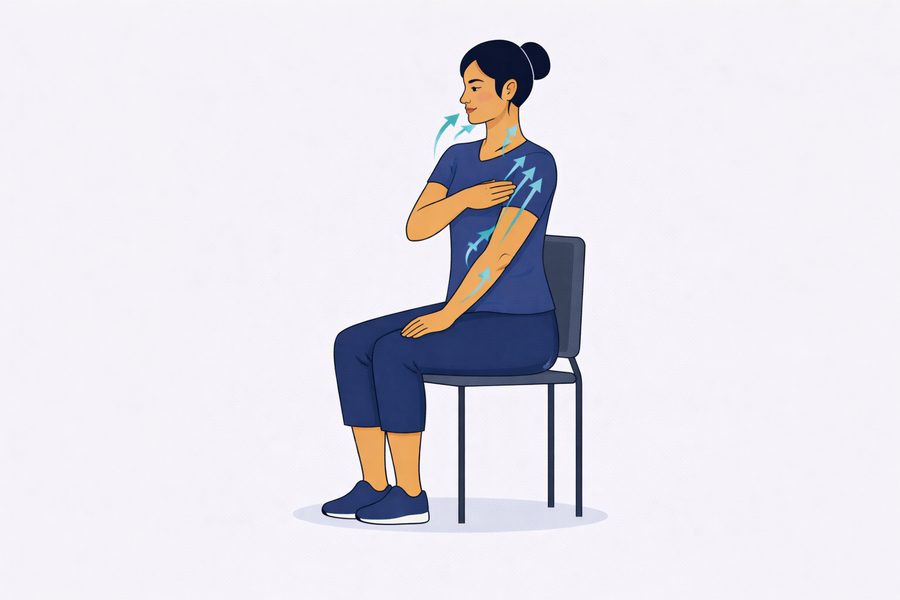
Self-lymphatic drainage is part of the self-management package the international guidelines recommend. [6] It is worth knowing what it is for: manual lymphatic drainage improves pain and may reduce incidence, but adds no further volume benefit on top of compression. [1][4]
What a course of treatment looks like
Assessment first: limb volume against the other side, skin condition, shoulder or hip range, strength, and what the limb is actually stopping you doing. Baseline measurement matters because everything afterwards is judged against it.
Then, where swelling is established, an intensive phase — usually daily or near-daily compression bandaging with exercise and skin care, over a few weeks — aimed at getting the volume down. This is time-consuming and is the part that most depends on having a trained therapist available.
Then maintenance, which lasts indefinitely: a fitted compression garment worn during the day, a self-management routine, and a progressive exercise programme. The international guidelines describe exactly this shape — decongestive therapy followed by self-management using skin care, self-lymphatic drainage massage, exercise and compression. [6]
The exercise programme is not a token add-on. The dose associated with the largest effect on swelling was high-intensity resistance training four times a week for 12 weeks or more, and for people who cannot tolerate that intensity, increasing frequency and duration was the recommended alternative. [3] Progression is monitored against perceived exertion, tolerance and symptoms. [2]
Garments need refitting as the limb changes, and any episode of cellulitis needs prompt antibiotics and a review of the plan.
Where the shoulder has become stiff and painful after surgery rather than swollen, see frozen shoulder and rotator cuff problems. Where the concern is general reconditioning during or after cancer treatment, cardiac rehabilitation describes the same principles of supervised, progressive exercise in a medically complex population.
What the evidence supports — and what it does not
Supported
- Complete decongestive therapy for volume reduction, with larger effects at later stages. [1]
- Exercise, including progressive resistance training — strong evidence for strength and upper-limb disability. [2]
- Higher-intensity, longer resistance programmes for a greater effect on swelling. [3]
- Prophylactic compression sleeves after axillary node dissection. [5]
- Manual lymphatic drainage for pain, and possibly for reducing incidence. [4]
Not supported
- Manual lymphatic drainage as the way to reduce limb volume. No additional volume benefit as a component. [1] No significant effect on volume. [4]
- Avoiding exercise or loading of the affected limb. [2][3]
- Any confident exercise recommendation for lower-limb lymphoedema. The reviewers could not make one. [7]
- Assuming international guidelines transfer directly to low-resource settings. All 14 came from high-income countries. [6]
How certain is this?
Evidence grade: Moderate.
The exercise evidence is the strongest here, and the umbrella review's own language — strong evidence for benefit on strength and upper-limb disability — is well supported by 46 randomised trials. [2] Note that this strong evidence concerns strength and disability, not swelling. On swelling, the resistance-training effect is real but modest, and it comes from a dose-response analysis whose subgroup findings (intensity, frequency, duration) are more fragile than the overall estimate. [3]
The evidence for decongestive therapy is weaker than its status as standard of care suggests. The review of reviews found that only one of 13 systematic reviews was of moderate quality and the remainder were critically low quality, and it explicitly calls for standardised staging criteria and outcome measures. [1] "Standard of care with supportive but low-quality evidence" is an honest description.
The manual lymphatic drainage picture is consistent across two independent analyses, which is why this page states it plainly. [1][4] The pain finding rests on a standardised mean difference whose confidence interval reaches close to zero (-1.34 to -0.09), so it is a real but not a large or precise effect. [4]
The compression sleeve trial is well-conducted and single. It measured swelling by two methods that gave quite different absolute incidences, and it found no significant quality-of-life difference. [5] It supports offering the sleeves; it does not establish how many women benefit in ways they would notice.
The lower-limb evidence is the weakest on the page and is included precisely so that readers with leg lymphoedema are not misled by the arm data. Twelve studies, 367 participants, high risk of bias, large heterogeneity, and the reviewers' own conclusion that no evidence-based recommendation was possible. [7]
What to expect
Expect management rather than cure. The intensive phase reduces the limb; the maintenance phase keeps it reduced, and it does not end.
Expect compression to do most of the volume work, and expect the daily garment to be the single most important thing you do. Expect the exercise programme to change what the limb can do rather than mainly how big it is — that is what the strongest evidence actually shows. [2]
Expect timescales in months. Resistance programmes of 12 weeks or more outperformed shorter ones on swelling, [3] and progressive resistance training over 8 to 12 weeks is the most studied format. [2]
Expect to be taught to watch for cellulitis, and to treat any episode as urgent. It is the complication most likely to set progress back.
Common questions
Is manual lymphatic drainage worth having?
For pain, and possibly for prevention — yes. For reducing the size of an established limb, the evidence does not support it. A review of systematic reviews found no additional volume benefit from manual lymphatic drainage as a component of decongestive therapy, [1] and a meta-analysis of 11 randomised trials found significant improvement in pain (standardised mean difference -0.72) and reduced incidence of lymphoedema (risk ratio 0.58) but no significant effect on limb volume. [4] Compression is what reduces volume.
Should I avoid lifting with that arm?
No. That advice has been overturned. An umbrella review of 46 randomised trials found strong evidence that exercise benefits upper- and lower-body strength and upper-limb disability in people at risk of or living with breast cancer-related lymphoedema, with progressive resistance training over 8 to 12 weeks the most studied format. [2] Resistance training also modestly reduces the swelling itself. [3] What matters is that the load is progressed sensibly and that exertion, tolerance and symptoms are monitored. [2]
How hard should I train?
Harder than most people assume, if you tolerate it. In the dose-response analysis, high-intensity resistance training at five to eight repetition maximum, four times a week, totalling 120 to 180 minutes weekly, had a larger effect on lymphoedema than lighter, less frequent training — and programmes lasting 12 weeks or more outperformed shorter ones. If high intensity is not tolerable, the authors note that increasing frequency and duration can achieve comparable benefit. [3]
Can lymphoedema be prevented?
Partly. In a randomised trial of 307 women who had undergone axillary lymph node dissection, wearing compression sleeves from surgery until three months after adjuvant treatment reduced and delayed arm swelling, with a hazard ratio of 0.61 by bioimpedance and 0.56 by arm volume. [5] Manual lymphatic drainage has also been associated with reduced incidence (risk ratio 0.58). [4] Neither eliminates the risk.
I have swelling in my leg, not my arm. Does this apply?
Only partly, and you should know that. The systematic review of exercise in lower-limb lymphoedema included 12 studies with 367 participants, found high risk of bias and heterogeneity too large for meta-analysis, and concluded that it was not possible to provide evidence-based recommendations. [7] Exercise appeared to have small positive effects on quality of life, physical function, pain and limb volume — but that is a description of weak data, not a recommendation.
Why does my limb suddenly become red, hot and painful?
That may be cellulitis, and it needs urgent medical attention and antibiotics rather than a physiotherapy appointment. Protein-rich stagnant fluid is vulnerable to infection, and each episode can further damage the remaining lymphatic vessels. Skin care is part of the recommended self-management for exactly this reason. [6]
Will it ever go away?
It is usually a long-term condition that is controlled rather than cured, and the maintenance phase is permanent. Effects of decongestive therapy are larger at later stages simply because there is more volume to remove, [1] which is not the same as later treatment being better — earlier management protects the tissue from the fibrous and fatty change that makes the limb harder to treat.
References
- Gilchrist L, Levenhagen K, Davies CC, et al. Effectiveness of complete decongestive therapy for upper extremity breast cancer-related lymphedema: a review of systematic reviews. Medical Oncology. 2024 Oct 23;41(11):297. doi:10.1007/s12032-024-02421-6 PMID 39438358 Review of systematic reviews
- García-Chico C, López-Ortiz S, Pinto-Fraga J, et al. Physical exercise and breast cancer-related lymphedema: an umbrella review, systematic review and meta-analysis. Disability and Rehabilitation. 2026 Jan;48(2):259–275. doi:10.1080/09638288.2025.2536722 PMID 40745968 Umbrella review, systematic review and meta-analysis
- Wang L, Liu Y, Zhang W, et al. Effects of resistance training on breast cancer-related arm lymphedema: a systematic review and dose-response meta-analysis. Supportive Care in Cancer. 2025 Apr 17;33(5):395. doi:10.1007/s00520-025-09448-z PMID 40244422 Systematic review and dose-response meta-analysis
- Lin Y, Yang Y, Zhang X, et al. Manual Lymphatic Drainage for Breast Cancer-related Lymphedema: A Systematic Review and Meta-analysis of Randomized Controlled Trials. Clinical Breast Cancer. 2022 Jul;22(5):e664–e673. doi:10.1016/j.clbc.2022.01.013 PMID 35370085 Systematic review and meta-analysis
- Paramanandam VS, Dylke E, Clark GM, et al. Prophylactic Use of Compression Sleeves Reduces the Incidence of Arm Swelling in Women at High Risk of Breast Cancer-Related Lymphedema: A Randomized Controlled Trial. Journal of Clinical Oncology. 2022 Jun 20;40(18):2004–2012. doi:10.1200/JCO.21.02567 PMID 35108031 Randomised controlled trial
- Torgbenu E, Luckett T, Buhagiar MA, et al. Guidelines Relevant to Diagnosis, Assessment, and Management of Lymphedema: A Systematic Review. Advances in Wound Care. 2023 Jan;12(1):15–27. doi:10.1089/wound.2021.0149 PMID 35196892 Systematic review of clinical practice guidelines
- Wittenkamp MC, Christensen J, Vinther A, et al. The effect of exercise in patients with lower limb lymphedema: a systematic review. Acta Oncologica. 2025 Mar 31;64:484–498. doi:10.2340/1651-226X.2025.42560 PMID 40165003 Systematic review
About this guide
If you need assessment
This page explains. It does not diagnose.
Lymphoedema needs measurement against the unaffected limb, a fitted compression garment, and exclusion of other causes of swelling before treatment begins. A red, hot, painful limb with fever is a medical emergency, not a physiotherapy appointment. Physiotherapist India publishes information and takes no bookings. Ask a qualified physiotherapist to examine your own case before acting on anything written here.