Condition guide · Cardiopulmonary rehabilitation
COPD and Pulmonary Rehabilitation
One of the few areas of physiotherapy where the evidence is considered settled — Cochrane closed its review because further trials comparing rehabilitation against usual care were judged unnecessary. The open questions are about access, not efficacy.
In plain words. Chronic obstructive pulmonary disease narrows and damages the airways, so moving air in and out takes more effort. The breathlessness that follows makes activity unpleasant, so people do less; doing less deconditions the muscles, which makes the same activity harder still. That spiral — not the lung damage alone — is what leaves people housebound.
Pulmonary rehabilitation is a supervised programme of exercise training plus education and self-management. It does not repair the lungs and does not change the numbers on a breathing test. It works on the deconditioning half of the spiral, and on that it is one of the most effective interventions in respiratory medicine.
Key points
- The benefit exceeds what patients notice, not merely what statistics detect. Across 65 trials, quality of life improved on all four Chronic Respiratory Questionnaire domains by more than the minimal clinically important difference of 0.5 units — dyspnoea 0.79 (95% CI 0.56 to 1.03), fatigue 0.68, emotional function 0.56, mastery 0.71. [1]
- Cochrane closed the review. In 2015 the editors judged that enough research had been done and that further trials of rehabilitation versus usual care in COPD were not a priority. [2] Very few physiotherapy questions have ever been closed this way.
- It carries a strong guideline recommendation for stable COPD and, separately, after hospitalisation for an exacerbation. [3]
- After a hospital admission it reduces readmissions — odds ratio 0.48 (95% CI 0.30 to 0.77) — and improves walking distance by 57 metres. It does not reduce mortality. [4]
- Home-based programmes match centre-based ones. No significant difference in exercise capacity or quality of life between them. [5]
- Gym equipment is not the active ingredient. Programmes using minimal equipment improved walking distance by 85 metres against usual care, and were no different from equipment-based programmes. [6]
- Adding inspiratory muscle training to rehabilitation does not help. Across 22 trials it failed to reach the minimal important difference on breathlessness, walking distance or quality of life. [7]
What is actually happening
COPD is persistent airflow obstruction, usually caused by long-term exposure to smoke or airborne particulates. In India that includes tobacco, but also biomass cooking fuel and occupational and ambient air pollution — which is why the condition is not confined to smokers here.
The airways narrow and lose elasticity, and air becomes trapped in the lungs. The chest sits in a more inflated position, the diaphragm is pushed flatter, and breathing becomes mechanically inefficient. Exertion then produces breathlessness quickly.
What happens next is behavioural rather than pulmonary, and it is where rehabilitation intervenes. Breathlessness is unpleasant and frightening, so activity is avoided. The leg and arm muscles weaken from disuse. Weaker muscles demand more oxygen for the same task, so the same walk produces more breathlessness than it did a year ago. People describe this as their lungs getting worse, and often the lungs have changed very little.
What it feels like
- Breathlessness on exertion — at first on hills and stairs, later on flat ground, eventually while dressing or washing.
- A persistent cough, often with sputum, frequently worse in the morning.
- Wheeze and a sense of chest tightness.
- Fatigue that is out of proportion to what was done.
- Periods of sudden worsening — exacerbations — often triggered by infection, sometimes requiring hospital admission.
The pattern that matters most for rehabilitation is not the worst day but the shrinking of ordinary activity: the shops that stopped being walked to, the stairs that became a reason to stay upstairs.
How it is diagnosed
COPD is diagnosed by a doctor using spirometry — a breathing test measuring how much air can be forced out in one second relative to the total. Persistent obstruction after a bronchodilator confirms it. Symptoms alone are not enough, because breathlessness has many causes, and heart failure in particular can look very similar.
A physiotherapist does not diagnose COPD. What a physiotherapy assessment establishes is different and complementary: how far you can actually walk, how breathless that makes you, how strong your legs are, what you have stopped doing, and what you would most like to be able to do again. That is what the programme is built from, and it is why two people with identical spirometry can need quite different programmes.
How physiotherapy and rehabilitation help
Pulmonary rehabilitation attacks the deconditioning half of the spiral. Exercise training makes the muscles more efficient, so a given task requires less oxygen and therefore produces less breathlessness. Nothing about the airway obstruction changes. What changes is how much you can do before it stops you, and how frightening that feels.
That distinction matters when judging results. Spirometry does not improve much with rehabilitation, and a clinician who measures success that way will conclude it did not work. The outcomes that do move are walking distance, breathlessness during activity, and quality of life — and those moved by more than the minimal clinically important difference across all four quality-of-life domains in the Cochrane review. [1] St George's Respiratory Questionnaire total score improved by 6.89 points where 4 points is considered clinically important, and that estimate held at 5.15 points when only the trials at lower risk of bias were analysed. [1]
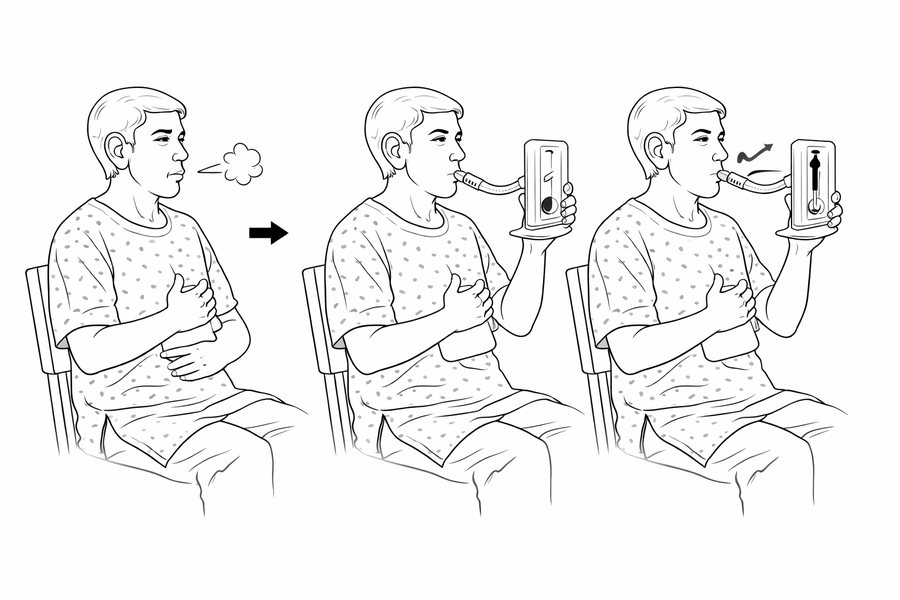
Breathing techniques and devices are part of most programmes, but they are not where the benefit comes from. Exercise training is the active ingredient — adding inspiratory muscle training on top of rehabilitation did not produce a clinically important improvement in breathlessness, walking distance or quality of life. [7]
What a programme involves
| Component | What it is | What it is for |
|---|---|---|
| Aerobic exercise training | Walking, cycling or step-based work, progressed in duration and intensity | The core of the programme and the source of most of the benefit |
| Resistance training | Strengthening for the legs and arms | Addresses the muscle weakness that drives the breathlessness spiral |
| Breathing techniques | Pursed-lip and paced breathing, positions of ease | Managing breathlessness during activity and settling it afterwards |
| Airway clearance | Techniques for moving sputum, where sputum is a problem | Only relevant for some people; not a universal component |
| Education and self-management | Recognising an exacerbation early, inhaler technique, pacing, action plans | What determines whether the gains survive after the programme ends |
What a course of treatment looks like
Most programmes in the Cochrane review ran for eight or twelve weeks, with the full range spanning four to fifty-two weeks. [1] Around two-thirds were hospital-based and the rest were delivered in community centres or in people's homes. [1] A typical course is two supervised sessions a week with prescribed exercise on the other days.
Assessment comes first, usually including a walking test, so that progress is measured rather than assumed. The programme is then set against what you can currently do, not against a standard protocol, and advanced as tolerance improves.
Where the real problem is
The ATS guideline states the difficulty plainly: despite known benefits, pulmonary rehabilitation is underused. [3] That is the live issue in this field — not whether it works, but whether people can get to it.
Three findings bear directly on that, and all three are good news for practice in India:
- Home-based works. Across 16 studies in 11 countries, home-based rehabilitation improved exercise capacity (SMD 0.88, 95% CI 0.32 to 1.44) and quality of life (SMD -0.62, 95% CI -0.88 to -0.36) compared with usual care, and showed no significant difference from centre-based programmes on either outcome. [5]
- Telerehabilitation is guideline-endorsed. The ATS makes a strong recommendation, on moderate-quality evidence, for offering people the choice of centre-based rehabilitation or telerehabilitation. [3] A choice, not a downgrade.
- Expensive equipment is not required. Programmes using minimal equipment increased six-minute walk distance by 85 metres compared with usual care (95% CI 37 to 132) and improved quality of life (SMD 0.99, 95% CI 0.31 to 1.67), with no difference from equipment-based programmes in walking distance or in upper or lower limb strength. [6] The authors say directly that this may improve access in rural and remote areas and in developing countries.
Taken together: a programme delivered at home, without a gymnasium, supported remotely, is not a compromise version of pulmonary rehabilitation. On the available evidence it is pulmonary rehabilitation.
What the evidence supports — and what it does not
Supported
- Rehabilitation for stable COPD — strong guideline recommendation on moderate-quality evidence. [3]
- Rehabilitation after hospitalisation for an exacerbation — a separate strong recommendation, [3] supported by a reduction in readmissions (OR 0.48) and a 57-metre gain in six-minute walk distance. [4]
- Improvement in quality of life beyond the clinically important threshold across all four CRQ domains. [1]
- Home-based and minimal-equipment delivery as genuine alternatives rather than second best. [5][6]
Not supported
- Any claim that rehabilitation prolongs life. The post-discharge analysis found no significant effect on mortality. [4]
- Adding inspiratory muscle training to a rehabilitation programme. Across 22 trials the gain in six-minute walk distance was 5.95 metres against a minimal important difference of 26 metres, and breathlessness and quality of life did not reach their thresholds either. [7]
- Judging the programme by lung function. Rehabilitation is not expected to change airflow obstruction, and measuring it that way will make an effective programme look useless.
- Treating equipment as the ingredient. Minimal-equipment programmes matched equipment-based ones. [6]
How certain is this?
Evidence grade: High, for the central question — and this is the strongest evidence base of any guide on this site.
The Cochrane review pooled 65 randomised trials and 3,822 participants and found statistically significant improvement on every included outcome. [1] The editors then took the unusual step of closing the review, judging that enough research had been done to answer whether rehabilitation helps and that the field should move on to other questions. [2] When a Cochrane review is retired for that reason, it is about as close to settled as clinical evidence gets.
Three honest qualifications. First, blinding is impossible in an exercise trial — participants know whether they are exercising — and allocation concealment was unclear in many of the earlier studies, which the reviewers flag as affecting overall risk of bias. [1] Second, individual quality-of-life domains were rated low quality even where the pooled effect was large. [1] Third, the supporting questions are much less settled than the central one: the post-discharge analysis carried high statistical heterogeneity, and the recommendation for maintenance rehabilitation after an initial programme is only conditional, on low-quality evidence. [3][4]
What survives all of that is the main finding, and it is unusually secure: for people with COPD, supervised exercise training improves breathlessness, walking capacity and quality of life by amounts patients can feel.
What to expect
Improvement in weeks rather than months, and in what you can do rather than in your breathing test. Most people notice walking further before they notice feeling less breathless, because the breathlessness arrives later in the walk rather than disappearing.
The harder truth is about what happens afterwards. Gains fade if activity stops, and the guideline's recommendation for supervised maintenance programmes is only conditional, on low-quality evidence. [3] The realistic plan is not a course that finishes but a level of activity that continues, which is why the education and self-management components matter more than they appear to.
Exacerbations will still happen. Rehabilitation reduces the chance of being readmitted after one [4] but does not prevent them, and an exacerbation is not evidence that the programme failed.
Common questions
Will pulmonary rehabilitation improve my lung function test?
Almost certainly not, and it is not designed to. Rehabilitation improves the muscles and the efficiency with which you use them, not the obstruction in the airways. Judged on spirometry it will look like it failed; judged on how far you can walk and how you feel doing it, it is one of the most effective treatments available for COPD. [1]
I get breathless walking to the door. Am I too unwell for this?
That is the group the programme is designed for, not a reason to be excluded. Programmes are set against what you can currently do. Rehabilitation is also specifically recommended after hospitalisation for an exacerbation, [3] which is when people are at their least fit, and the post-discharge trials reported no intervention-related adverse events. [4]
Can I do this at home instead of travelling to a centre?
On the evidence, yes. Home-based programmes showed no significant difference from centre-based programmes in exercise capacity or quality of life, [5] and the ATS guideline makes a strong recommendation for offering the choice of centre-based rehabilitation or telerehabilitation. [3] What matters is that the programme is properly assessed, prescribed and progressed — not where it happens.
Do I need a gym, a treadmill or an exercise bike?
No. Minimal-equipment programmes improved six-minute walk distance by 85 metres against usual care and were no different from equipment-based programmes on walking distance or muscle strength. [6] The reviewers highlight this as a way of widening access in settings where gymnasium equipment is not available.
Should I be doing breathing-muscle training with a device?
Not as an addition to a rehabilitation programme, on current evidence. A Cochrane review of 55 trials found that adding inspiratory muscle training to pulmonary rehabilitation did not produce clinically important improvements in breathlessness, walking distance or quality of life. [7] Breathing techniques for managing breathlessness during activity are a different matter and remain a normal part of care.
I have heart problems as well. Does that change anything?
It needs to be assessed, not assumed to be a barrier. Breathlessness commonly has both a respiratory and a cardiac component, and exercise prescription has to account for both. The principles overlap considerably with cardiac rehabilitation, which is worth reading alongside this page.
References
- McCarthy B, Casey D, Devane D, et al. Pulmonary rehabilitation for chronic obstructive pulmonary disease. Cochrane Database of Systematic Reviews. 2015 Feb 23;2015(2):CD003793. doi:10.1002/14651858.CD003793.pub3 PMID 25705944 Systematic review and meta-analysis
- Lacasse Y, Cates CJ, McCarthy B, et al. This Cochrane Review is closed: deciding what constitutes enough research and where next for pulmonary rehabilitation in COPD. Cochrane Database of Systematic Reviews. 2015 Nov 18;2015(11):ED000107. doi:10.1002/14651858.ED000107 PMID 26593129 Cochrane editorial
- Rochester CL, Alison JA, Carlin B, et al. Pulmonary Rehabilitation for Adults with Chronic Respiratory Disease: An Official American Thoracic Society Clinical Practice Guideline. American Journal of Respiratory and Critical Care Medicine. 2023 Aug 15;208(4):e7–e26. doi:10.1164/rccm.202306-1066ST PMID 37581410 Clinical practice guideline
- Jenkins AR, Burtin C, Camp PG, et al. Do pulmonary rehabilitation programmes improve outcomes in patients with COPD posthospital discharge for exacerbation: a systematic review and meta-analysis. Thorax. 2024 Apr 15;79(5):438–447. doi:10.1136/thorax-2023-220333 PMID 38350731 Systematic review and meta-analysis
- Uzzaman MN, Agarwal D, Chan SC, et al. Effectiveness of home-based pulmonary rehabilitation: systematic review and meta-analysis. European Respiratory Review. 2022 Sep 30;31(165):. doi:10.1183/16000617.0076-2022 PMID 36130789 Systematic review and meta-analysis
- Cheng SWM, McKeough ZJ, McNamara RJ, et al. Pulmonary Rehabilitation Using Minimal Equipment for People With Chronic Obstructive Pulmonary Disease: A Systematic Review and Meta-Analysis. Physical Therapy. 2023 May 4;103(5):. doi:10.1093/ptj/pzad013 PMID 37140475 Systematic review and meta-analysis
- Ammous O, Feki W, Lotfi T, et al. Inspiratory muscle training, with or without concomitant pulmonary rehabilitation, for chronic obstructive pulmonary disease (COPD). Cochrane Database of Systematic Reviews. 2023 Jan 6;1(1):CD013778. doi:10.1002/14651858.CD013778.pub2 PMID 36606682 Systematic review and meta-analysis
About this guide
If you need assessment
This page explains. It does not diagnose.
COPD is diagnosed with spirometry and medically managed by a doctor. A physiotherapy assessment establishes something different — how far you can walk, how breathless that makes you, how strong your legs are, and what you have stopped doing — and builds a programme from that. Physiotherapist India publishes information and takes no bookings. Ask a qualified physiotherapist to examine your own case before acting on anything written here.