Condition guide · Knee
ACL Injury Rehabilitation
A torn anterior cruciate ligament does not automatically mean surgery. The trial that tested the alternative — rehabilitate first, operate only if needed — followed people for five years to find out.
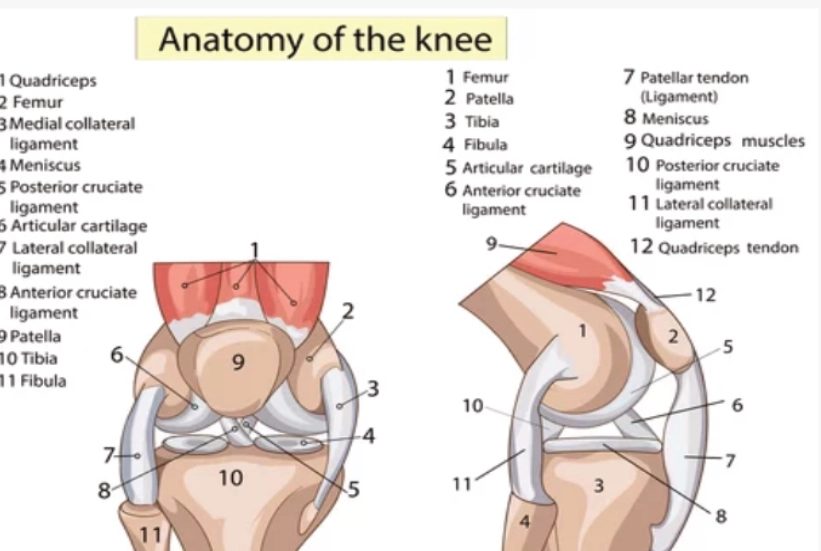
In plain words. The anterior cruciate ligament, or ACL, sits inside the knee and stops the shin bone sliding forward under the thigh bone. It commonly tears in sport, with a sudden twist or a pivot — often with a pop, rapid swelling, and a feeling that the knee is not trustworthy.
The reflexive assumption is that a torn ligament must be reconstructed surgically. A landmark Swedish trial tested that assumption directly, by randomising young active adults to early surgery or to rehabilitation with the option of surgery later if needed — and following them for five years.
Key points
- At five years, there was no meaningful difference between early reconstruction and rehabilitation with optional delayed surgery (KOOS4 difference 2.0 points, 95% CI −8.5 to 4.5). [1]
- Half of the rehabilitation group never had surgery at all. 51% underwent delayed reconstruction; the rest managed without it. [1]
- No difference was found in any of the knee-specific subscales, general health, activity level, or the rate of radiographic osteoarthritis at five years. [1]
- Results were the same whether analysed by assigned group or by treatment actually received. [1]
- The trial's own conclusion: young active adults should be encouraged to consider rehabilitation as a primary treatment option after an acute tear. [1]
- None of this says surgery is wrong for you individually — it says the decision is a genuine choice, not a foregone conclusion.
What is actually happening
The ACL is one of four main ligaments stabilising the knee. It resists the shin sliding forward and controls rotation, particularly during cutting, pivoting and landing. A tear — partial or complete — removes some or all of that restraint, which is why the knee can feel unstable on twisting movements even once the initial pain and swelling have settled.
Reconstruction replaces the torn ligament with a graft, usually taken from the patient's own hamstring or patellar tendon. Rehabilitation without surgery instead works to restore strength, control and confidence in the knee using the muscles around it — principally the hamstrings and quadriceps — to compensate for the missing mechanical restraint.
What it feels like
- A sudden twisting or pivoting injury, often with an audible pop.
- Rapid swelling within hours, from bleeding inside the joint.
- A sense that the knee is unstable or might give way, particularly turning or changing direction.
- Pain that may settle over days to weeks, while instability persists.
- Difficulty trusting the knee for sport, even once swelling and pain have gone.
How it is diagnosed
By history, examination and specific ligament tests, supported by MRI to confirm the tear and check for associated damage to the menisci or cartilage — both of which affect the treatment decision. The KANON trial enrolled young, active adults with an acute, isolated ACL tear and assessed them carefully for these associated injuries. [1]
How physiotherapy and rehabilitation help
Whichever pathway is chosen — early surgery, delayed surgery, or no surgery — rehabilitation is the common thread. In the KANON trial, both groups received the same structured rehabilitation programme; the only difference was whether reconstruction happened early, or was delayed and made optional. [1] That is worth sitting with: rehabilitation was not the alternative to treatment, it was the treatment both groups had.
The programme is built around restoring full range of movement, then progressively loading and strengthening the quadriceps and hamstrings, then retraining balance and control, and finally sport-specific work — cutting, pivoting, landing — before return to sport is considered.
What a programme involves
| Component | What it is for | Evidence |
|---|---|---|
| Early swelling and range-of-movement management | Settling the acute reaction and restoring full knee extension and flexion before strength work begins. | Standard care Foundational; not separately isolated in the cited trial |
| Progressive quadriceps and hamstring strengthening | Building the muscular support that partly compensates for the missing ligament restraint. | Core of the tested strategy Delivered to both trial groups; the strategy that matched surgery at 5 years [1] |
| Neuromuscular and balance training | Retraining the knee's control during pivoting and landing. | Standard care Part of structured rehabilitation; not separately isolated |
| Graded return to sport-specific movement | Rebuilding confidence and capacity for cutting and pivoting before returning to sport. | Standard care |
| Rehabilitation with optional delayed reconstruction | Treating surgery as a later option rather than an automatic first step, guided by how the knee performs. | Supported No difference from early reconstruction at 5 years; 51% avoided surgery entirely [1] |
| Early ACL reconstruction | Surgically replacing the torn ligament soon after injury. | Not shown superior Equivalent outcomes to rehabilitation with optional delayed surgery at 5 years [1] |
Rehabilitation is the common thread whichever pathway is chosen. Both groups in KANON received the same structured programme; the only difference was whether reconstruction happened early or was left optional. [1]
What a course of treatment looks like
Assessment first, including checking for meniscal or cartilage damage that changes the picture. Then a structured programme progressing through stages — swelling and range, strength, control, sport-specific movement — with objective criteria, not just time, used to decide when to progress.
The decision about surgery, where it is not obvious either way, is made alongside this: does the knee remain unstable despite rehabilitation, and does that instability matter for the sport or activities that person wants back? That is an individual judgement, not a rule.
What the evidence supports — and what it does not
KANON at 5 years: early reconstruction vs rehabilitation with optional surgery
Supported
- Rehabilitation as a genuine primary treatment after an acute ACL tear — equivalent five-year outcomes to early surgery. [1]
- Delaying surgery to see how the knee responds — only 51% of the rehabilitation group went on to need reconstruction, with no penalty for waiting. [1]
- Structured rehabilitation regardless of the surgical decision — it was delivered to both groups and is common to every pathway.
Not supported
- "You must have surgery or your knee will be ruined" — no significant difference in KOOS4, any subscale, general health, activity level, or radiographic osteoarthritis at five years. [1]
- Early reconstruction as a way to prevent later meniscus surgery — no difference between groups in meniscus surgery or in the proportion of meniscuses operated on over time. [1]
- Applying this to knees with major associated damage — the trial enrolled people with isolated ACL tears; a knee with significant meniscal or cartilage injury is a different decision.
How certain is this?
Evidence grade: Moderate. KANON is described by its own authors as the first high-quality randomised trial in this area, with minimal loss to follow-up at five years — a genuine strength for an orthopaedic trial run this long. [1] Results were consistent whether analysed by original group assignment or by the treatment people actually ended up having, which adds confidence.
The limits: 121 patients is a modest sample for detecting small differences, and the confidence interval (−8.5 to 4.5 points) is wide enough that a real but modest advantage either way cannot be fully excluded. The population was young, active adults with isolated tears — the findings should not be extended to older patients, occupational athletes with very high demands, or knees with substantial associated damage without individual judgement.
What to expect
Recovery, whichever path is chosen, is measured in months. Early rehabilitation focuses on swelling and movement, strength work follows over subsequent months, and a graded return to cutting and pivoting sport is the final stage — commonly not before nine months to a year, regardless of whether surgery has been done, because tissue healing and neuromuscular retraining both take time.
Some people manage very well without ever having surgery; others find ongoing instability that surgery resolves. The KANON data support taking the time to find out which applies to you, rather than assuming the answer in advance. [1]
When a knee injury needs urgent assessment
Seek prompt medical attention if you have:
- A knee that will not straighten or bend, or that locks — this can indicate a displaced meniscal fragment.
- Marked deformity, or the knee visibly out of position.
- Rapid, tense swelling within hours of injury — suggests bleeding inside the joint and needs assessment.
- Inability to bear any weight at all on the leg.
- Numbness, coldness or loss of pulse in the foot after a knee injury — this is an emergency.
- A hot, red, swollen knee with fever, which can indicate infection.
This list is not exhaustive. If you are worried about a symptom, seek professional advice.
Common questions
I tore my ACL. Do I need surgery straight away?
Not automatically. In a trial that randomised young active adults to early reconstruction or to rehabilitation with the option of later surgery, the two strategies produced equivalent outcomes at five years, and half the rehabilitation group never needed surgery at all. [1] It is a genuine decision, best made with a clinician who can assess your specific knee.
Will skipping surgery lead to arthritis?
The five-year data found no difference in radiographic osteoarthritis between the two strategies. [1] Longer-term risk is influenced by other factors too, particularly meniscal and cartilage damage at the time of injury, which is part of why that assessment matters.
What if I try rehabilitation and the knee still gives way?
That is exactly the scenario the delayed-surgery option is for. In the trial, people could move to reconstruction if rehabilitation did not resolve the instability, and outcomes for that group were no worse than for those who had surgery immediately. [1]
Does this apply to professional or high-level athletes?
The trial enrolled young, active adults, not specifically elite athletes with very high rotational demands, and it does not address every sporting context. The decision for a competitive pivoting-sport athlete involves considerations beyond what this trial measured, and should be made individually.
Is rehabilitation the same whether or not I have surgery?
Largely, yes — both groups in the trial received a structured rehabilitation programme. [1] What differs is the addition of post-surgical stages if reconstruction is done, and the timeline for returning to pivoting sport, which is generally more cautious after surgery while the graft matures.
What the most recent evidence adds
KANON reported its five-year outcomes in 2013. Nothing published since overturns it — but a good deal has been added.
There is now a guideline for rehabilitation after reconstruction. Aspetar published one in 2023, developed using AGREE II and GRADE. Its central position is that exercise should be the mainstay, with modalities useful as an adjunct early on when pain, swelling and stiffness limit what you can do. Two admissions in it matter: there is little evidence on how much exercise, at what intensity, produces what result; and there is no evidence on which criteria should be used to decide you are ready to return to running or sport. Most of its recommendations rest on expert agreement at a very low certainty of evidence. [2]
The belief that surgery is needed to return to sport has been tested directly. A 2025 systematic review and meta-analysis pooled 18 articles reporting 15 studies. Reconstruction was not associated with higher return-to-sport rates (odds ratio 1.5, 95% CI 0.76 to 2.97). A small difference in activity level favoured reconstruction (Tegner mean difference 0.7, 95% CI 0.16 to 1.24), but it did not exceed the minimal detectable change and it disappeared once studies at high risk of confounding were excluded. Read the caveat alongside the result: only two of the 15 studies were randomised, ten were at high risk of confounding bias that would tend to favour surgery, and the certainty of evidence is low to very low. [3]
Several popular add-ons do not hold up. A systematic review of 50 Level-I and Level-II studies found that postoperative bracing offers no advantage and does not improve limb asymmetry, that blood flow restriction training combined with high-intensity exercise is not effective, and that high-intensity plyometric exercise is not effective. What did hold up: early introduction of open kinetic chain exercise may improve outcomes, neuromuscular electrical stimulation is effective, and supervised rehabilitation is more effective than unsupervised. [4] The last of those is the one most often ignored.
Confidence in the knee is part of the physical result. A systematic review of 38 studies found that kinesiophobia and fear of re-injury are common after reconstruction, and that psychological factors impede return to sport, alter measurable knee biomechanics, and potentially increase the risk of re-rupture. [5] Psychological readiness is recognised in clinical practice guidelines but is rarely actually measured during rehabilitation — a gap worth raising with your physiotherapist rather than waiting for someone else to raise it.
One thing this page does not claim: that either pathway protects the joint long term. Anyone who tears an ACL is at raised risk of knee osteoarthritis later, and KANON found no difference in radiographic osteoarthritis at five years between the two strategies. [1]
References
- Frobell RB, Roos HP, Roos EM, et al. Treatment for acute anterior cruciate ligament tear: five year outcome of randomised trial. BMJ. 2013 Jan 24;346:f232. doi:10.1136/bmj.f232 PMID 23349407 Randomised controlled trial
- Kotsifaki R, Korakakis V, King E, et al. Aspetar clinical practice guideline on rehabilitation after anterior cruciate ligament reconstruction. British Journal of Sports Medicine. 2023 May;57(9):500–514. doi:10.1136/bjsports-2022-106158 PMID 36731908 Clinical practice guideline
- Filbay SR, Bullock G, Russell S, et al. No Difference in Return-to-Sport Rate or Activity Level in People with Anterior Cruciate Ligament (ACL) Injury Managed with ACL Reconstruction or Rehabilitation Alone: A Systematic Review and Meta-Analysis. Sports Medicine. 2025 Sep;55(9):2191–2205. doi:10.1007/s40279-025-02268-5 PMID 40603829 Systematic review and meta-analysis
- Glattke KE, Tummala SV, Chhabra A. Anterior Cruciate Ligament Reconstruction Recovery and Rehabilitation: A Systematic Review. Journal of Bone and Joint Surgery (American). 2022 Apr 20;104(8):739–754. doi:10.2106/JBJS.21.00688 PMID 34932514 Systematic review
- Nedder VJ, Raju AG, Moyal AJ, et al. Impact of Psychological Factors on Rehabilitation After Anterior Cruciate Ligament Reconstruction: A Systematic Review. Sports Health. 2025 Mar;17(2):291–298. doi:10.1177/19417381241256930 PMID 39041333 Systematic review
About this guide
If you need assessment
This page explains. It does not diagnose.
Whether your particular knee is a good candidate for rehabilitation alone depends on associated meniscal or cartilage damage, your activity goals and how the knee responds — all of which require examination. Physiotherapist India publishes information and takes no bookings. Ask a qualified physiotherapist to examine your own case before acting on anything written here.