
Condition guide · Foot and ankle
Achilles Tendinopathy
Pain and stiffness in the tendon at the back of the heel. Forty-two treatments have been tested against each other. The most useful finding is which one to start with, and why.
In plain words. The Achilles is the thickest, strongest tendon in the body, and it takes several times your body weight every time you push off. When the load asked of it outruns what it can currently tolerate, the tendon becomes painful, stiff first thing in the morning, and sore to squeeze.
The evidence has an unusual shape. Across 29 trials testing 42 different treatments, almost everything active beat doing nothing — and almost nothing clearly beat anything else. That sounds unhelpful, but it points firmly at a sensible first move.
Key points
- Wait-and-see is not recommended. Every class of active treatment appeared superior to it at three months. [1]
- No active treatment clearly beat another at either three or twelve months. [1]
- The reviewers' practical conclusion: because exercise therapy is easy to prescribe, low cost and has few harms, clinicians could start with a calf-muscle exercise programme. [1]
- The evidence is weak. No trial was at low risk of bias; 76% were at high risk, and the comparative estimates carried large uncertainty. [1]
- 86% of the trials studied midportion tendinopathy — pain in the body of the tendon, not where it meets the heel bone. [1]
- Insertional tendinopathy is not covered. No network meta-analysis could be performed for it at all. [1]
What is actually happening
The calf muscles — gastrocnemius and soleus — converge into the Achilles tendon, which attaches to the back of the heel bone. Every step, every push-off, every hop passes through it. It is designed to store and return energy like a spring, which is exactly why it is vulnerable to sudden increases in how much springing you ask of it.
Tendinopathy is a change in the tendon's structure and its capacity, not a simple inflammation. That distinction matters practically: the tissue responds to being loaded in a controlled way, and generally does not respond well to being rested completely and then loaded suddenly again.
Two locations behave differently. Midportion tendinopathy sits two to six centimetres above the heel bone and is what most of the research covers. Insertional tendinopathy sits right where the tendon meets the bone, is often aggravated by positions that compress it against the heel, and has a much thinner evidence base — the review could not analyse it at all. [1]
What it feels like
- Pain and stiffness in the tendon on the first steps of the morning, easing as you warm up.
- Pain that warms up during activity, then is worse the following day — a very characteristic pattern.
- Tender to pinch the tendon between finger and thumb, sometimes with a thickened area.
- Worse with hills, stairs, speed work, or a sudden increase in walking or running.
- In insertional cases, pain right at the back of the heel, often aggravated by stiff shoe backs and by stretching the calf.
How it is diagnosed
Clinically, from the location of the tenderness, the load-related pattern of symptoms, and testing the tendon under increasing load — heel raises, then hopping. Imaging is not required to make the diagnosis and tendon changes on ultrasound are common in people without pain.
The essential distinction is a partial or complete tendon rupture, which is a different and time-critical problem — see the red flags below.
How physiotherapy and rehabilitation help
The goal is to rebuild the tendon's capacity so it tolerates the loads you want to put through it. That is done by loading it progressively: starting at a level that does not flare the symptoms unacceptably, then increasing over weeks and months. Alongside that sits a plan for the training or activity that provoked it, because the condition is usually a mismatch between load and capacity rather than an event.
The review's recommendation to start with a calf-muscle exercise programme is not a claim that exercise is superior. It is a decision made under uncertainty: when several treatments look equivalent and none is clearly best, the sensible starting point is the one that is cheap, easy to prescribe and carries few harms. [1]
What a programme involves
| Component | What it is for | Evidence |
|---|---|---|
| Progressive calf-muscle loading heel raises progressed in load and speed over months |
Rebuilding the tendon's tolerance to the demands of walking, stairs and running. | Recommended starting point Comparable to other active treatments; easy, low cost, few harms [1] |
| Load management | Temporarily adjusting hills, speed, distance and frequency — the things that usually caused the mismatch. | Not separately tested Standard practice; not isolated in the review |
| Education on the expected timeframe | Knowing that pain warming up during activity and being worse the next day is the normal pattern, not a sign of harm. | Not separately tested |
| Night splints | Holding the ankle in a position that reduces morning stiffness. | Comparable when added to exercise Exercise plus night splint was comparable to injection therapy at 12 months [1] |
| Injection therapies | A range of injectable treatments used for stubborn tendon pain. | Comparable, not superior No clinically relevant difference from exercise at 3 or 12 months [1] |
| Wait and see | Doing nothing active and allowing time to pass. | Not recommended All active treatment classes seemed superior at 3 months [1] |
| Shockwave, laser and other modalities | Commonly offered for tendon pain. | Among the 42 treatments, no clear winner No treatment showed a clinically relevant advantage over another [1] |
This table looks unusually flat because the evidence is unusually flat. When 42 treatments are compared and none pulls ahead, the honest presentation is a table without a winner — and a recommendation based on cost, ease and safety rather than on a superiority that has not been demonstrated.
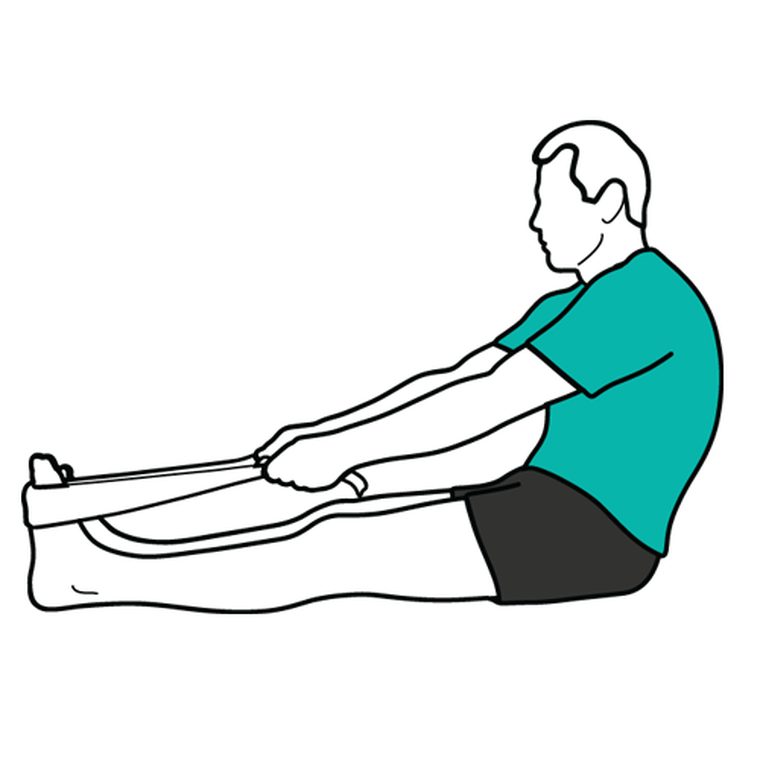
Calf loading is where the reviewers suggested starting — not because it beat the alternatives, but because it is easy to prescribe, low cost and carries few harms. [1] The dose is what has to be matched to your tendon.
What a course of treatment looks like
Assessment first, including where exactly the tendon is tender — because midportion and insertional problems are loaded differently and the insertional form has almost no trial evidence behind it. [1] Then a loading programme set at a level your tendon tolerates, and a review of the training or activity history that produced the overload.
Progress is measured by what the tendon tolerates rather than by how it feels on any single day: heel raises, then single-leg work, then spring-loaded activities such as hopping and running, added back in stages. Expect this to run over months, and expect some day-to-day variability throughout.
What the evidence supports — and what it does not
Supported
- Doing something active rather than waiting — every treatment class appeared superior to wait-and-see at three months. [1]
- Starting with calf-muscle exercise — the reviewers' own recommendation, on the grounds that it is easy to prescribe, can be low cost and has few harms. [1]
- Combining exercise with other treatments where needed — exercise, exercise plus injection and exercise plus night splint were all comparable at twelve months. [1]
Not supported
- Any claim that one treatment is best — there was no clinically relevant difference in effectiveness between active treatments at three or twelve months. [1]
- Confident recommendations for insertional tendinopathy — no network meta-analysis could be performed for it. Evidence about midportion problems should not be transferred to it uncritically. [1]
- Treating the comparative estimates as precise — no trial was at low risk of bias and the uncertainty was large. [1]
How certain is this?
Evidence grade: Low. This is the weakest evidence base of any guide on this site so far, and the reviewers say so themselves.
Of 29 included trials, none was at low risk of bias: 22 (76%) were at high risk and the remaining 7 had some concerns. The certainty of evidence for the comparisons was very low to low, and the reviewers describe large uncertainty in the comparative estimates. [1] A network meta-analysis of 42 treatments across 29 small trials is asking a great deal of the data.
What survives that uncertainty is the shape of the finding rather than any individual number: active treatment beats waiting, and nothing has been shown to beat anything else. That is enough to justify starting with the safest, cheapest option, and not enough to justify paying for anything on the promise that it works better.
What to expect
Months. Tendon problems are slow, and the review's follow-up points were three and twelve months for good reason. Expect the morning stiffness to be an early indicator of how things are going, and expect setbacks after unaccustomed activity.
The practical marker of progress is capacity rather than comfort: being able to do more heel raises, then single-leg raises, then return to hopping and running, with symptoms settling within a day afterwards.
Suspected Achilles rupture — seek same-day assessment
Seek urgent medical attention if you have:
- A sudden sharp pain in the back of the calf or heel, often described as being kicked or struck — sometimes with an audible snap.
- Inability to push off, to rise onto tiptoe on that leg, or a sense that the ankle has no power.
- A palpable gap in the tendon, or marked bruising and swelling after a sudden onset.
- Achilles pain that began soon after starting a fluoroquinolone antibiotic — this class is associated with tendon problems and needs medical review.
- A hot, red, swollen calf, or calf pain with breathlessness — a clot needs excluding.
- Fever, feeling unwell, or pain in multiple tendons and joints.
A rupture is treated differently and the timing matters. This list is not exhaustive; if you are worried about a symptom, seek professional advice.
Common questions
Should I rest it completely?
The evidence points the other way. Every class of active treatment appeared superior to wait-and-see at three months. [1] What usually helps is adjusting the provoking load — hills, speed, distance — while loading the tendon deliberately, rather than stopping altogether and then returning to the same volume.
Which treatment is best?
Nobody knows, and that is the honest answer. Across 29 trials of 42 treatments there was no clinically relevant difference between active treatments at three or twelve months. [1] The reviewers suggest starting with calf-muscle exercise because it is easy, cheap and low-risk — not because it was proven superior.
My pain is right at the back of the heel bone, not up the tendon.
That is insertional tendinopathy, and it is important that you know the evidence here does not cover it: no network meta-analysis could be performed for insertional cases at all. [1] It also tends to behave differently — positions that compress the tendon against the heel, including some calf stretches, can aggravate it. Worth an individual assessment rather than a generic programme.
Is it normal for it to hurt during exercise?
Some discomfort that settles within about a day is generally accepted in tendon rehabilitation. Pain that escalates during the session, or that is markedly worse the next morning and stays worse, suggests the load was too high. The specific limits should be set with your clinician.
Would an injection speed things up?
The review found injection therapy comparable to exercise at both three and twelve months, not better. [1] Given that, and given that injections cost more and carry more risk than a calf-raise programme, exercise is the reasonable starting point.
What the most recent evidence adds
The network meta-analysis this page is built on was published in 2021. Four things published since change what can be said, and one of them cuts against the summary above.
There is now a current guideline. The Academy of Orthopaedic Physical Therapy revised its clinical practice guideline for midportion Achilles tendinopathy in December 2024 — the third edition on this topic, replacing the 2018 version. It covers diagnosis, examination, imaging and physiotherapy interventions, and is the reference standard a physiotherapist should be working from. [2]
The injection question now has a better answer than this page gave. A participant-, physician- and assessor-blinded randomised trial of 100 patients compared ultrasound-guided corticosteroid injection against placebo injection, both added to the same exercise programme. At six months the corticosteroid group had a 17.7-point larger improvement in VISA-A score (95% CI 8.4 to 27.0, p<0.001). No severe adverse events occurred in either group, and there was no deterioration at two-year follow-up. [3] That is a stronger design than the pooled indirect comparisons above, and it points the other way: adding a corticosteroid injection to exercise did better than exercise alone over six months. It does not make injection a first move, and it is one trial — but it is worth knowing before anyone tells you injections have been shown not to work.
Insertional tendinopathy is no longer a complete blank. The 2021 review could not analyse it at all. A 2023 network meta-analysis of nine trials and 464 participants has since ranked eccentric exercise plus soft-tissue therapy as the most effective combination for short-term pain. The authors are careful about it: overall confidence in the included trials was very low, and they state that no recommendation of a best treatment option can be made from their review. [4] The direction is now sketched in; the confidence is not.
Shockwave looks different here than it does next door. A 2023 meta-analysis assessed shockwave across three conditions and found only a small, inconclusive short-term effect on pain and function for Achilles tendinopathy compared with eccentric exercise — while the same treatment significantly affected both short- and long-term pain and function in plantar fasciitis. [5] Neighbouring tissues do not necessarily respond alike, which is reason for scepticism when a clinic offers one machine as the answer to every heel and tendon problem.
References
- van der Vlist AC, Winters M, Weir A, et al. Which treatment is most effective for patients with Achilles tendinopathy? A living systematic review with network meta-analysis of 29 randomised controlled trials. British Journal of Sports Medicine. 2021 Mar;55(5):249–256. doi:10.1136/bjsports-2019-101872 PMID 32522732 Systematic review and network meta-analysis
- Chimenti RL, Neville C, Houck J, et al. Achilles Pain, Stiffness, and Muscle Power Deficits: Midportion Achilles Tendinopathy Revision - 2024. Journal of Orthopaedic & Sports Physical Therapy. 2024 Dec;54(12):CPG1–CPG32. doi:10.2519/jospt.2024.0302 PMID 39611662 Clinical practice guideline
- Johannsen F, Olesen JL, Øhlenschläger TF, et al. Effect of Ultrasonography-Guided Corticosteroid Injection vs Placebo Added to Exercise Therapy for Achilles Tendinopathy: A Randomized Clinical Trial. JAMA Network Open. 2022 Jul 1;5(7):e2219661. doi:10.1001/jamanetworkopen.2022.19661 PMID 35816306 Randomised controlled trial
- Ko VM, Cao M, Qiu J, et al. Comparative short-term effectiveness of non-surgical treatments for insertional Achilles tendinopathy: a systematic review and network meta-analysis. BMC Musculoskeletal Disorders. 2023 Feb 7;24(1):102. doi:10.1186/s12891-023-06170-x PMID 36750789 Systematic review and network meta-analysis
- Charles R, Fang L, Zhu R, et al. The effectiveness of shockwave therapy on patellar tendinopathy, Achilles tendinopathy, and plantar fasciitis: a systematic review and meta-analysis. Frontiers in Immunology. 2023;14:1193835. doi:10.3389/fimmu.2023.1193835 PMID 37662911 Systematic review and meta-analysis
About this guide
If you need assessment
This page explains. It does not diagnose.
Where the tendon is tender changes the plan, a rupture has to be excluded, and the starting load for a programme has to match what your tendon currently tolerates. Physiotherapist India publishes information and takes no bookings. Ask a qualified physiotherapist to examine your own case before acting on anything written here.