
Condition guide · Foot and ankle
Plantar Fasciitis
Heel pain that is worst on the first steps of the morning. What loading the tissue does that stretching it does not — and why the difference matters less by twelve months than you would expect.
In plain words. A thick band of tissue — the plantar fascia — runs along the sole of your foot from the heel bone to the base of the toes. It works like a bowstring, holding up the arch and storing energy each time you push off. Where it attaches to the heel, that load is concentrated into a small area.
When that attachment is loaded beyond what it currently tolerates, it becomes painful — classically for the first few steps out of bed, easing as you move, then returning after you have been on your feet all day. Despite the name, it is not primarily an inflammatory condition, which is part of why anti-inflammatory approaches often disappoint.
Key points
- First-step pain in the morning is the signature. Pain that eases with walking then worsens with prolonged standing is the classic pattern.
- High-load strength training beat stretching at three months — by 29 points on the Foot Function Index (95% CI 6 to 52, P=0.016). [1]
- By twelve months there was no difference between the two groups. The strength programme got people there faster; it did not take them further. [1]
- The strengthening protocol was strikingly simple: heel raises with a towel under the toes, every second day. [1]
- Both groups also used shoe inserts. That was the shared baseline in the trial, not an optional extra. [1]
- Most people improve substantially. At twelve months, Foot Function Index scores were low in both groups. [1]
What is actually happening
Every step loads the plantar fascia. As you push off, the toes extend, the fascia is pulled taut around the ball of the foot and the arch is drawn up — a mechanism that makes the foot a rigid lever at exactly the moment it needs to be one. All of that tension converges on the attachment at the heel.
The plantar fascia as a bowstring, and where the load concentrates
Because the problem is one of load tolerance rather than inflammation, the logic of treatment is the same as for tendon problems elsewhere: reduce what provokes it for a while, then progressively rebuild what the tissue can take. That reasoning is what the trial below tested directly.
What it feels like
- Sharp pain under the heel on the first few steps in the morning, or after sitting for a while.
- Easing after a few minutes of walking, then returning as a dull ache after prolonged standing or a long day.
- Tender to press on a specific spot at the inside of the heel.
- Worse barefoot on hard floors, better in supportive shoes.
- Often begins after a change — new shoes, more walking, a new job on your feet, a return to running, or weight gain.
How it is diagnosed
Clinically. The morning pattern plus tenderness at the medial heel is usually enough. Imaging is not needed to make the diagnosis; heel spurs seen on X-ray are common in people without heel pain and are not the cause of the symptom.
The distinctions worth making are a stress fracture of the heel bone, nerve entrapment, and referred pain from the low back — each of which has a different pattern and is separated by examination.
How physiotherapy and rehabilitation help
The aim is to restore the tissue's tolerance to load while reducing the peak stress on it in the short term. In practice that means two things at once: a progressive strengthening programme for the foot and calf, and support under the arch so that each step asks less of the painful attachment.
The trial that tested this randomised 48 people with ultrasound-verified plantar fasciitis. Everyone received shoe inserts. One group added daily plantar-specific stretching; the other added high-load progressive strength training — heel raises with a towel under the toes, every second day. At three months, the strength group was 29 Foot Function Index points better. [1]
What a programme involves
| Component | What it is for | Evidence |
|---|---|---|
| High-load progressive strength training heel raises with a towel under the toes, every second day |
Rebuilding the tolerance of the fascia and calf to the load of walking and push-off. | Supported 29 FFI points better than stretching at 3 months (95% CI 6 to 52) [1] |
| Shoe inserts | Reducing the peak stress at the heel attachment with every step. | Part of the tested care Both groups in the trial received them; not tested alone [1] |
| Plantar fascia-specific stretching | Reducing tension and morning stiffness. | Supported, slower Equal to strength training by 12 months, behind it at 3 [1] |
| Calf flexibility work | A tight calf increases the demand on the fascia at push-off. | Not separately tested Standard practice; not isolated in this trial |
| Load management and footwear advice | Temporarily reducing standing time, barefoot walking on hard floors, and sudden increases in walking or running. | Not separately tested Standard practice |
| Corticosteroid injection | Short-term pain relief in stubborn cases. | Not tested here Not evaluated in the cited trial; see the guideline [2] |
| Shockwave, ultrasound, laser, dry needling | Commonly offered for heel pain. | Not tested here Not evaluated in the cited trial, so this page makes no claim |
The clinical practice guideline for heel pain published by the Orthopaedic Section of the American Physical Therapy Association covers a wider range of interventions than the single trial above, and is the appropriate reference for a clinician choosing between them. [2]
What a course of treatment looks like
Assessment first, to confirm the diagnosis and to work out what changed — because plantar heel pain usually follows a change in load. Then inserts fitted, a strengthening programme started at a level the heel accepts, and a plan for the activities that provoke it.
The programme in the trial was performed every second day, which is worth noting: this is not a daily grind, and the loading needs recovery time between sessions. Reviews are for progressing the load rather than for passive treatment. Expect months.
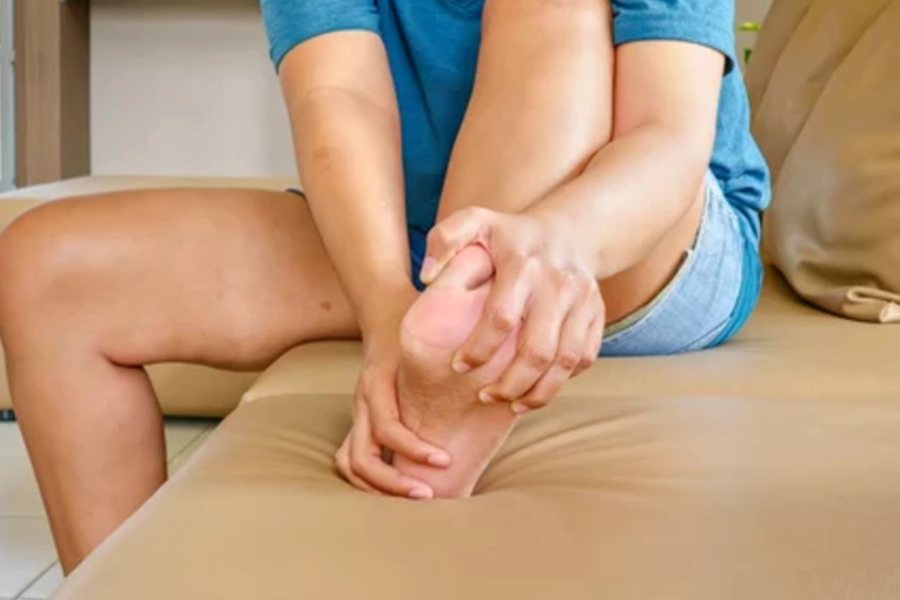
Plantar fascia stretching had the largest effect on first-step pain in the short term of any single measure in the best practice review (SMD 1.21, 95% CI 0.78 to 1.63). [3] It is also free, which is part of why it is the place to start.
What the evidence supports — and what it does not
Strength training versus stretching: an advantage that closes
Supported
- High-load strength training for faster improvement — 29 Foot Function Index points better than stretching at three months (95% CI 6 to 52, P=0.016). [1]
- Progressive loading as the principle — a simple protocol performed every second day was enough to produce that difference. [1]
- Stretching, given time — the stretch group caught up, reaching an equivalent Foot Function Index by twelve months. [1]
- Expecting substantial recovery — both groups had low Foot Function Index scores at twelve months. [1]
Not supported
- Claiming strength training produces a better final outcome — there was no difference at 1, 6 or 12 months (all P>0.34). Its advantage is speed. [1]
- Treating heel spurs as the cause — the diagnosis is clinical, and imaging findings do not drive treatment.
- Reading "fasciitis" as inflammation to be suppressed — the intervention that worked fastest was loading the tissue, not calming it.
What the most recent evidence adds
There is a best practice guide, and it is unusually practical. A 2021 guide combined a systematic review of 51 trials and 4351 participants with interviews of 14 international experts and a patient survey. Two self-management measures had good agreement between the trial evidence and the experts for first-step pain in the short term: taping (SMD 0.47, 95% CI 0.05 to 0.88) and plantar fascia stretching (SMD 1.21, 95% CI 0.78 to 1.63). The recommended core approach is to combine those with education and footwear advice, then escalate only if needed. [3] Note the ordering — the cheap measures are not a holding pattern before the real treatment; they are the first step of the recommended pathway.
Shockwave has a genuine place here, and it is worth being precise about why. The same guide supports stepped-care management with focused shockwave for first-step pain in the short term (OR 1.89, 95% CI 1.18 to 3.04), medium term (SMD 1.31, 95% CI 0.61 to 2.01) and long term (SMD 1.67, 95% CI 0.88 to 2.45). [3] A 2023 meta-analysis agrees, finding that shockwave significantly affects both short- and long-term pain and function in plantar fasciitis. [4] That same analysis found only a small, inconclusive effect for Achilles tendinopathy — so a clinic offering one shockwave machine for every foot and heel complaint is going beyond what the evidence supports for the other conditions, even though it is on reasonable ground for this one.
Scanning rarely changes what happens next. A systematic review and meta-analysis of 42 imaging studies and 2928 participants found people with plantar heel pain are more likely to have a thickened plantar fascia, abnormal fascia tissue, a thicker loaded heel fat pad and a calcaneal spur. [5] Only 21% of the included studies were rated good quality. Those findings confirm the diagnosis rather than alter the treatment — which is the practical reason imaging is not routine, and why a heel spur seen on x-ray is not the thing that needs treating.
How certain is this?
Evidence grade: Low to moderate. The central comparison rests on a single randomised trial of 48 people. That is small. The confidence interval around the headline result runs from 6 to 52 points, which is compatible with a modest advantage or a very large one. [1]
Its strengths are real: participants had ultrasound-verified plantar fasciitis rather than a loose clinical label, follow-up ran to twelve months, and the convergence at later time points was consistent across outcomes. But a 48-person trial should not be read as settling the question of how best to treat plantar heel pain, and the guideline cited alongside it exists precisely because the wider evidence base is broader than one study. [2]
Note also that both groups received shoe inserts, so this trial cannot tell you what strength training alone would achieve.
What to expect
Improvement over months rather than weeks, and a good outcome for most people. In the trial, both groups had low Foot Function Index scores at twelve months regardless of which programme they had followed. [1]
Morning pain is usually the last symptom to go. It is common for the heel to remain sensitive to a sudden increase in walking, or to a day spent barefoot on hard floors, well after everyday pain has settled.
When heel pain is not plantar fasciitis
Seek assessment promptly if you have:
- Heel pain that came on suddenly during activity with a snap or pop, or inability to push off or rise onto tiptoe.
- Pain that is constant and present at rest and at night, rather than load-related.
- A hot, red, swollen heel, or fever and feeling unwell.
- Numbness, pins and needles or burning spreading into the sole or toes.
- Heel pain after a fall from height or a direct impact — a stress or traumatic fracture needs excluding.
- Heel pain with pain in several other joints, morning stiffness lasting over an hour, or a rash — inflammatory arthritis can present this way.
This list is not exhaustive. If you are worried about a symptom, seek professional advice.
Common questions
Should I stretch it or strengthen it?
Both work; strengthening worked faster. At three months the high-load strength group was 29 Foot Function Index points better than the stretching group, and by twelve months the two were equivalent. [1] If you want to be more comfortable sooner, the strength programme has the better evidence. If stretching is what you will actually keep doing, it still gets you there.
What exactly was the exercise?
Unilateral heel raises with a towel rolled under the toes, performed every second day, with the load progressed over time. [1] The towel keeps the toes extended so the fascia is under tension while the calf works. Your starting load and progression should be set for you individually.
Do I need special insoles?
Everyone in this trial received shoe inserts, in both groups, so the results describe exercise added to inserts rather than exercise instead of them. [1] That is a reason to take the footwear side seriously, but it does not establish that expensive custom orthotics beat simpler ones.
My X-ray shows a heel spur. Is that the problem?
Almost certainly not on its own. Heel spurs are common in people with no heel pain, the diagnosis here is made clinically, and the treatments with evidence behind them do nothing to the spur.
How long will it take?
Months. Both groups in the trial were still being followed at twelve months, and both had improved substantially by then. [1] Early progress is encouraging but this is not a condition that resolves in a fortnight.
References
- Rathleff MS, Mølgaard CM, Fredberg U, et al. High-load strength training improves outcome in patients with plantar fasciitis: a randomized controlled trial with 12-month follow-up. Scandinavian Journal of Medicine & Science in Sports. 2015 Jun;25(3):e292–e300. doi:10.1111/sms.12313 PMID 25145882 Randomised controlled trial
- Martin RL, Davenport TE, Reischl SF, et al. Heel pain — plantar fasciitis: revision 2014. Journal of Orthopaedic & Sports Physical Therapy. 2014 Nov;44(11):A1–A33. doi:10.2519/jospt.2014.0303 PMID 25361863 Clinical practice guideline
- Morrissey D, Cotchett M, Said J'Bari A, et al. Management of plantar heel pain: a best practice guide informed by a systematic review, expert clinical reasoning and patient values. British Journal of Sports Medicine. 2021 Oct;55(19):1106–1118. doi:10.1136/bjsports-2019-101970 PMID 33785535 Best practice guide and systematic review
- Drake C, Whittaker GA, Kaminski MR, et al. Medical imaging for plantar heel pain: a systematic review and meta-analysis. Journal of Foot and Ankle Research. 2022 Jan 22;15(1):4. doi:10.1186/s13047-021-00507-2 PMID 35065676 Systematic review and meta-analysis
- Charles R, Fang L, Zhu R, et al. The effectiveness of shockwave therapy on patellar tendinopathy, Achilles tendinopathy, and plantar fasciitis: a systematic review and meta-analysis. Frontiers in Immunology. 2023;14:1193835. doi:10.3389/fimmu.2023.1193835 PMID 37662911 Systematic review and meta-analysis
About this guide
If you need assessment
This page explains. It does not diagnose.
Heel pain can come from the fascia, from the heel bone, from a nerve, or from the back, and the starting load for a strengthening programme has to be set for your foot rather than from a page. Physiotherapist India publishes information and takes no bookings. Ask a qualified physiotherapist to examine your own case before acting on anything written here.